
Deep Dive
The Chronic
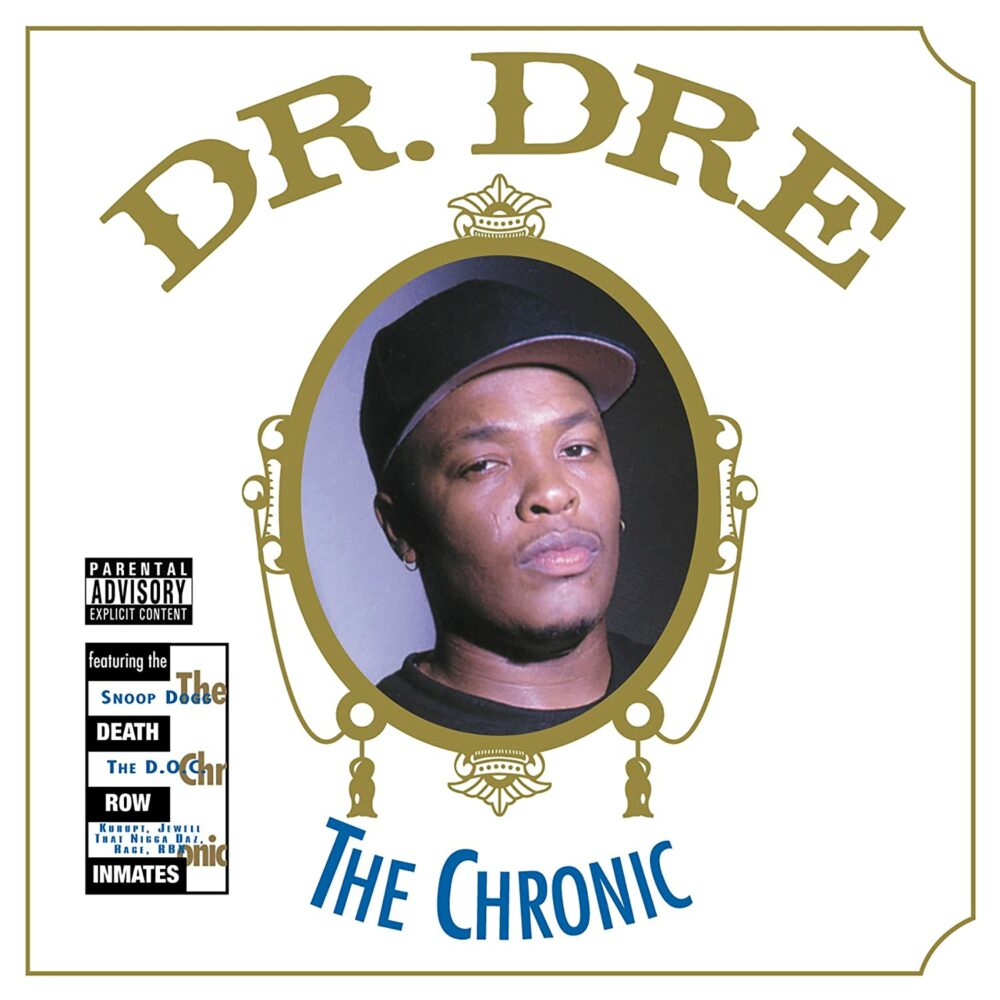
The Chronic by Dr. Dre (1992) — what a copy is worth and which pressing to own, in a full Lead-In dossier: Dr. Dre's first solo album, made with a band replaying old funk in Solar Records' Hollywood building.
The Chronic by Dr. Dre (1992) — what a copy is worth and which pressing to own, in a full Lead-In dossier: Dr. Dre's first solo album, made with a band replaying old funk in Solar Records' Hollywood building.
Dr. Dre's first solo album and Death Row's first, made with musicians replaying old funk on the third floor of Solar Records' Hollywood building. Its production changed rap; its rapping trails behind.
In December 1992 the Los Angeles Times called the rap flat and the beat unbeatable. Both halves still stand. The Chronic's band-played funk set the sound of mainstream rap for years, while its verses, skits and filler keep it just short of perfect.
On 27 December 1992, 12 days after The Chronic came out, the Los Angeles Times ran Jonathan Gold's review under the headline 'The Rap's Flat, But Ya Can't Beat the Beat'. He gave it 3 stars out of 4. He put Dr. Dre's production in the company of Phil Spector and Brian Wilson. He also found the rappers short of the wit of Ice Cube and MC Ren, and thought Dre sounded forced. More than 30 years later, nobody has written a fairer one-line review. Most of what's been said since is an argument about which half of that headline matters more.
The beat matters more, by a distance, and that's both the case for the record and the case against it. The Chronic is a producer's album in the fullest sense. Dre took the kind of funk that rap had been sampling and had a band play it again. The result sounded cleaner than the East Coast records Gold set it against, and it pulled mainstream rap towards Los Angeles for years. But a producer's album depends on what's said over it, and here that's uneven. Snoop Doggy Dogg is a revelation. Dre, whose name is on the cover, is one of its weaker rappers. Add the skits and a couple of filler tracks, and you have a great album with a soft middle.
It was made to get Dre out of a contract and back into money. He wanted out of Ruthless Records over royalties. On 23 April 1991, at Solar Records, Suge Knight got Eazy-E to sign contract releases. Knight had been the D.O.C.'s bodyguard. Pitchfork says the signatures came under threat, and that the releases weren't deemed legally binding anyway. Dre told Rolling Stone in 1993 that he'd been broke and had earned nothing in 1992. He needed a record out, and a company willing to release it.
Sony wouldn't take it. People interviewed for LA Weekly's 2012 oral history say the company was wary of Death Row and of Dre's contract status. Dick Griffey and Virgil Roberts played the album to Jimmy Iovine and David Cohen at Interscope. Iovine took it on, but he had to pay off Ruthless and distribute through Priority. Ruthless kept a royalty on Dre's Death Row records, The Chronic included. Doug Young put Eazy-E's cut at 25 to 50 cents a copy. That sits oddly beside the music. The intro taunts Ruthless and Eazy-E, and 'Dre Day' is a diss record aimed partly at Eazy. Every copy that mocked him paid him.
The sessions moved between Dre's house in Calabasas and Griffey's Solar building in Hollywood. Death Row had the third floor of Griffey's six-storey building. Being housed there, he said, meant they 'didn't have a lot of expenses'. Even so, nobody had any money. What they had was a method. Pitchfork describes the order Colin Wolfe built tracks in: drums, then bass, then keys, then guitar. Rather than lift old funk records, Dre had musicians replay the parts. Gold heard what that did in 1992. With the guitar and bass recreated, the sound wasn't dragged down by worn records. Wolfe later said the aim was 'a real Parliament-Funkadelic album'.
Even the record's harshest critic gave it that. Robert Christgau made it his Dud of the Month in the Village Voice in March 1994, with a C+. He still called the move away from sampling the real innovation. What he disliked was the result: bad pop on blaxploitation-soundtrack keyboards, or in his words 'sociopathic easy-listening'. It's an unfair verdict that notices something true. The record does sound easy, and that ease was worked for. Snoop told LA Weekly he did one song 15 times before he got it right. He had a toothache, and one of Dre's notes was that he'd had too much energy. Snoop's word for Dre was 'a precisionist'. Even the high Moog lead has a pedigree: The Ringer hears it as a descendant of the Ohio Players' 'Funky Worm'.
'Nuthin' but a "G" Thang' shows the method at its best. It's built on Leon Haywood's 'I Wanna Do Something Freaky to You', credited on the sleeve. The beat runs for 9 seconds before the first voice. Billboard's 2012 retrospective says Snoop wrote the whole song, and the US LP credits him as its only writer. So the album's biggest hit is a Dre beat carrying Snoop's words. 'Let Me Ride' works the same trick on Parliament's 'Mothership Connection'. It won Dre the Grammy for Best Rap Solo Performance in March 1994. It's also the single that charted lowest, at #34.
Past the singles, the best detail sits in the deep cuts. 'The Day the Niggaz Took Over' carries live audio from the 1992 riots, credited to Matthew McDaniels. Pitchfork says the song began life as 'Mr. Officer'. 'Lil' Ghetto Boy' also opens on riot audio before it turns to Donny Hathaway's 'Little Ghetto Boy'. Not everything was replayed. 'Lyrical Gangbang' puts the Lady of Rage, Kurupt and RBX over a sample of John Bonham's drums from 'When the Levee Breaks'. Snoop told LA Weekly that Dre cut the reels and spliced the album together by hand, so that every song ran into the next. It lets the news into a record that mostly keeps it outside, and it does so in passing rather than as a speech.
The voice that carries the record is Snoop's. Warren G, Dre's stepbrother, passed Dre a tape of him, and Dre phoned to ask him to the studio. Their first record together was the title song of the film Deep Cover, on its soundtrack in spring 1992. On The Chronic he's on most of the tracks; he later put it as 'damn near every song'. Havelock Nelson gave the album 4 stars out of 5 in Rolling Stone in March 1993, and treated Snoop as its star. Billboard ranks his closing verse on 'Stranded on Death Row' among his best. He's the reason the album sounds like a crew record, and a large part of why it has lasted.
The trouble is the name on the cover. Dre is a lesser rapper than he is a producer. Gold said so in 1992, and Pitchfork agreed in 2019, in a review that still gave the album 10 out of 10. The Ringer goes further. It finds him short of charisma as a lead, and says the D.O.C. wrote some of his lines. 'A Nigga Witta Gun' is, by The Ringer's count, his only true solo song on the album. Its best moments belong to a bassline, which Billboard traces to Johnny Hammond Smith's 'Big Sur Suite', and a drum break from Whodini's 'Friends'. 'Rat-Tat-Tat-Tat' follows with another gun song. Billboard called it the nearest thing to filler, and the running order doesn't help. Its hook comes round 11 times in under 4 minutes.
The skits are the other drag. 'The $20 Sack Pyramid' is a parody of the game show Pyramid, with the D.O.C. as a contestant, and it lasts nearly 3 minutes. 'The Doctor's Office' lasts about a minute. Billboard called it 'bad, really, really bad' and blamed it for a habit of sex skits that ran through '90s rap. 'High Powered' should have stopped after Dre's intro, the same review argued, and it found RBX's verse flat. None of this is fatal. But for all the care Dre took over the joins, the album plays better as a set of songs than as a sequence. That's why it scores lower for cohesion than for anything else.
The content has aged worse than the running order. Havelock Nelson flagged the misogyny and the revenge fantasies in 1993. The Ringer notes homophobic insults on 'Dre Day'. The hidden 16th track, 'Bitches Ain't Shit', isn't listed on the US sleeve and is missing from European editions. And Dre's assault on Dee Barnes in 1991 now frames how the album is heard. He pleaded no contest in August 1991, and her civil suit was settled. In 2015 he apologised publicly. A listener can admire the production and still hear what it was built to carry. Both are on the record.
What it changed is easy to document. It entered the Billboard 200 at #27 on 2 January 1993, nowhere near the top. It took 6 weeks to reach #3, and The Bodyguard sat at #1 for the first 4 of its 6 weeks there. It went 3× Platinum on 3 November 1993 and spent 97 weeks on the chart. Doggystyle, produced by Dre and fronted by Snoop, came out that November and went to #1. Warren G's Regulate... G Funk Era followed in 1994. Even Eazy-E's reply record took up the sound, The Ringer notes. Pitchfork traces a line from here to Kendrick Lamar, The Game, YG and Nipsey Hussle. Kanye West has said he used to spend all his time trying to get his beats mixed as well as Dre's. In March 2020 the Library of Congress added it to the National Recording Registry.
So which half of Gold's headline wins? The beat, still. Put on 'Nuthin' but a "G" Thang' or 'Let Me Ride' and the production sounds like a choice rather than a period piece. Take out the skits, and what's left is a near-flawless sound with a few flat verses on top. That gap keeps it just short of the very top. Dre built a superb stage and handed most of it to other people, which was the right call. The Chronic is a great album, essential for what it did and for how it sounds. As a rap album it's a notch lower, and you can hear the difference in most of Dre's own verses.
The original to own is the 1992 US LP, P1 57128 on Death Row / Interscope, made and distributed by Priority and pressed by Rainbo. It's a single LP. The runouts read 'S-27216 P1 57128-A' and 'P1 57128-B X S-27217'. The catch is that the c.1996 repress, P1 50611, has the same runout matrix and was also pressed by Rainbo. The catalogue number on the labels and jacket separates them, and so does the barcode: 0 4992-57128-1 0 on the original, 0 4992-50611-1 6 on the repress. The hidden 16th track is on the record but not listed on the cover or labels.
© The Lead-In · an independent, reader-supported music publication.