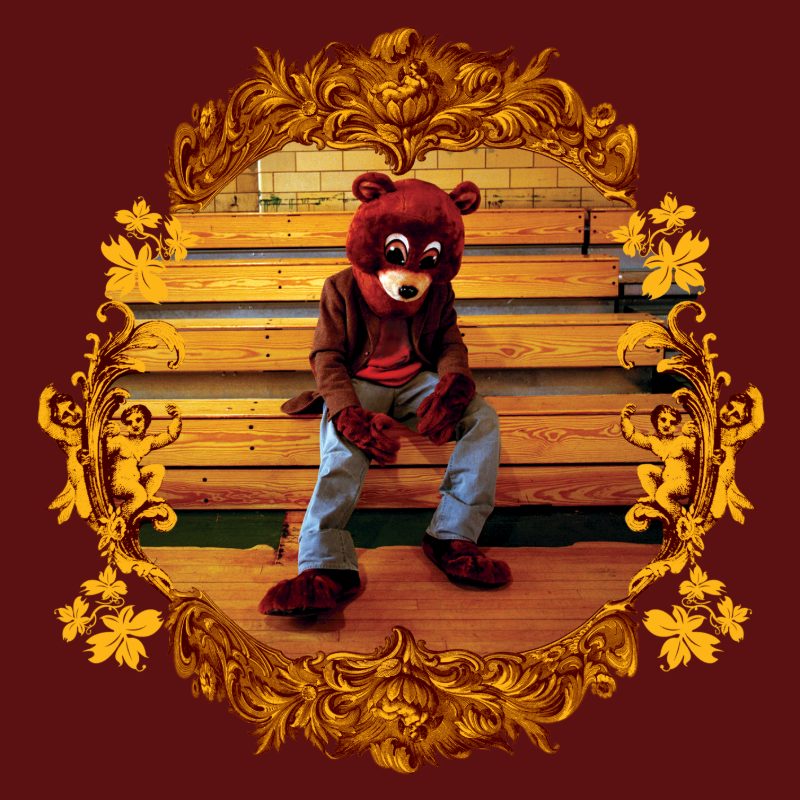
Kanye West's 2004 debut, a producer's argument that he could rap too. The beats and the guests win it for him, and 76 minutes of running order nearly lose it.
- Released
- 10 February 2004 (US)
- Label
- Roc-A-Fella Records, marketed by Island Def Jam (US LP B0002030-01, US CD B0002030-02)
- Producer(s)
- Kanye West, on every track; co-producers Brian 'All Day' Miller and Evidence; additional production by Porse
- Runtime
- 76:13 (21 tracks)
- Chart peak (US)
- #2 (Billboard 200), on debut, behind Norah Jones's Feels Like Home
- Chart peak (UK)
- #12 (Official Albums Chart), first reached on 3 July 2004
- Certifications
- RIAA 6× Platinum (17 July 2026); BPI 3× Platinum (22 April 2022)
- Awards & honours
- Grammy, Best Rap Album, and Best Rap Song for 'Jesus Walks' (2005); nominated for Album of the Year. #1 in the Village Voice Pazz & Jop poll for 2004. #74 on Rolling Stone's 500 Greatest Albums (2020)
West spent years being told to stick to beats, and his debut proves the doubters half right. He's a likeable, limited rapper and a superb producer and host. The record's real flaw is its editing.
In June 2003, eight months before his debut came out, Kanye West told MTV News something few new rappers say out loud. He'd kept his best beats for himself, he said, because he didn't think he was the best rapper. He placed himself between two worlds: Jay-Z's on one side and Talib Kweli's on the other. That's the plan for The College Dropout, set out by the man who made it. It's a producer's case that he could rap. The case is won, but mostly by the producer.
The record holds up because of how it's built and who West invited onto it. The beats are warm, the guests are well chosen, and the best songs still sound like no one else's. West the rapper is likeable and limited, and the album runs longer than its ideas. At 76:13 it's a great record carrying more than 9 minutes it doesn't need. Its reputation rests on the songs, and that's fair. It forgives the editing, and that isn't.
He had good reason to hedge. Gee Roberson, who signed him as a producer in 1998, says people called to ask why West wouldn't just stick to beats. His partner Kyambo 'Hip Hop' Joshua called the eventual Roc-A-Fella artist deal "more like a default". John Legend thought the label mainly wanted to keep a key producer in-house. Damon Dash's account, in Complex's oral history of the album, is blunter still. He says Jay-Z didn't want the album released, and that he and Kareem 'Biggs' Burke outvoted him. Dash also says West's fear made him fearless. That fearlessness is all over the record.
Then, on 23 October 2002, West got his story. MTV News reported that day that he'd crashed his rented car in Los Angeles at about 3 a.m., just after a late studio session. The police report was said to have him asleep at the wheel; West later said another driver cut him off. His jaw was broken in three places. By his own account, the hospital wired it wrongly and had to break it again. Plain Pat, his A&R, says the little Lexus was all they could get him, because West "wasn't popping" yet. Roberson says West told him from the hospital bed that the crash would make him. He left hospital 2 weeks after he was admitted and went straight into the studio. There, jaw still wired, he recorded 'Through the Wire' for his Get Well Soon mixtape.
The title came out of the same winter. West named the album in a December 2002 interview with MTV. He explained it as a message about making your own decisions instead of following the script society hands you. He'd had a one-semester scholarship at the American Academy of Art, then a semester and a half at Chicago State, where his mother ran the English department. Robert Christgau gave the album an A and still saw the trick. He argued that West's case against education was as aimed at a market as other rappers' case for thug life. He's right, and it barely matters. The concept is a frame for the jokes, not an argument the songs make.
The sound is where the argument lies, and it's well documented. West sped old soul records up until they were rappable. He told Rolling Stone he'd taken Chaka Khan's 'Through the Fire' to 83 bpm, then fought to stop it sounding "chipmunky". He worked fast. GLC remembers a Louis Vuitton bag full of discs, and beats made in about 15 minutes. Kweli watched him build 'Get Em High' in about the same time. Nor were the records a connoisseur's hoard. Hip Hop says many came from a crate given to West by his girlfriend's father, and that West "wasn't a big old record collector like that". The sound came from speed and nerve, not from years of digging.
'Jesus Walks' is the best thing here, and the strangest to build. Rhymefest co-wrote it, and it rests on a sample of the ARC Choir's 'Walk With Me'. The chanted voices start in its very first second. Miri Ben-Ari says she recorded her violin without hearing the lyrics, aiming for something like a doomsday film score. John Legend says the flute-like sound is his own voice run through Auto-Tune. Those are odd choices for a song about faith, and they work. It won the Grammy for Best Rap Song, and it was #6 in the Village Voice critics' singles poll for 2004.
Some of the album's sampled sound wasn't sampled at all. 'All Falls Down' is built on Lauryn Hill's 'Mystery of Iniquity', from her live MTV Unplugged No. 2.0. Hill wouldn't clear her vocal, so Syleena Johnson, a Chicago singer, sang it again. That re-sung line opens the track, before West says a word. 'Never Let Me Down' rests on a Blackjack song, 'Maybe It's the Power of Love', recreated by Ken Lewis. The sample on 'Last Call' didn't clear either, and Evidence says musicians replayed it. In those three songs, the soul you hear is a copy, made to sound like the record West wanted. That's a strength. When a source fell through, West rebuilt the feeling rather than lose the song.
He's also a superb host. 'Slow Jamz' began as a beat for Consequence over Luther Vandross's 'A House Is Not a Home'. Twista came up with its roll-call of soul singers, and Jamie Foxx recorded his part at his own house. Released as Twista's single, it was #1 on the Hot 100 chart dated 21 February 2004. 'Spaceship' started as GLC's song. 'Two Words' puts Mos Def and Freeway beside the Boys Choir of Harlem. Consequence says they drove about 4 hours upstate to record the choir. Plain Pat says hip-hop was "way more segregated back then", and that putting Mos Def and Freeway on one beat bridged the underground and the mainstream. Bringing those camps together is the album's great achievement.
The record was finished by adding things, not cutting them. It was due out on 12 August 2003 and missed the date. After it leaked, GLC says, West answered with strings, choirs, new verses and harder drums. Monopoly says West paid for the orchestras out of his own pocket, and that the album was remixed two or three times. GLC says even the 'Last Call' beat had been offered to Jay-Z, Beanie Sigel and, he thinks, Memphis Bleek. Nobody wanted it, so West kept it for himself. A producer who saves everything makes a generous album. He doesn't always make a tight one.
The weakness is the other half of West's 2003 admission. Next to Jay-Z, Mos Def or Common, he's often the least interesting rapper on his own song. Christgau heard a limited voice and flow. Pitchfork's Rob Mitchum called the album "flawed, overlong, hypocritical, egotistical, and altogether terrific". Overlong is the charge that sticks. Five skits take up almost 4 minutes, from Deray Davis's 'Intro' to the 'Lil Jimmy Skit'. West told Rolling Stone that the skits were "a little harsh". Plain Pat says he fought their number, while West kept adding more during mastering. Two songs drag as well. Plain Pat hated 'The New Workout Plan', a 5:22 joke that runs out of ideas long before the end. Consequence says West himself was on the fence about 'Breathe In Breathe Out', though Roberson thought it should have been a single. Then 'Last Call' closes the album at 12:40, filled out, as Mitchum noted, by a spoken account of how West got signed. The story is funny, and true to him. It's also something you only need to hear once.
None of that held it back. It debuted at #2 in America with about 440,000 copies, behind Norah Jones's Feels Like Home. By late April it had sold over a million. It topped the Village Voice's Pazz & Jop critics' poll for 2004, ahead of Brian Wilson's SMiLE. In February 2005 it won the Grammy for Best Rap Album and lost Album of the Year. John Legend says he wouldn't have been signed without it. In 2014 Vibe named 10 albums it said the record shaped, from Lupe Fiasco's Food & Liquor to Chance the Rapper's Acid Rap. What they share, on our reading, isn't sped-up soul. It's a rapper allowed to doubt himself and joke about it on the same record.
Some of the listening has changed. Hearing it in 2026 means hearing it after its author's antisemitic statements from 2022 onward. The sportswear firm adidas ended its partnership with him that October. That changes how many people feel about pressing play, and it's a reasonable thing to weigh. It doesn't change what's on the record. This is a young man's album about ambition and being underestimated. In July 2026 the RIAA certified it 6× Platinum. Few of his later records are as easy to like.
So it's a great record with a real flaw, and the flaw is the editing. Take out the five skits and 'The New Workout Plan' and you lose more than 9 minutes, and little you'd miss. What's left, led by 'Jesus Walks', 'All Falls Down', 'Spaceship' and 'Through the Wire', stands with the best rap albums of its decade. West the producer and host wins the argument he set himself in 2003. West the rapper only survives it, and that was always the plan.
Pressing guide — the one to own
The original to own is the 2004 US 2×LP, Roc-A-Fella B0002030-01, with labels for Roc-A-Fella, Hustle. and Handprint. It has 15 tracks and a lyrics-and-credits insert. It was mastered by Eddy Schreyer at Oasis Mastering and pressed by United Record Pressing. Collectors list two runout families. One reads 'B0002030-01/006249817410-LP01-A' and so on, stamped MASTERDISK. The other reads 'B0002030-01 LP I A', with 'NiP63' on side C, and has 'Printed in the USA' on the back cover and insert. The catch: later US pressings reuse the catalogue number, and by the catalogue notes the 2022 repress looks the same from outside as the MASTERDISK original. The runouts settle it: later pressings carry 'RE' with a 'TML-M' stamp, or 'MASTERED BY CAPITOL'.