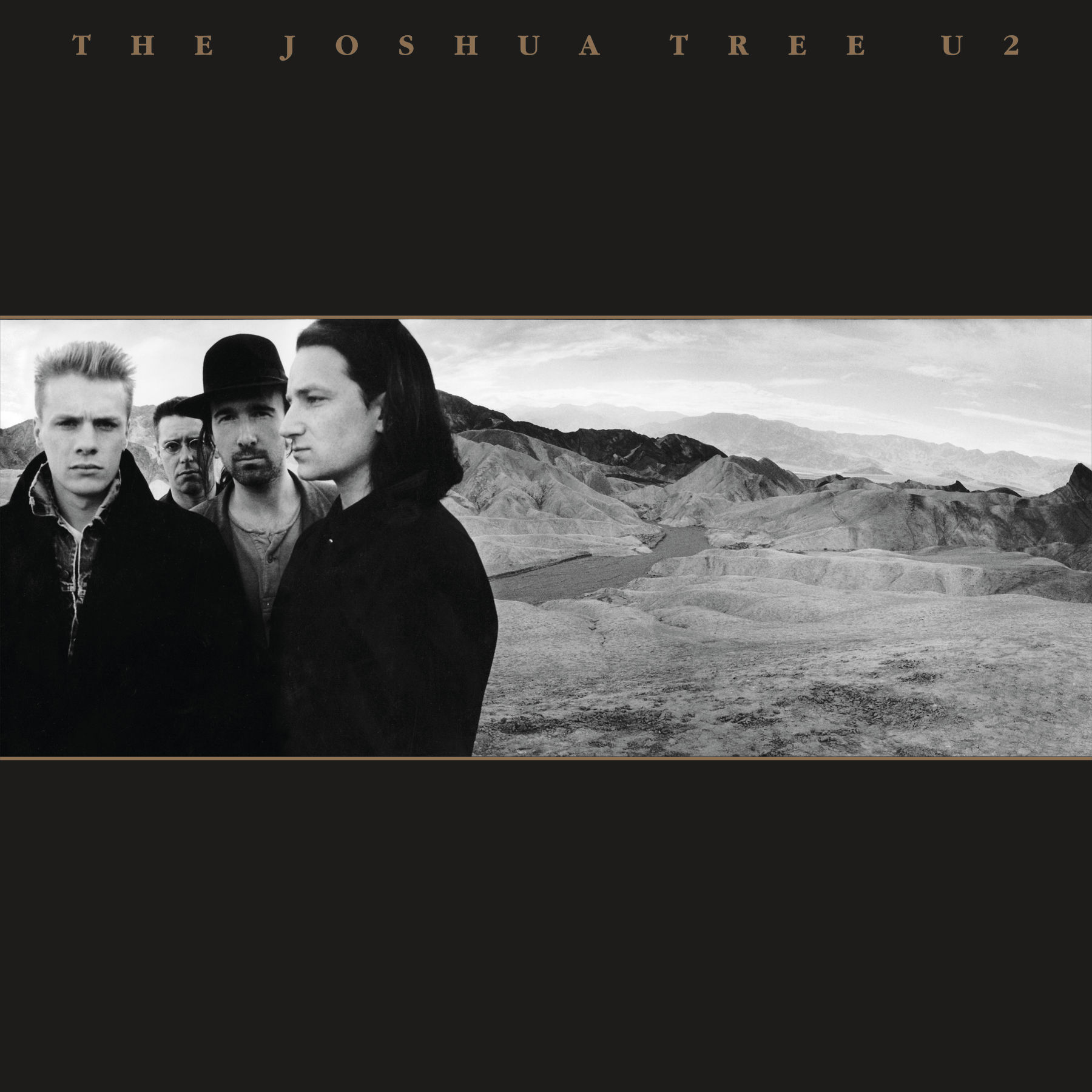
U2's fifth album, made in Dublin with Brian Eno and Daniel Lanois: 9 weeks at #1 in America, two US #1 singles, and a title tree missing from the front cover.
- Released
- 9 March 1987 (UK, US and Europe); 21 March 1987 (Japan)
- Label
- Island Records (distributed in the US by Atlantic)
- Producer(s)
- Daniel Lanois and Brian Eno
- Runtime
- 50:14 (11 tracks; 1987 European label timings, with 'In God's Country' corrected from the misprinted 3:57 to 2:57)
- Chart peak (US)
- #1 (Billboard 200), 9 weeks from the chart dated 25 April 1987
- Chart peak (UK)
- #1 (Official Albums Chart), 2 weeks from the chart dated 21 March 1987
- Certifications
- RIAA Diamond (11 September 1995); BPI 10× Platinum (2 June 2023)
- Awards & honours
- Grammys for Album of the Year and Best Rock Performance by a Duo or Group with Vocal (2 March 1988); National Recording Registry (2014)
The Joshua Tree arrived as U2's big statement about America, but it was made mostly in two Dublin houses. Its politics are its weakest moments. Its restraint, learned with Eno and Lanois, is why the best of it still sounds right.
There's no Joshua tree on the front of The Joshua Tree. Anton Corbijn's cover shows the four members of U2 at Zabriskie Point in Death Valley, in black and white, with bare hills behind them. The tree is inside the gatefold. Corbijn had wanted it the other way round. After the first day of a three-day shoot in December 1986, he suggested a Joshua tree for the front and the band for the back. Bono looked the tree up in the Bible overnight and proposed it as the title. The next day they found a lone one beside Route 190, near Darwin in California, and posed by it for about 20 minutes. So the record is named after the one thing its front cover leaves out.
That gap between the title and the contents runs through the whole album. It arrived as U2's big statement about America, and it's still remembered as one. Its working titles were The Two Americas and Desert Songs. But it was made mostly in two houses in County Dublin, and its best music has little to do with deserts or politics. What lasts is restraint: a loud, earnest band learning, with Brian Eno and Daniel Lanois, how much to leave out. Where the album reaches hardest for meaning, it's at its weakest. Where it holds back, it's as good as rock got in the 1980s.
U2 were already a big band in 1986. War had entered the British chart at #1 in 1983, and both War and The Unforgettable Fire had reached #12 in America. For The Unforgettable Fire they'd brought in Eno and Lanois rather than make a sequel to War. Robert Hilburn, reviewing the new record in the Los Angeles Times in March 1987, put the change simply. The last album had been mostly sketches, he wrote, and this one filled them in. The Edge told Hot Press that month that the band had chosen limits this time. They wanted songs that were less vague and impressionistic, and more focused and concise. That's a smaller ambition than reinvention, and here it was the right one.
The American subject was largely Bono's. In the same interview he agreed when asked if he was the band's American and the Edge its European. The Edge was less taken with the new direction at first, Bono said, and came round when he saw that the songs were good. The year kept feeding Bono's side. In June 1986 U2 played Amnesty International's Conspiracy of Hope, six benefit concerts across America. On 3 July Greg Carroll, a 26-year-old New Zealander who worked as Bono's assistant, was killed in Dublin. He was taking Bono's motorbike home in the rain when a car cut him off. 'One Tree Hill' was written for him. Bono also went to Nicaragua that year. Central America is the subject of 'Bullet the Blue Sky'.
The music, meanwhile, was being made at home. The sleeve credits one studio, Windmill Lane in Dublin, but much of the work happened elsewhere. By January 1986 the band had turned Danesmoate, a two-storey Georgian house in Rathfarnham, into a studio. The dining room became the control room. The drawing room, with its hardwood floor and double-height ceiling, became the live room, behind a glass screen. Adam Clayton, who later bought the house, said the album's big drum sound is the sound of that room. The rest came together at Melbeach, the Edge's newly bought house by the sea in Monkstown. Lanois reckoned the bulk of the record was done there, with Danesmoate supplying its backbone and much of the drums. Flood recorded the album, with Dave Meegan and Pat McCarthy engineering.
'Where the Streets Have No Name' shows what that patience cost. It opens on sustained synthesiser chords, and the band builds for nearly 2 minutes before Bono sings at 1:48. The Edge wrote the demo alone at Melbeach, on a four-track, in an empty room at the top of the house. His guitar part switched time signatures, and the rest of the band were less excited than he was. Lanois remembered walking them through the changes at a blackboard, like a science teacher. Eno said later that probably half the album's time went on that one song. At one point he planned to stage an accident and erase the tapes, so they'd have to start again. He never did. The long build is the song's whole case, and it earns its size slowly.
The next two songs, both American #1 singles, were built a different way. 'I Still Haven't Found What I'm Looking For' grew out of an early jam whose one saving grace, by Rolling Stone's account, was Mullen's drum part. Only Larry Mullen's drum part was kept, and new parts went on top of it. Lanois compared the process to putting up a building, and he pushed Bono towards gospel. The Edge supplied the title, a phrase from his notebook, and handed it to Bono on paper as he sang. The song moves like a hymn without calling in a choir. 'With or Without You' nearly didn't make the album. It was rescued by a prototype Infinite Guitar from its inventor, Michael Brook. The song keeps refusing the climax it promises. After Bono's last line at 3:38, the band plays on for more than a minute. Neither sounds built to be a single, and both went to #1.
'Bullet the Blue Sky' is where the restraint breaks. Andrew Mueller, reviewing the 2007 reissue in Uncut, heard it as a critique of American adventures in El Salvador. He heard the Edge's guitar as fighter jets. The Edge told Hot Press in 1987 that on this one he'd decided there should be no limitations. The result is the loudest thing on the record, and it makes its point early and then makes it again. Joshua Klein, reviewing the same reissue for Pitchfork, found it slightly out of place on a record of grace and subtlety. He's right, and the reason matters. The album's anger works best when it's held in. 'Running to Stand Still', which follows, came from a real story Bono had heard about a Dublin couple addicted to heroin. It barely raises its voice, and it's more frightening for that.
The second side is where the album's reputation and its music part company. Mueller noted how front-loaded the running order is, with the three big singles first. Bono later put that down to Kirsty MacColl, who was asked to sequence the record and simply listed the songs in order of preference. Mueller didn't think it cost anything: across these 11 tracks, he wrote, U2 don't hit a duff note. He's too kind to the middle of side two. After 'Red Hill Mining Town', a miners' strike song that was once the favourite for first single, the album thins out. 'In God's Country' is under 3 minutes and leaves little behind. 'Trip Through Your Wires' is a harmonica-and-Omnichord blues that could be another band's B-side. Neither is bad. On a record this ambitious, both sound like filler.
The last three songs earn the side back. Klein heard the album's second half, which for him runs from 'Running to Stand Still' to the end, as its more mysterious stretch. These three are where that's most true. 'One Tree Hill' is named after the Auckland hill where Carroll took Bono on his first night in New Zealand. The music grew from a jam that Eno supervised, and Bono sang it in one take. Steve Morse, reviewing the album in the Boston Globe in March 1987, compared his cries near the end to Otis Redding. 'Exit' was Bono's attempt at a story told from inside a killer's mind, after Norman Mailer's The Executioner's Song. It came out of a long jam that Eno cut down, and it's the album's most unsettling noise. 'Mothers of the Disappeared' closes the record slowly, and leaves a lot of air.
The voice is the album's other problem. Robert Christgau gave the record a B in the Village Voice in May 1987. He liked the music and said the lyrics wouldn't make you wince. But in Bono's singing he heard one of the worst cases of 'significance' he'd come across. Bono had his own doubts. In his notes for the 2007 reissue, he admitted that he'd never finished the album's lyrics. On 'Where the Streets Have No Name' that hardly matters, because the music carries the meaning. On 'Bullet the Blue Sky' and 'Red Hill Mining Town', the singing has to supply what the song doesn't, and you can hear the effort.
None of that slowed it down. It entered the British chart at #1 on 21 March 1987. The BPI had already certified it Platinum on 12 March, 3 days after release. In America it reached #1 on the chart of 25 April and stayed for 9 weeks. Only Whitney Houston's Whitney had a longer run that year. On 27 April U2 were on the cover of Time. That year's tour was Pollstar's top-grossing in the US and Canada, at $35.1 million. In March 1988 the album beat Whitney, Bad and Sign o' the Times to Album of the Year. The band's next real turn was a reaction against it. Bono described their reinvention in the 1990s as the sound of four men chopping down the Joshua Tree.
Its standing has split since. Mueller called it 'a milestone and a millstone'. It made U2 colossal, and it also turned them, in his view, into caricatures of themselves. Rolling Stone ranked it #27 among the 500 greatest albums in 2012, and #135 in 2020. That same year, listeners to BBC Radio 2 voted it the best album of the 1980s. The 2017 anniversary tour, which played the album in full, was Pollstar's top-grossing tour of the year, at $316 million. Critics have cooled and the audience hasn't. They're hearing different things: the critics hear the earnestness, and the audience hears the songs.
The audience is closer to right. The Joshua Tree's American statements are its loudest and least sure of themselves. Its method is restraint, and it was made by a loud band in two Dublin houses with two producers who knew when to stop. The first side holds five songs, three of them among the best singles of the decade. The second sags in the middle before a closing run as strong as anything here. Bono's need to mean something weighs on it in places, and the reputation weighs on it more. Take it off the pedestal and it's a great record with a soft middle, and one of the best-produced rock albums of its decade.
Pressing guide — the one to own
The original to own is the 1987 UK LP, Island U26, in a gatefold sleeve with a double-page lyric sheet that has a poster on the reverse. It was pressed by EMI and by PRS, and cut at The Town House, with some PRS side As cut at The Exchange. Collectors' catalogue notes treat the earliest back cover as the one with eight 'Thanks to' lines and no asterisk after 'Red Hill Mining Town'. Later backs add a ninth thanks line and the asterisk. A special thanks to Tony Parker for his book Red Hill appears on a later back, not on the earliest. That's a reading of sleeve states, not a documented first-day fact. The catalogue number is U26; runouts sometimes space it as 'U2 6', mostly on PRS copies.