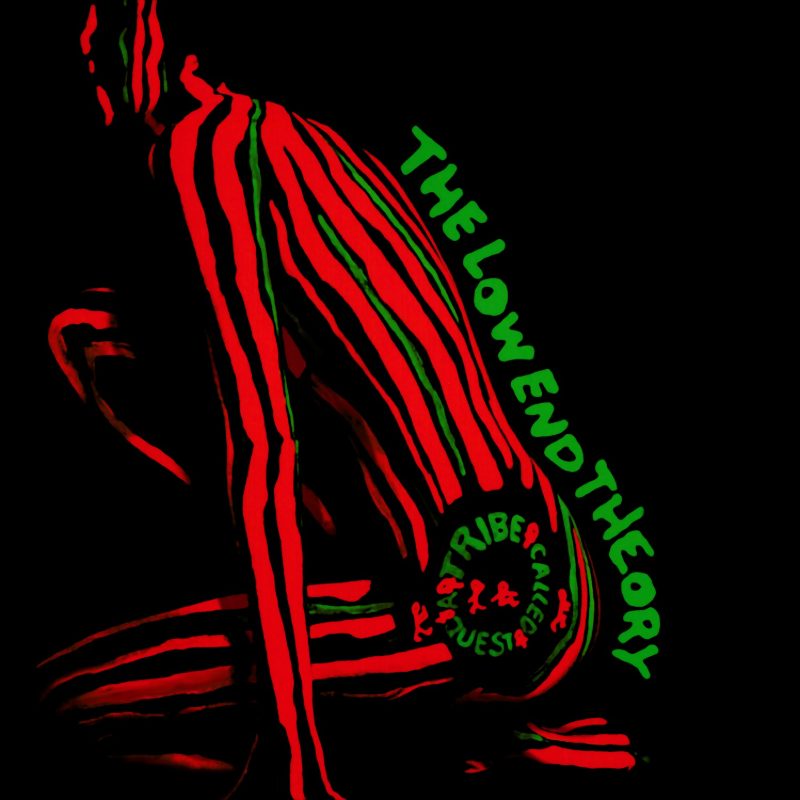
A Tribe Called Quest's second album, recorded in New York in 1990–91: the record where Phife Dawg stepped up beside Q-Tip, built on bass, drums and the space between them.
- Released
- 24 September 1991
- Label
- Jive (US CD 1418-2-J; UK LP HIP 117, CD CHIP 117; Europe LP ZL 74940)
- Producer(s)
- A Tribe Called Quest; Skeff Anselm on 'Show Business' and 'Everything Is Fair'. Recorded and mixed by Bob Power with the group
- Runtime
- 48:03 (14 tracks; the 1991 UK and European LPs have 12)
- Chart peak (US)
- #45 (Billboard 200, chart dated 12 October 1991, its first week)
- Chart peak (UK)
- #58 (Official Albums Chart, 12 October 1991; 1 week)
- Certifications
- RIAA Platinum (1 February 1995); BPI Gold (3 July 2026)
- Awards & honours
- #43 in Rolling Stone's 500 Greatest Albums (2020); #9 in Pitchfork's 150 Best Albums of the 1990s (2022); added to the National Recording Registry (announced 13 April 2022)
Jive worried the record was too commercial. It's easy to love because Q-Tip built it from the bottom up, and that makes it the group's best-produced record, thin songs and all.
A Tribe Called Quest's own label had doubts about The Low End Theory, and they weren't the ones you'd expect. In Michael Rapaport's 2011 documentary, Beats, Rhymes and Life, Jive's CEO Barry Weiss recalled the label's first reaction. The album was very different from the debut and less "left" in some ways, he said. They'd worried the group were trying to go too commercial. Then he said they'd been completely wrong. The album entered the Billboard 200 at #45 on 12 October 1991, and it never went higher. It still went Gold five months after release, and Platinum in 1995.
The worry was wrong, but it had noticed something real. The Low End Theory is easy to love on a first hearing, and that comes from design rather than compromise. Q-Tip built it from the bottom up: a bass line, a drum sound stacked until it hits hard, and two voices with room around them. There's nothing for a new listener to get past. It's the best-produced record the group made, and the one where Phife Dawg stepped up beside Q-Tip. It also has four songs that are beats waiting for an idea. The reputation it carries now tends to skip over those.
Phife's bigger part has a documented cause, and it isn't musical. A month after the group's debut came out in April 1990, he learned he was diabetic. Exclaim!'s 2008 history of the group says he thought about quitting for a regular job. Instead, he and Q-Tip agreed he'd take a bigger part on the next record. Phife's own account, from 2015, is plainer. Q-Tip ran into him on the train and told him he could be on a couple of songs if he took it seriously. On the debut, People's Instinctive Travels and the Paths of Rhythm, he'd made only brief appearances. It had peaked at #91 in America.
Q-Tip's reason was somebody else's record. In a 2013 lecture for the Red Bull Music Academy, he named N.W.A's Straight Outta Compton as the spur. He and Ali Shaheed Muhammad were out driving when they decided they had to make something with that kind of weight. He admired Dr. Dre's dynamics. The title has two meanings, according to Exclaim!: the status of Black men in society, and the bass frequencies. Meanwhile the business around the music was coming apart. During the sessions the group left Kool DJ Red Alert for Chris Lighty at Rush Artist Management. They fired their lawyers and faced lawsuits. Renegotiating with Jive took more than a year. Jarobi, the fourth member, drifted out of the sessions, by Skeff Anselm's account. Exclaim! says he left to study culinary arts.
Q-Tip has described the method himself. The first beats he made were 'Excursions' and 'Mr. Incognito', on the same drum pattern. He doubled and tripled kicks and snares to build a single drum sound. He chopped phrases in 3/4 and 7/8 and set them inside a 4/4 bar, and he dropped elements out for dynamics. Much of the album went through the Neve desk at Battery Studios, which he calls the "John Lennon Neve". Bob Power recorded and mixed it with the group. He also cleaned up and isolated the sounds Q-Tip and Ali wanted to sample. The work moved between Battery, Greene Street and Soundtrack, all in New York. Two tracks were programmed at Jazzy Jay's Studio in the Bronx. It took about a year, by Skeff Anselm's count, and he remembers "20-something or 30 songs" for the 14 that were kept.
'Excursions' sets the terms. Q-Tip, its only credited writer, is in by 0:09. The sleeve credits a sample of the Last Poets' 'Time Is Running Out', and Pitchfork traces the music to an Art Blakey record. Opening on a jazz record and the voices of the Last Poets reads as a statement of where this music comes from. Then 'Buggin' Out' brings Phife in, and the album has its second voice. He's quicker and funnier than Q-Tip, and the contrast does the work a chorus would do elsewhere. Writing in The Quietus, Angus Batey heard the track as a sparse drum loop over a cycling bass line. The last vocal comes at 2:58, and the track runs on for another 40 seconds without one. Only a group that thought the beat was the song would end it that way.
Only one track has a credited live player. Ron Carter, who'd worked with Miles Davis and Thelonious Monk, plays double bass on 'Verses from the Abstract'. In a 2022 interview on Bullseye, he recalled giving the group a hard time about their swearing. Vinia Mojica adds what the sleeve calls "vocal tones". Rolling Stone's 2016 anniversary piece also put Carter on 'Excursions' and 'Buggin' Out', where the label doesn't credit him. The mistake is easy to make. Skeff Anselm says Q-Tip sampled many of the bass lines from jazz records, and told Bob Power he wanted the bottom as heavy as it could be made. Robert Christgau, writing about the next album, called Carter's bass here "a glorified sound effect", admired for the class it signified. As a jab at how the credit was received, that's fair. As a reading of the record, it misses: the bass is the plan, and Carter's track is only its most literal statement.
'Butter' shows how the partnership worked. Q-Tip meant it as another trade-off, but Phife wanted it to himself. They argued, Q-Tip told VH1 in 2011, and Phife kept the verses while Q-Tip took the hook. Q-Tip compared it to Lennon and McCartney taking turns. Skeff Anselm remembers it differently: he thinks a solo track for Phife was Q-Tip's own idea. 'Check the Rhime', the first single, puts both MCs on a credited Average White Band sample. It reached #1 on Billboard's Hot Rap Singles chart on 30 November 1991. Its widely quoted line about record companies is Q-Tip's. In The Big Payback, Dan Charnas suggests it grew out of the group's dealings with Jive. Christgau, who was otherwise cool on the album in 1991, picked it out along with 'Buggin' Out'.
The middle of the record is looser. 'Show Business' brings in Diamond D and Brand Nubian's Lord Jamar and Sadat X on a Skeff Anselm beat. It was first cut at Jazzy Jay's and redone at Battery, after Chris Lighty didn't like where it was going. 'Vibes and Stuff' runs on a credited Grant Green sample, 'Down Here on the Ground'. Near its end Q-Tip dedicates it to Vinia Mojica's late mother. These tracks make the album feel like a scene as well as a partnership. They're also where it loosens its grip, and where the guests fill space the rest of the record leaves open.
The last stretch leans on friends. 'Jazz (We've Got)' began as a Pete Rock beat that Q-Tip heard and remade, and Pete Rock gets a spoken credit on the track. Then 'Scenario' closes the album as a party. Skeff Anselm says about 20 people recorded on it before the group started cutting voices, Chris Lighty among them. Rolling Stone's 2016 account adds Jarobi and members of De La Soul and Black Sheep. The released take keeps Leaders of the New School: Charlie Brown, Dinco D and Busta Rhymes. Q-Tip wrote a few bars of his own verse for Busta to deliver in Busta's style. The closing verse is Busta's own, and it made his name. 'Scenario' reached #57 on the Hot 100 in July 1992. It's the least typical thing on the record, loud where the rest is lean.
For all its craft, the songwriting is where the album gives ground. 'Rap Promoter' and 'Skypager' each run 2:13, and they play like premises rather than songs. Michael Rapaport, making the case for Midnight Marauders in Complex in 2011, said he'd skip 'The Infamous Date Rape' and 'Everything Is Fair'. He has a point. 'The Infamous Date Rape' raises a serious subject and leaves it as a sketch. 'Everything Is Fair', one of Skeff Anselm's two productions, is the beat that does least on the album. Anselm has said his two tracks weren't as low as the ones Q-Tip built. On a record named for the low end, that's a real handicap. Four soft spots in 14 tracks is a real cost on a record this short.
What it changed has named witnesses, though one of them is secondhand. Pitchfork's 2022 list of the best albums of the 1990s ranked it #9. It says Dr. Dre told Q-Tip that hearing this album made him know he had to make The Chronic. Pitchfork doesn't say who told the story, and we found no first-hand version. Pitchfork also traced a line from the album to the Roots, J Dilla and Kanye West, among others. Bob Power went on to work on D'Angelo's Brown Sugar, Erykah Badu's Baduizm and albums by the Roots. He died on 1 March 2026, aged 73. The sound of this record travelled through the people who made it as much as through the people who heard it.
The critics took longer than the musicians. Christgau gave the album only an honourable mention in the Village Voice in 1991. In June 2022 he raised it to an A, after reading Dan Charnas's book about J Dilla. Rolling Stone put it at #43 in its 2020 list of the 500 greatest albums. The Library of Congress added it to the National Recording Registry in April 2022. Britain was slowest of all. The album spent 1 week on the UK chart in October 1991, at #58. It went Gold there on 3 July 2026, almost 35 years later. That's a reputation built by people playing the record, not by a launch.
So Jive was wrong about the danger and right about the effect. The Low End Theory is accessible, and it got there by taking things away. 'Excursions', 'Buggin' Out', 'Verses from the Abstract' and 'Check the Rhime' make its case. Each one makes bass, drums and a voice or two feel like plenty, and 'Scenario' shows the same floor can hold a crowd. The production is the best thing here, and Phife's arrival is the best story. The thin songs are real, though, and Midnight Marauders runs more evenly from start to finish. That's why this is a great album with a flaw rather than a flawless one. It's still the Tribe record to start with, because it shows its working most clearly.
Pressing guide — the one to own
There was no 1991 US commercial LP: in America the album came out on CD and cassette, and the only 1991 US LPs were promos. The originals to own are the UK Jive HIP 117 and the European ZL 74940. Both are 12-track LPs that leave off 'Vibes and Stuff' and 'Skypager' and close side A with 'Scenario'. The UK copy was pressed by DFI, with stamped runouts reading 'DFI 91 8 HIP 117 A1' and 'B1'. The full 14 tracks reached US shops on vinyl with Jive's 1996 double LP; before that, only the JQ2 promo set carried them.