
Deep Dive
The Marshall Mathers LP
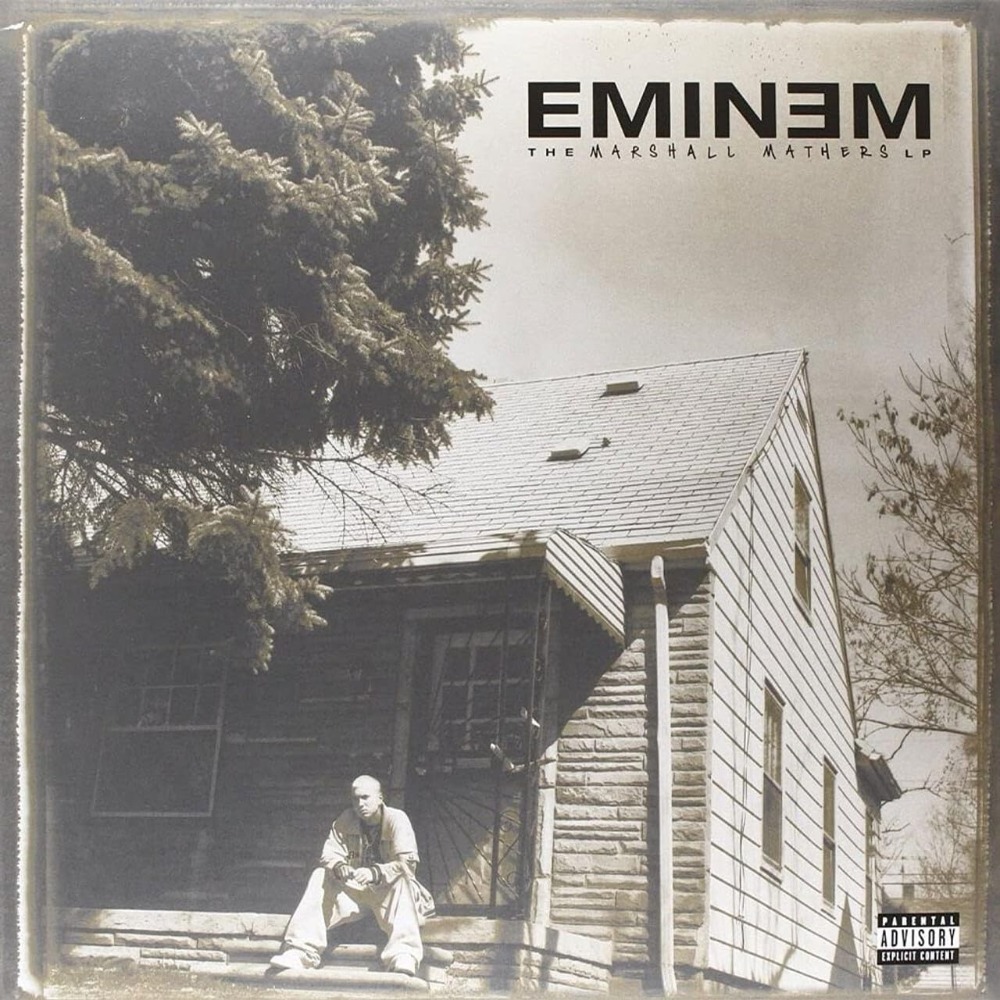
The Marshall Mathers LP by Eminem (2000) — what a copy is worth and which pressing to own, in a full Lead-In dossier: Eminem's 2000 album sold 1,760,049 copies in its first US week.
The Marshall Mathers LP by Eminem (2000) — what a copy is worth and which pressing to own, in a full Lead-In dossier: Eminem's 2000 album sold 1,760,049 copies in its first US week.
Eminem's second major-label album sold 1,760,049 copies in its first US week in 2000. It's a record about being watched, made by a rapper who answered every one of his watchers.
The Marshall Mathers LP turns everyone watching Eminem, from his label to his fans, into characters, and that's where its greatness lies. The same hunger for a reaction pads its second half and keeps its cruelty aimed at easy targets.
Early in 2000 The Marshall Mathers LP was finished, and Interscope couldn't hear a single on it. Pitchfork's 2018 retrospective puts that verdict with Jimmy Iovine. Eminem's first answer was 'The Way I Am', a song about refusing to be anyone's product. He heard its piano figure in his head on the plane after the meeting, and built the backing himself. It's the only track on the album he produced alone. Interscope still wanted a hit. Mike Elizondo, who played bass on the record, remembers Iovine giving them two more weeks. Dr. Dre told VH1 that the second answer, 'The Real Slim Shady', took about a week.
Those two songs hold the album in miniature. One is a refusal, and the other is a hit that mocks the business of hits. Both are about being looked at, and that's the real subject here. The label, the critics, his manager and his fans all watch him, and all of them are written into the record. When it turns the watchers into characters, it's as good as rap got in 2000, and his performances are the best of his career. When it only wants a reaction, it repeats itself, pads its second half with guests and aims its cruelty at easy targets. It's a great record with a real flaw, and the flaw comes from the same appetite as the greatness.
The pressure came from the first album. The Slim Shady LP, released in February 1999, had made him famous and then made him a target. By May 2000, Robert Hilburn wrote in the Los Angeles Times, 3 million people had bought it. His mother's $10 million defamation suit over his lyrics was still pending. Eminem told VH1 that success had brought new kinds of problems. Even on his old basketball courts, people treated him as a celebrity rather than as Marshall. He wanted to answer what was being said about him. He also said the label was talking about a million copies in the first week, and that the number frightened him.
The record was made by camps, and you can hear the joins. Dr. Dre produced six of its 14 songs, five of them with his partner Mel-Man. Mark and Jeff Bass, credited as F.B.T., produced six more, five of them with Eminem. The 45 King made 'Stan', and Eminem made 'The Way I Am' alone. The sleeve names six studios, from the Mix Room in Burbank to Chung King in New York and 54 Sound in Ferndale, outside Detroit. It doesn't say which song was cut where. Elizondo recalls month-long stints in Los Angeles and 20-hour sessions across two rooms, run like a small factory. Dre said every song but one was made on the spot. The exception was 'Kill You': Eminem heard the beat playing down the phone, Dre sent it to him, and he wrote to it before coming in.
The two camps sound like two ideas of the same rapper. Dre's tracks are spare, built for radio and for the voice to sit on top. The Bass brothers' are plainer and closer to home. The brothers had been recording him in Detroit before he had a deal. Steve King, who engineered at 54 Sound, says an EP they made was what connected him with Dre. Eminem co-produced five of their six tracks here, and they're where he speaks most as himself, on 'Marshall Mathers' and 'Criminal'. The album never quite reconciles the two sounds, and that's one reason it plays as a collection rather than a single argument.
'Stan' is where the method pays off. Paul Rosenberg, his manager, passed on a tape of beats by the 45 King, and 'Stan' was built on the second one. That beat used Dido's 'Thank You', from her album No Angel. Eminem told VH1 he mapped the whole story out before writing it, which he says he rarely did. Three letters from a fan grow more desperate, and Eminem's reply comes too late. Thunder rolls under the letters. Dido found out about the song from a letter sent by Eminem's side after it was made, and she liked it. Eminem has said an engineer accidentally erased what he thought was a better take of the car-crash section. The skill on show isn't rhyme density. It's plotting, and the patience to let a borrowed chorus carry the sadness. In 2000 Hilburn called it superb storytelling with a point, and he was right.
'The Way I Am' works the other way round. Its piano figure is the one from the plane, and the vocal doesn't arrive until 33 seconds in. Elizondo plays bass and guitar, and Eminem mixed it himself. When he comes in, the song states the album's subject outright, and it's his best production. 'The Real Slim Shady' is the same complaint turned into a party. The title phrase arrives 9 seconds in. Pitchfork hears Dre's bass and a figure that sounds like a harpsichord. It was built to order, and it holds up better than most made-to-order singles because the jokes are about the order.
The performances are why the record lasts. On 'Kim' he plays both parts, his own and Kim's, almost entirely in screams and sobs, for 6:17. He wrote it in late 1998, during a split from Kim Scott, before his debut was even in the shops. It works as horror because he commits to it completely and never winks. It's also the track the persona defence can least explain away, and the clean edition simply swaps it for another song, 'The Kids'. 'Criminal' closes the album with a spoken opening about whether he means any of it. The music answers yes and no, which was the only honest answer he had.
The skits do the watchers' work for them. In 10 seconds Paul Rosenberg leaves a worried message. Later, Steve Berman, then Interscope's president of sales and marketing, plays himself. Putting a real executive on the record turns the label's nerves into material, and the joke lands because Iovine really had doubted the album had a single. The third skit, Ken Kaniff, is a different matter. XXL tied it to his feud with Insane Clown Posse. It's a minute-long gay joke, and it's the one track here with nothing to recommend it.
The structural flaw is the second half. Four of the last 10 tracks have credited guests, from his Detroit crew D12 to Snoop Dogg and Nate Dogg. None of them is bad. But each is a party the album's argument isn't invited to, and together they run for 18 minutes. Hilburn ran through the producers in his review and still credited the album's energy and direction to Eminem's own vision. On the guest tracks that vision is missing, and the beats have to carry them alone. At 72 minutes, this is an album you return to by the song.
The bigger problem has aged worse. Hilburn gave the album 3½ stars out of 4 and said he'd docked half a star for its recurring homophobia. GLAAD issued statements from May 2000 and protested when the MTV Video Music Awards honoured 'The Real Slim Shady' that September. On 21 February 2001 it staged what MTV News called a modest protest outside the Grammys at Staples Center. That night Eminem performed 'Stan' with Elton John, and said afterwards that the performance was statement enough. It was a smart reply, but the record keeps raising the question anyway. The persona defence covers 'Kim', which is horror and announces itself as horror. It covers much less when the slurs are aimed outward, at whole groups of people. Pitchfork gave the album 9.4 in 2018 and still found it full of hate for women and gay people. Its reviewer called reading it as satire an act of bad faith.
What it changed is easier to count than to judge. It sold 1,760,049 copies in its first US week, a record for a solo artist. That was more than twice the old rap record, the 800,000 of Snoop Dogg's Doggystyle. Only NSYNC had sold more in a week, with 2.4 million. It spent 8 straight weeks at #1. That September, Lynne Cheney named him at a Senate hearing on marketing violent entertainment to children. In 2019 Merriam-Webster added 'stan' as a noun and a verb. Max Bell, writing in Spin in 2020, listed Tyler, the Creator, Earl Sweatshirt, Kendrick Lamar and Juice WRLD among the rappers Eminem influenced at his peak. That's Bell's list, and none of the four is quoted on it, but it's a reasonable one.
Its standing has held. In 2020 Rolling Stone ranked it #145 among the 500 greatest albums of all time. The reputation is earned by 'Stan', 'The Way I Am', 'Kim' and the sheer control of his voice. The ranking overlooks how much of the record belongs to 2000. Its pop targets, from NSYNC to Will Smith, have dated, and the jokes about them have dated too. Pitchfork's reviewer saw both sides: a record made for kids, and now a time capsule.
Its best half dozen songs are as strong as any rap from that year, and no Eminem album since has matched the voice on it. As a whole it sprawls. The guests dilute it, the skits have aged badly, and the cruelty it dared people to take literally still reads as cruelty. Play it for 'Stan', 'The Way I Am', 'Kim' and 'Criminal', and expect to skip. That's the honest shape of an album made by someone who knew he was being watched and wanted every reaction at once.
The original to own is the 2000 US double LP, Interscope / Aftermath / Web 069490629-1. Its etched runouts read 0694906301-A and -B on the first disc, and 0694906311-A 1 MATT P and 0694906311-B 1 on the second. A front sticker names 'The Real Slim Shady', 'Criminal' and 'Marshall Mathers'. It's widely held: in October 2026 more than 10,000 collectors had logged a copy. Shady Records isn't on the 2000 labels, and there was never a clean edition on vinyl.
© The Lead-In · an independent, reader-supported music publication.