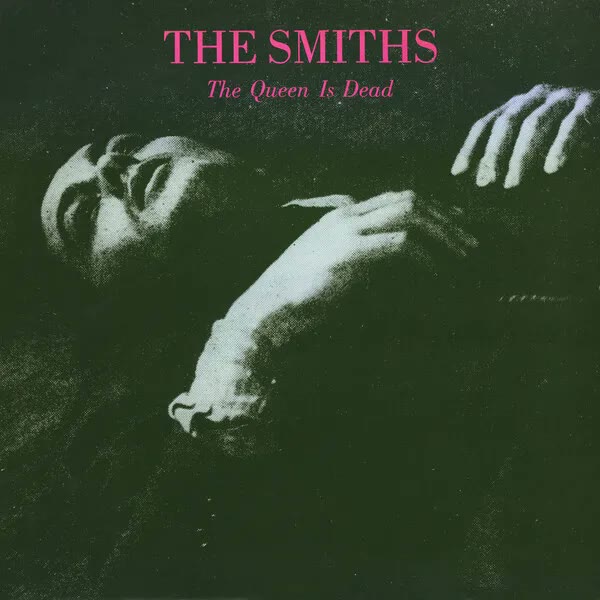
The Smiths' third album, recorded in 1985 and released in June 1986. It holds their best set of songs, and two jokes it could have done without.
- Released
- 16 June 1986 (UK, Rough Trade); 23 June 1986 (US, Sire)
- Label
- Rough Trade (UK, ROUGH 96); Sire (US, 9 25426-1)
- Producer(s)
- Morrissey and Johnny Marr; engineered by Stephen Street, with John Porter on 'Frankly, Mr. Shankly'
- Runtime
- 36:47 (10 tracks)
- Chart peak (US)
- #70 (Billboard 200, 23 August 1986), 38 weeks on the chart
- Chart peak (UK)
- #2 (Official Albums Chart, week of 22 June 1986), behind Genesis's Invisible Touch; 30 weeks on the chart in all, 22 of them in 1986–87
- Certifications
- BPI 2× Platinum (13 June 2025); RIAA Gold (19 September 1990)
- Awards & honours
- #1 in NME's 500 Greatest Albums of All Time (October 2013); #9 in NME's critics' albums of 1986; 10/10 from Pitchfork for the 2017 reissue
Its reputation as the Smiths' best album is mostly earned, by the songs and by a rhythm section that's still undersold. Two comic songs keep it from being seamless.
The drums that open The Queen Is Dead are a loop. Mike Joyce played a tom pattern, and Stephen Street sampled it on a Window, 'a very basic little sampler' that Jacobs Studios was trying out. It held about 1.5 seconds of sound. Street looped the pattern so it would run 'the same speed all the way through'. Andy Rourke's bass and Johnny Marr's rhythm guitar went on top. Joyce then overdubbed the snare and kick on their own, and added the cymbals after the vocal. The album most people call the Smiths' best has a machine keeping time for its drummer.
That's worth holding on to, because the album's legend is of four people at their peak, playing as one. It was partly built in pieces, by a band that would split 13 months after its release. Its standing has changed more than its sound. NME's critics put it #9 among the albums of 1986, below Prince's Parade. In October 2013 a vote of the magazine's writers put it #1 of all time. The rise is mostly earned. At its best this is the strongest set of songs Marr and Morrissey wrote, played by a rhythm section that's still undersold. But it isn't the seamless record its reputation describes. Two of its 10 songs are jokes, and Marr rated one of them low himself.
It was made at the top of the band's first run. Meat Is Murder had gone to #1 early in 1985. Marr's method for the next songs was quick. He'd play Morrissey a new piece from a cassette, and Morrissey would have words 'in a couple of days'. That's how Marr put it to NME for a 2016 history of the album. Simon Goddard's Mozipedia puts 'Frankly, Mr. Shankly', 'I Know It's Over' and 'There Is a Light That Never Goes Out' in one late-summer session at Marr's house in Bowdon. The business around them was less settled. Street remembered 'Rough Trade and EMI trying to sign up everything' while they worked. The sleeve says the album was recorded in the winter of 1985. It'd been due out in February 1986 but didn't reach the shops until 16 June, held back, Goddard writes, by tensions with Rough Trade. By February 1987 the band's move to EMI was public. Even the title shifted. The working title was 'Margaret on the Guillotine'. The final one came from Hubert Selby Jr.'s novel Last Exit to Brooklyn.
Most of it was recorded and mixed at Jacobs, a residential studio in a Georgian mansion in Farnham, Surrey. 'Bigmouth Strikes Again' and 'Some Girls Are Bigger Than Others' came from RAK in London. 'The Boy with the Thorn in His Side' began in a small Manchester studio. Morrissey and Marr produced, and Street engineered, as he had on Meat Is Murder. Street said Marr sat with him in the control room most of the time. Morrissey came and went. He sang in the live room, screened off so nobody could see him, and Street said 'two or three takes were all he needed'. Street then stitched the best passages together. So the sound of the record is largely Marr's design, worked out with Street in the control room. The voice was caught in a few quick takes.
The title track shows what that design could do. It opens with Cicely Courtneidge singing 'Take Me Back to Dear Old Blighty', taken from the 1962 film The L-Shaped Room. Street said the clip was Morrissey's idea, tried out on a record deck. Then the tom loop starts, and Rourke's bass carries the song. Street called it 'a real killer bass line'. Marr wanted 'the aggression of the Detroit garage bands', and described the track as the Smiths doing the Stooges doing the Velvet Underground. His wah-pedal feedback was a happy accident, Street said, of his guitar and how close he stood to the amp. Street kept it running through the whole track, and cut about 4 more minutes of it. Morrissey said he didn't want to attack the monarchy 'in a sort of beer monster way'. He didn't need to. The song is angrier in its playing than in its words, and that's why it works.
The slower songs called for different choices. Street told NME that they tried a trumpet player on the closing refrain of 'I Know It's Over'. He liked it, but thought Morrissey was uneasy with someone outside the band on the record, and it went. Simon Goddard's account puts the scrapped trumpet take on 'Frankly, Mr. Shankly' instead, so the memories differ. Either way, the slow song is left to the four of them, and that restraint is right. 'There Is a Light That Never Goes Out' borrows its opening from the Rolling Stones' cover of Marvin Gaye's 'Hitch Hike'. Marr called that 'a convoluted in-joke'. Street said Marr had been wary of keyboards until then. Here he tried string ideas, then a cello line, then a flute, and it sounded dry until he added a delay 'to make it float'. The extra colour is spent on the right song. Marr said the writing and recording 'poured out'.
Elsewhere the craft is quieter. Marr nearly binned 'Cemetry Gates' after writing it in his kitchen, and kept it because Morrissey loved it. He said 'Bigmouth Strikes Again' was as close as the band got to the early Rolling Stones. Its high backing voice, credited to 'Ann Coates', is Morrissey through an AMS harmoniser. 'The Boy with the Thorn in His Side' had been a single in September 1985. The album version is a remix, with strings, extra guitar and marimba on the verses. Street didn't find 'Some Girls Are Bigger Than Others' that interesting until he mixed it to sound 'far and near'. It fades in wet, drops away and comes back dry. Simon Reynolds heard it as an anticlimax in 1986 and as the right ending in 2017. He's right the second time. Closing on 'There Is a Light' would have been too neat.
The playing is the album's other argument. Reynolds wrote in 2017 that Rourke and Joyce supplied 'foundation and frolic', and called them indispensable. The record bears him out. Rourke said Marr told him the title-track bass was one of the best he'd ever heard. Street knew the rumours about Rourke's drug use at the time, but said he never saw any sign of it in the studio. Early in 1986 Rourke was dismissed from the band anyway, and reinstated about 2 weeks later. 'Never Had No One Ever' shows what the two of them add. Marr wanted the feeling of hearing the Stooges' Raw Power at 16, 'beautiful and dark at the same time'. The words are bleak, but it's the band that gets it there.
The flaw is two songs long. 'Vicar in a Tutu' is a comic song about a cross-dressing clergyman. Marr said the band allowed themselves a couple of things 'a little more throwaway', and called it 'not one of my favourites'. Rourke counted 'two oom-pahs on one album'. The other is 'Frankly, Mr. Shankly', usually read as a dig at Rough Trade's boss, Geoff Travis. Reynolds called it 'petty', because only industry insiders could have got the joke at the time. On a 10-song album of under 37 minutes, that's a fifth of the tracklist spent on asides. They don't sink it, but they stop it being seamless. Nor is it a record of new forms. Its borrowings are open: the Stones, the Stooges, the Velvets, a 1962 film. Its one new trick, the sampled loop, is on one song.
It sold quickly at home and slowly elsewhere. It entered the UK chart at #2 in the week of 22 June 1986, behind Genesis's Invisible Touch. It spent 22 weeks on the chart over the next eight months. The BPI certified it Gold on 1 July, 15 days after release. In America it peaked at #70 on the Billboard 200. Robert Christgau gave it a B+ in the Village Voice. The lead single was 'Bigmouth Strikes Again', which reached #26. Rough Trade had wanted 'There Is a Light' instead, by Goddard's account. That song wasn't a single until October 1992, when it reached #25. By October 2026 it had passed 1.2 billion Spotify streams, far more than any other Smiths song.
The band barely outlived it. Marr left in July 1987, and Strangeways, Here We Come came out on 28 September, after the split. Joyce later sued Morrissey and Marr over his share of the earnings, and won in the High Court in December 1996. The album's standing grew in the band's absence. In 1996 the French magazine Les Inrockuptibles marked the album's tenth anniversary with The Smiths Is Dead, on which 10 acts covered it track by track. The BPI certified it Platinum only in July 2013, and 2× Platinum in June 2025. The 2017 deluxe edition took it back to #10 in Britain. Reviewing that edition, Reynolds gave it 10/10 and called it the band's 'imperial moment'. He also noted that at the time there 'weren't that many believers'.
So is the reputation right? Mostly. The title track, 'I Know It's Over', 'Cemetry Gates', 'Bigmouth' and 'There Is a Light' are songs the band never bettered. Rourke and Joyce are the reason they move rather than mope. But it's a great record with two weak spots, not a seamless one. Two of its 10 songs are asides, and its guitarist didn't rate one of them. Its inventions are mostly in the playing, not the form. It's the Smiths' best album. Play it whole, and accept the vicar as the price.
Pressing guide — the one to own
There's no single prize. The 1986 UK original, Rough Trade ROUGH 96, was pressed at two plants, EMI and MPO, and neither is documented as the earlier. The EMI copies come in a gatefold with a printed inner sleeve, and the catalogue entry for the MPO copies calls them almost identical. Both carry two messages in the runout, stamped on EMI copies and etched on MPO ones: FEAR OF MANCHESTER on side A and THEM WAS ROTTEN DAYS on side B. EMI copies have a 'U' in the matrix, and MPO copies end the runout with 'MPO'. The messages also appear on the 1990 and 2009 reissues, so on their own they don't date a copy.