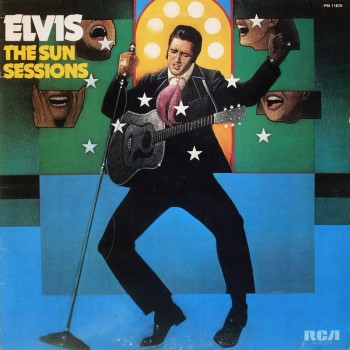
Elvis Presley's 1954–55 recordings for Sam Phillips, gathered on one LP by RCA in 1975 and 1976: the start of his career, heard as an album it was never meant to be.
- Released
- July 1975 (UK, RCA Starcall, as The Sun Collection); 1976 (US, RCA Victor; on the Billboard 200 from 17 April). Recorded July 1954 to July 1955
- Label
- RCA Victor (US, APM1-1675); RCA Starcall (UK, HY 1001)
- Producer(s)
- Sam Phillips (the original recordings)
- Runtime
- 38:34 (16 tracks, label timings)
- Chart peak (US)
- #76 (Billboard 200, 29 May 1976); #2 (Billboard Hot Country LPs, 5 June 1976)
- Chart peak (UK)
- #16 (Official Albums Chart, September 1977, as The Elvis Presley Sun Collection); #18 on its first run in 1975
- Certifications
- None. The 1987 expansion, The Complete Sun Sessions, was certified Gold by the RIAA on 6 August 2002
- Awards & honours
- Rolling Stone's 500 Greatest Albums: #11 in 2003 (entry headed RCA, 1999), #78 in 2020. Presley's Sun Records sessions of 1954–1955 entered the Library of Congress National Recording Registry in 2002
Everything new on The Sun Sessions is in how Presley, Moore and Black played other people's songs, and the first ten tracks, his five Sun singles, prove it. The last six, leftovers RCA added two decades later, let the album down.
The first sound on The Sun Sessions is Elvis Presley's own acoustic guitar. He strums alone for a few seconds, and his voice comes in at 0:05. The date is 5 July 1954. Presley, Scotty Moore and Bill Black had tried 'Harbor Lights', a Bing Crosby hit, and 'I Love You Because', a country ballad by Leon Payne. Then they took a break. Presley started fooling around with Arthur Crudup's 'That's All Right', and the other two joined in. Sam Phillips asked what they were doing and had them start again. On 19 July it came out as Sun 209, Presley's first single.
Everything that matters about this record is in that scene. Presley wrote none of its 15 songs. Most had already been records for somebody else. Two came from writers at Sun: 'I'm Left, You're Right, She's Gone' and 'I Forgot to Remember to Forget', both co-written by Stan Kesler. So the songs are mostly borrowed. What Presley, Moore and Black did to them in a small room was new, and this is still the best single place to hear it. It's also a compilation, put together by RCA two decades later, and that shows. The first ten tracks are all five of Presley's Sun singles, A-sides and B-sides, in the order they came out. The last six are what was left over, and the record sags under them.
It isn't an album Presley set out to make. RCA bought his contract and his Sun masters, and the deal was signed at Sun on 21 November 1955. Phillips's price was $35,000, plus $5,000 for royalties Sun owed Presley. RCA reissued all five Sun singles on its own label, starting with 'Mystery Train' within weeks. Five Sun recordings that Sun had never released went onto Elvis Presley, his first RCA album, in 1956. What American buyers had never had, as Robert Christgau pointed out in the Village Voice, was these sides on one LP. RCA's British company issued them that way in July 1975, as The Sun Collection. Several other editions carry the same year, and a French one, catalogued under 1975, used the title The Sun Sessions. The American LP followed in 1976, and Christgau called it “the rock reissue of the year”. Now the Sun singles ran in order, from the first to the last, on one record.
The room explains a lot. Phillips had opened the Memphis Recording Service at 706 Union Avenue in January 1950. Its recording room was 18 by 33 feet, with square acoustic tiles and a V-shaped ceiling. He recorded in mono through a rebuilt RCA console he'd bought used for $500, and used no EQ until mastering. A second Ampex tape machine gave him slapback, the short tape echo that hangs off a sound. It's easy to assume the echo is on everything. It isn't. Peter Guralnick, Phillips's biographer, says there's none on 'That's All Right'. On 'Blue Moon of Kentucky', cut within days, Phillips did add it. Jim Dickinson's view was that the main character on these records is the room itself, with slapback sometimes added. That's why these records still sound close: what you hear is a room, not an effect.
Thirteen of the 16 tracks have no drums. Black slaps his double bass, so it carries the beat as well as the bass line. While they worked up 'That's All Right', Phillips got Moore to drop the conventional turnaround and cut down his flourishes. Earlier that night, during the ballads, he'd thought Moore was trying too hard to sound like Chet Atkins. You can hear the result in the instrumental break on 'That's All Right', from 0:47 to 1:12. Then play 'Blue Moon of Kentucky'. Bill Monroe's 1947 record is a bluegrass waltz. The trio speed it up, still with no drummer. The Library of Congress notes that Monroe later revised his own performance to reflect Presley's influence. When a song's writer changes his own performance because of a cover, the cover has done more than borrow.
The later singles show the trio working out what they had. 'Milkcow Blues Boogie', from late 1954, opens as a slow blues. Then Presley halts the band with a spoken aside, and they restart at speed. Planned or not, it plays as a manifesto: the old way first, then the new one. 'Baby Let's Play House', from early 1955, reached #5 on Billboard's country disc-jockey chart that summer. 'I'm Left, You're Right, She's Gone' was cut that spring with Jimmie Lott, the first drummer on a Presley session. A slower version survives on RCA's 1999 Sunrise set. The master is the better record, and it's the earliest of the album's three tracks with drums.
The last session on the album, in July 1955, produced three of its best tracks. Earlier that month Moore had traded his Gibson ES-295 for a Gibson L5, and 'Mystery Train' was the first thing he recorded with it. The song was Junior Parker's, cut for Phillips's Sun label in 1953. When Billboard reviewed the new single in August, it singled out the guitar. 'I Forgot to Remember to Forget' brought in a drummer, Johnny Bernero, and became Presley's first national #1, on Billboard's country chart. On 'Trying to Get to You' Presley played the piano himself. According to Phillips, it would've been one side of a sixth Sun single. It's where the album should have ended.
The record's greatness is in the playing, not the writing. A Chicago blues by Crudup, a bluegrass waltz by Monroe and an R&B party record by Roy Brown all come out sounding like members of one new family. So, more or less, does a Rodgers and Hart song. The songs themselves are uneven. 'You're a Heartbreaker' is pleasant and slight, and nobody would miss it from the singles run. What carries the album is the nerve of the playing. A young singer and two sidemen treat a song's origin as if it doesn't matter. They're right far more often than they're wrong. Played straight, these songs would make a decent covers record.
The problem is most of side two. By the close of 'I Forgot to Remember to Forget', the record has played all ten sides of the five singles. Then it goes back in time. None of the last six tracks came out on Sun, and at least four of them were recorded in 1954. After 'Mystery Train' they sound like a step backwards, because they are one. 'Trying to Get to You' is the exception, stranded among them. 'I'll Never Let You Go' starts slow and then speeds up, a plan written on its own tape box. 'Blue Moon' is the strangest thing here, fascinating once and hard to love. Then the album closes on a second version of 'I Love You Because', from the first night. At 3:21 it's the longest track here and the least necessary. Ending on it was a sequencing choice, not a historical one, and it's the wrong choice.
What this music changed is documented, and it's the strongest thing about the record. Monroe's revision of his own song is one piece of evidence. Others are records. John Lennon told Rolling Stone in 1970 that 'Run for Your Life' was inspired by 'Baby Let's Play House', though he called it a very vague connection. The Beatles recorded 'I Forgot to Remember to Forget' for BBC radio in May 1964. The Band put 'Mystery Train' on Moondog Matinee in 1973. Most of it travelled through the singles, long before this LP existed. But these are the same performances, and the credit goes with them. What the LP added was one object to hold: five singles and some spare masters became an album, and albums get ranked. When the Library of Congress added this music to its registry in 2002, though, it chose the Sun Records sessions of 1954–55, not the record. It said they helped to create the rock 'n' roll era.
That distinction has grown. In 1987 RCA issued The Complete Sun Sessions, 33 tracks on two LPs, with 'Harbor Lights', 'Tomorrow Night', 'When It Rains, It Really Pours' and outtakes. Other sets followed, Sunrise in 1999 among them. When Rolling Stone ranked The Sun Sessions #11 in 2003, its entry described RCA's 1999 double CD. In 2020, ranking the 1976 LP, it put it at #78. The RIAA has never certified this LP, though the 1987 set went Gold in 2002. Even its credits proved unreliable. Some sleeves between 1975 and 1981 credited D.J. Fontana on drums, though the only drummers on the album are Lott and Bernero. The reputation belongs to the music, and the music has outgrown its 16-track container.
So the reputation is right about the music and generous about the album. The first ten tracks are as good as any ten sides in early rock and roll, and 'Trying to Get to You' would sit happily among them. The playing is the record's real achievement, it hasn't dated, and its reach runs from Monroe's own stage to the Beatles' BBC sessions. The writing was mostly other people's, and the last six tracks feel like a filing decision. Buy it anyway, and play the first side far more often than the second. As a single LP of Presley at Sun, nothing does the job better. For the whole story, you'll need the 1987 set.
Pressing guide — the one to own
Two editions matter most. The British one, RCA Starcall HY 1001, is the only 1975 issue the catalogue dates to the month: July. Its front reads 'The Sun Collection', while the spine and the green labels read 'The Elvis Presley Sun Collection'. Pete Norman cut the lacquers, and his initials, PN, are in the side-one runouts. The American LP is RCA Victor APM1-1675 from 1976: mono and tan-labelled, with Sun International Corporation credited as licensor. The five original Sun singles, Sun 209 to Sun 223, are a separate collecting field and aren't this album.