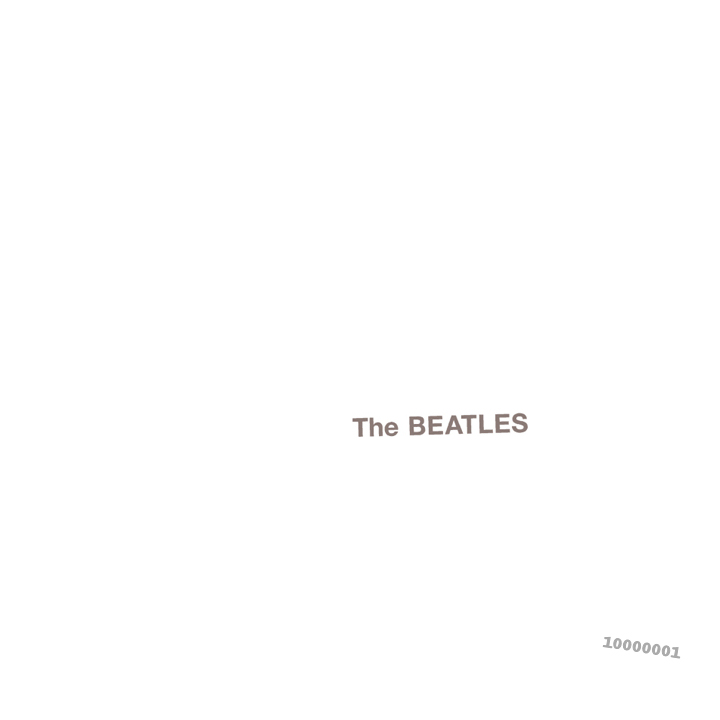
The Beatles' 1968 double album: 30 songs, many written in India and recorded at Abbey Road and Trident, read here through the 24-hour session that put them in order.
- Released
- 22 November 1968 (UK, Apple PMC 7067/8 mono and PCS 7067/8 stereo); 25 November 1968 (US, Apple SWBO 101)
- Label
- Apple (manufactured by EMI in the UK and by Capitol in the US)
- Producer(s)
- George Martin; Chris Thomas produced sessions uncredited while Martin was on holiday in September
- Runtime
- About 93 minutes in stereo, 30 tracks on four sides (the original sleeve printed no timings)
- Chart peak (US)
- #1 (Billboard Top LPs), 9 weeks at the top from the chart of 28 December 1968
- Chart peak (UK)
- #1 (Official Albums Chart), 8 weeks at the top in 1968–69
- Certifications
- RIAA 24× Platinum (2019, counting both discs); BPI Platinum by 2013 (counting sales since 1994 only)
- Awards & honours
- #10 on Rolling Stone's 500 Greatest Albums (2003 and 2012), #29 on its new list in 2020; #5 in Colin Larkin's All Time Top 1000 Albums (2000)
The White Album holds the best set of songs the Beatles put on one release, and they play it as a band far more often than its legend allows. What it lacks is an editor, and across four sides it never finds a shape.
On 16 October 1968, John Lennon, Paul McCartney and George Martin started putting 30 songs in order. The session ran for 24 hours, the only one that long the Beatles ever held. George Harrison had already flown to America. They left no silence between the songs. Edits, crossfades and stray fragments run each track into the next. Martin had wanted a single album and had lost that argument. The running order still follows his rule of strong songs at the start and end of every side. The heavy songs are grouped on side three, and Harrison gets one song on each side. Side two even puts three animal songs in a row.
That night is the whole album in small: a great band with a mountain of songs and nobody with the power to cut it to a single album. The White Album is often described as four solo records sharing a sleeve. The session credits don't bear that out. Ian MacDonald counts all four Beatles on 16 of the 30 tracks, and other session credits add a 17th, 'Dear Prudence', where Starr's part is disputed. The songs are the best the Beatles put on one release, and the album is still a side too long. Both things are true, and its reputation swings on which one you hear first.
The songs came out of India. In mid-February 1968 the Beatles went to Rishikesh to study Transcendental Meditation with the Maharishi Mahesh Yogi. Ringo Starr left after less than a fortnight, and McCartney in mid-March. Lennon and Harrison stayed until about 12 April. By then Lennon had turned on the Maharishi over rumours of improper behaviour spread by Alexis Mardas. Cynthia Lennon later said there was no evidence for them. Lennon's anger became 'Sexy Sadie', which he said in 1970 was about the Maharishi. MacDonald counts about 40 songs written in Rishikesh, most of them on acoustic guitars, the only Western instruments to hand. Donovan taught Lennon the fingerpicking pattern he used on 'Dear Prudence' and 'Julia'.
They came home to a press wondering whether they were finished. Sgt. Pepper had come out in May 1967, and the Magical Mystery Tour film had since been panned. In late May they demoed the new songs at Kinfauns, Harrison's bungalow in Esher, and recording started at EMI on 30 May. Lennon explained the double album plainly in 1969. Three writers' songs wouldn't fit on one record, he said, and "that's why we did a double". Martin believed the band also wanted to use up its EMI contract faster, and Harrison said the double cleared the backlog. The length, in other words, had practical causes. Harrison had four songs on the album, his most on any Beatles record so far, and Starr had his first song written alone. The White Album is the sound of a band making room for everyone, which is generous and very hard to edit.
The early sessions were good-humoured. By the third month they weren't. Yoko Ono, with Lennon since May, was in the studio from the first day, against the band's old habit of keeping outsiders out. On 16 July Geoff Emerick, their engineer since Revolver, quit after a session for 'Cry Baby Cry'. He cited the bickering and swearing. On 22 August Starr walked out during 'Back in the U.S.S.R.' McCartney took over the drums, with parts added by Lennon and Harrison. Starr came back to find his kit covered in flowers. Sources disagree on the day, but he was back within a fortnight.
They did sometimes work apart. Harrison remembered three studios running at once. On 20 August McCartney recorded 'Wild Honey Pie' and the brass for 'Mother Nature's Son' in Studio Two. Lennon and Starr were working on 'Yer Blues' elsewhere. But the solo rooms are few. 'Wild Honey Pie', 'Blackbird' and 'Mother Nature's Son' are McCartney alone. 'Julia' is Lennon's only solo recording in the Beatles' catalogue. 'Back in the U.S.S.R.' has three Beatles on it, and 'Birthday', 'Helter Skelter' and 'Honey Pie' have all four. It's a band record with a few solo rooms off the corridor.
The best of it rewards close attention. 'While My Guitar Gently Weeps' began as Harrison's solo acoustic demo on 25 July. When the band remade it on 5 and 6 September, he brought in Eric Clapton, who was reluctant to play on a Beatles record. Clapton went uncredited. He played Lucy, the Les Paul he'd given Harrison a month before. Listen from 1:55 to 2:31, where the musicologist Walter Everett times Clapton's solo. He hears it rise steadily in intensity, rhythm and register. The wobble on the guitar is artificial double tracking, added by Chris Thomas during mixing on 14 October. Clapton had asked for a more "Beatley" sound.
'Happiness Is a Warm Gun' is the album's range squeezed into 2:44. Lennon took the title from the cover of a gun magazine Martin showed him. The finished track is an edit of two takes, 53 and 65. It moves through separate sections, three or four depending on who's counting, and holds back the title until 1:34. 'Helter Skelter' goes for volume instead. McCartney said it started with a Pete Townshend interview boasting that the Who had made the loudest record, though he never found out which track Townshend meant. On 18 July the band played one take for 27 minutes 11 seconds, the longest recording of their career. The released version is a remake from 9 September. Starr's shout at the end is on the stereo mix only.
'Revolution 9' is where the missing editor shows most. It grew out of take 18 of 'Revolution 1', the first song they recorded. Lennon built it between 30 May and 25 June, with Yoko Ono choosing some of the tape loops. Its big night was a live mix on 20 June that used all three of EMI's studios. The sources include Sibelius, Vaughan Williams and a reversed Schumann, and at one point you can hear a tape machine rewinding. McCartney was in America for that session. At 8:22 it's the longest track the Beatles released while they were together. In 1968 the NME's Alan Smith called it pretentious. As a sound collage it's fair enough; as the second-to-last track of a 30-song album, it's a test of patience.
The quiet songs are the strength, and they're easy to miss under the noise. McCartney recorded 'Blackbird' alone on 11 June while Lennon compiled effects in Studio Three. Its guitar part comes from Bach's Bourrée in E minor. Lennon recorded 'Julia', for his mother, alone on 13 October. Harrison said he modelled the music of 'Long, Long, Long' on Bob Dylan's 'Sad Eyed Lady of the Lowlands'. Its subject, he said, was finding God. 'Dear Prudence', written for Prudence Farrow, rides Donovan's fingerpicking pattern for nearly 4 minutes. 'Mother Nature's Son' is McCartney alone with a brass arrangement by Martin. These are the songs any single-album edit would keep.
The filler is real, too. 'Wild Honey Pie' is a 52-second fragment McCartney kept because Pattie Harrison liked it. 'Ob-La-Di, Ob-La-Da' took about 42 hours and two remakes, and Lennon disliked it. 'Honey Pie' and 'Rocky Raccoon' are pastiche, neat and slight. Lennon called his own 'Cry Baby Cry' rubbish in 1980. Martin's sequencing gives each side a beginning and an end, but it can't give four sides a shape. His own verdict, that it should have been a very good single album, was outvoted rather than answered. Starr's version was a joke about two albums, a White and a Whiter. In 1971 Robert Christgau called it "their most consistent and probably their worst".
Opinion split the same way from the start. In The Observer, Tony Palmer ranked Lennon and McCartney as the greatest songwriters since Schubert. In the New York Times, Nik Cohn found it "boring beyond belief". Later critics kept arguing. In 1998 the Guardian's John O'Reilly gave it 2 stars out of 5, calling it an OK single album trapped inside a double. Christgau, who'd called it probably their worst, had come round to a high A minus by 2020. Pitchfork gave it 10/10 in 2009. Both camps are describing the same record. They disagree about whether the excess is the price or the point.
Its clearest influence runs through 'Helter Skelter', covered by Siouxsie and the Banshees, Mötley Crüe and U2. Critics count that song as an early step towards heavy metal, and Kerrang! later put the album at #49 of the 50 heaviest. Elvis Costello argued that the album's scope gave later acts such as OutKast and Radiohead permission to work on a bigger canvas. That's his reading rather than their testimony, but it's a fair one. Its darkest afterlife came at Charles Manson's trial. The prosecution argued he'd heard the album as a prophecy of race war. In court Manson disowned the conspiracy and said the music wasn't his, while saying in the same breath that the songs urged violence.
Rolling Stone ranked it #10 of all albums in 2003 and again in 2012, then #29 on its new list in 2020. On the songs, the higher placing is right. 'While My Guitar Gently Weeps', 'Happiness Is a Warm Gun' and 'Julia' would anchor any band's best record. But the White Album asks you to take them with 'Wild Honey Pie' and 8 minutes of tape loops. That's what the length costs. It's the Beatles' finest songwriting, in a shape nobody was allowed to edit. Play it whole once. After that you'll make your own single album from it, which was Martin's point all along.
Pressing guide — the one to own
The originals to own are the 1968 UK Apple pressings: PMC 7067/8 in mono and PCS 7067/8 in stereo. Both come in a top-opening laminated gatefold printed by Garrod & Lofthouse, numbered on the front, with black inner sleeves, the poster and four portrait prints. The runouts are machine-stamped XEX 709-1 to XEX 712-1 on the mono and YEX 709-1 to YEX 712-1 on the stereo. The first mono labels lack the words 'An E.M.I. Recording'. Early stereo labels carry them on sides C and D only, later ones on all four. It was the last Beatles album mixed separately in mono, and the mono was issued only in Britain.