Sly Stone built the Family Stone's fifth album largely alone, over a preset drum machine, in a rented Bel Air house. The method made it new, and it cost the playing something.
- Released
- Early November 1971 (Epic, US). On Billboard's album chart from 13 November 1971
- Label
- Epic Records (CBS). A Stone Flower Production
- Producer(s)
- Sly Stone (credited as Sylvester Stewart)
- Runtime
- 47:31 (12 tracks, from the sleeve timings)
- Chart peak (US)
- #1 (Billboard Top LPs & Tape, now the Billboard 200), 2 weeks: charts dated 18 and 25 December 1971
- Chart peak (UK)
- #31 (Official Albums Chart, 12 February 1972)
- Certifications
- RIAA Platinum (7 September 2001)
- Awards & honours
- GRAMMY Hall of Fame (1999). #82 in Rolling Stone's 500 Greatest Albums of All Time (2020). #7 among critics in the Village Voice's Pazz & Jop poll for 1971 (#17 with readers' votes added)
The darkness gets the attention, but the method is the story: a band record built mostly without the band, one overdub at a time. It gave the group their only #1 album. It also left some of the playing half-asleep.
The sleeve of There's a Riot Goin' On lists the title track last on side one, with a running time of 0:00. On CD it's 4 seconds of silence. Around 1997, Sly Stone told Jonathan Dakss, who ran a fan site, that it had no running time because he felt there should be no riots. In December 1971 his manager, David Kapralik, had offered another reading. The empty track, he suggested, gave listeners room to examine the riot going on around them. Both readings fit a record so often defined by what isn't there.
What isn't there, mostly, is the band. The Family Stone's earlier hits were recorded to sound live, in a big room. For their fifth album, Sly built much of the music himself, overdubbing one part at a time over a preset drum machine. That method is why the record still sounds strange half a century on. It's also why parts of it sound half-asleep. There's a Riot Goin' On is a great album with a real flaw, and the flaw comes from the same place as the greatness.
The delay was public. Stand! entered Billboard's album chart in April 1969, and that August the band played Woodstock. Joel Selvin's oral history has the next album due by 1970. It didn't come. Epic filled the gap with Greatest Hits, which entered the chart in November 1970 and peaked at #2. Clive Davis, who'd signed the group to Epic in 1967, later wrote that he'd heard Sly was cutting hundreds of instrumental tracks with no vocals. Kapralik, meanwhile, had devised a slogan for Epic to cover the delay. It said, roughly, that 2 years was a short time to wait for a work of genius. The label was selling the wait.
The album was made mostly at 783 Bel Air Road, a house Sly rented from John and Michelle Phillips. John Phillips's memoir describes an armed and unfriendly entourage, with guns and big dogs. Sly was using cocaine, then PCP. Barney Hoskyns, writing in 2006, says sessions rarely began before midnight and sometimes ran for days. In 1970 Sly missed 26 of 80 booked concerts. Greg Errico, the band's drummer, remembers Sly knocking at 3 or 4am to record, or calling sessions off. Eventually Errico stopped going, and he left early in 1971, midway through the sessions. That's the detail that reaches the music. By Errico's account, the drum machine at the heart of the album came in because the drummer stopped turning up.
How it was built explains how it sounds. Hoskyns describes Sly overdubbing instruments one at a time, plugged straight into the desk. The result was dry and close, the opposite of the band's earlier live-room records. Miles Marshall Lewis, in his 2006 book on the album, says band members came in to overdub alone. He also says Sly recorded vocals lying in bed, with a wireless microphone. Lewis describes parts being overdubbed and then erased, and Robert Christgau later called the result 'taped-over murk'. Bobby Womack, who played on the sessions, told Hoskyns that Sly called his own music so loose and raw you couldn't recognise its sources. The 1971 sleeve credits six engineers and an engineering consultant. It doesn't credit a single musician.
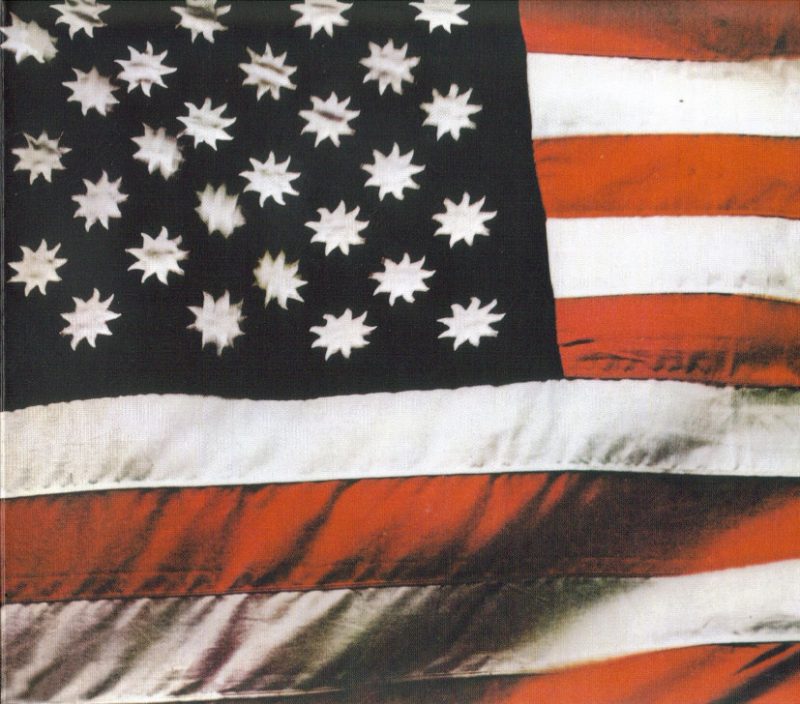
Even the cover leaves things out. The front is a photograph of a cloth flag, with no title and no band name. Where the stars should be, white nine-point suns sit in a black canton. Sly explained the choices to Dakss in his own terms. Black was the absence of colour, white was every colour combined, and red was the blood everyone shares. He chose suns because stars suggest searching, and the sun is always there. Read as a statement, it's an American flag with the blue taken out and nothing written on it. When Epic reissued the album in 1986, it put a live photograph of the band on the front instead. That gets the record exactly backwards.
The drum machine was a Maestro Rhythm King, which Billboard and the gear site Reverb both identify as the MRK-2. It had 18 preset rhythms and couldn't be programmed. Its only knobs were for volume and tone. Sly wasn't the first to put one on a pop record: Robin Gibb's 'Saved by the Bell' used one in 1969. Reverb's Harold Heath argues that Sly was the first to put one at the centre of a rhythm section. What made that work was his refusal to use it as designed. He told Dakss he'd record a bar while holding several pattern buttons down at once, then rewind and hold down a different set. Errico says that starting the pattern on an off-beat turned the beat inside out. In Sly's hands the box stopped being a stand-in drummer and became an instrument.
'Family Affair' is where it all pays off. Rose Stone sings the chorus, Billy Preston plays electric piano and Bobby Womack adds guitar. Sly sings the verses in what Billboard's Andrew Unterberger calls a heavily filtered voice, half-crooned and half-spoken, with its register dropped. Unterberger also notes that nobody is 100% sure who played what. David Hepworth writes that the engineering consultant Richard Tilles muted most of Sly's guitar, brought up Preston's Hohner Pianet and edited the rhythm box to sound like a heartbeat. Errico says the band first cut the song in 1970, but the released version runs on the machine. It spent 3 weeks at #1 in December 1971. It's a #1 single whose lead singer sounds as if he's talking to himself.
The long tracks show the method at full stretch. 'Africa Talks to You' runs 8:45, the longest on the album, and its main vocal is over by 2:37. In 1971 Vince Aletti heard the second half drift off as if dazed, mixed with ghostly voices. Christgau's first review described garish stereo separations and a voice that growls, shrieks and murmurs. Both descriptions fit this track well. The closer, 'Thank You for Talkin' to Me, Africa', slows down the band's 1970 #1, 'Thank You (Falettinme Be Mice Elf Agin)'. It idles for 1:46 before anyone sings. Hoskyns credits Larry Graham's bass line on the original with starting the thumb-plucked popping style. Here the same song comes back slowed, as though remembered rather than played.
The case against the record is about the playing, and it's stronger than its admirers tend to allow. In Creem, John Morthland complained of a plodding, lethargic beat that ran for 45 minutes. Steve Vai, marking the album's 50th anniversary in the Guardian, said the opener 'basically falls apart'. On some songs, he added, you can't hear the vocals. Aletti found 'Poet' pretentious, 'Spaced Cowboy' cute and dumb, and 'Time' inconsequential. He was wrong about 'Time', which Howard Devoto calls his favourite Sly song. He was right about the other two. 'Poet' starts its last sung line at 1:12 and coasts for well over a minute and a half more. 'Spaced Cowboy' is a yodelling joke that breaks the spell. When nobody plays in the same room, nobody pushes. A groove that never builds can be hypnotic, but across 47 minutes it can also just be slow.
Its first reception was more divided than its reputation suggests. Aletti's Rolling Stone review admitted that he'd hated it at first, before he came to respect its honesty. Christgau gave it an A+. In the Village Voice's Pazz & Jop poll for 1971, the critics' ballots put it #7, with Who's Next on top. Readers voted in the same poll, and once their ballots were added it fell to #17. Buyers had fewer doubts. The album entered Billboard's chart at #39 on 13 November 1971, and it was #1 by the chart of 18 December. It stayed on the chart for 31 weeks, and it's still the only #1 album the band ever had. In Britain it lasted 2 weeks on the chart, peaking at #31.
Its standing grew from there, and most of the growth is earned. Greil Marcus, in Mystery Train in 1975, called it 'Muzak with its finger on the trigger'. It entered the GRAMMY Hall of Fame in 1999, and Rolling Stone placed it #82 among its 500 greatest albums in 2020. The influence that's documented is specific. Lewis told Hoskyns that D'Angelo played it constantly while making Voodoo, which came out in 2000. Lewis also argues that its sound helped push Miles Davis and Herbie Hancock towards jazz-funk. Hoskyns says Miles dropped in on the sessions. Even Errico, who first felt Sly should have stuck with the band, came to hear it as really creative. What lasts is the method more than the mood: a groove built by one person at a desk, around a machine.
So what's it worth now? A great deal. It's a #1 album built largely by one man at a mixing desk, around a machine he wouldn't let behave. 'Family Affair', 'Africa Talks to You' and the slowed 'Thank You' are reason enough to own it, and they still sound new. But the method had a price, and the record pays it in plain sight. Some songs are thin, and some of the playing is slack in a way no amount of mystique can turn into a choice. It's easier to admire whole than to love whole. Play it for its nerve and its best grooves. Don't let anyone tell you 'Spaced Cowboy' is part of the genius.
Pressing guide — the one to own
The original to own is the 1971 US Epic KE 30986 in its gatefold, with the printed 'Epic Undercover' inner sleeve and the lyric insert. The inner sleeve is numbered 71/1004. Columbia pressed it at its own plants, and the runouts say which: 'P' for Pitman, 'T' for Terre Haute, 'S1' for Santa Maria. The label matrices read AL-30986 and BL-30986. Sealed copies may carry a 'Good News' newspaper-style sticker listing the tracks.