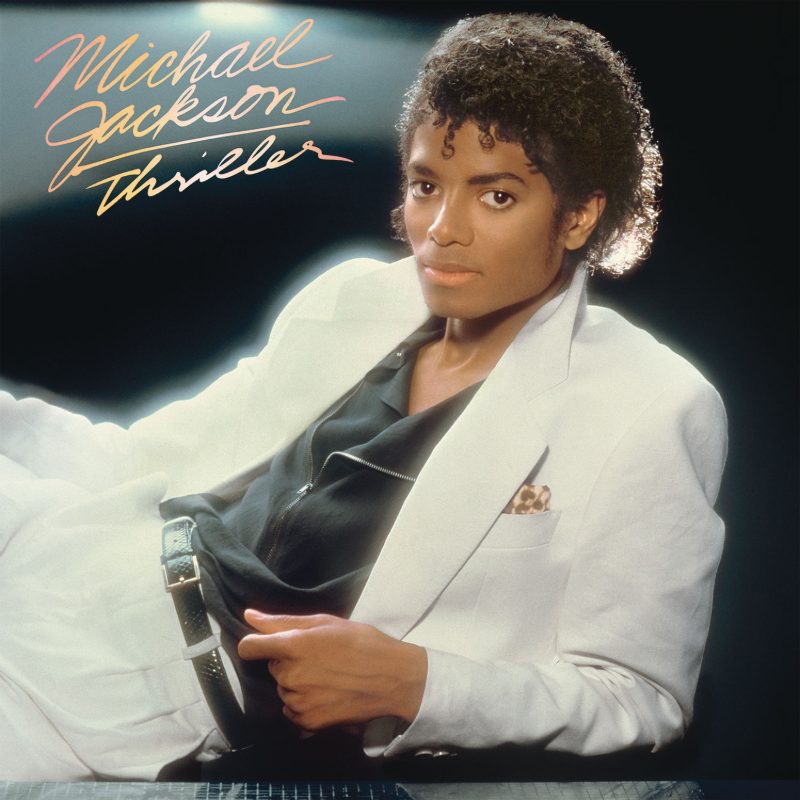
Michael Jackson and Quincy Jones's 1982 album, built so every song could be a single. Seven were, and all reached the US top 10. Two of those hits are its weak links.
- Released
- 29 November 1982 (US, Epic QE 38112), the date Epic set; some sources give 30 November. UK: Epic EPC 85930, 30 November or 1 December 1982
- Label
- Epic (CBS)
- Producer(s)
- Quincy Jones; co-produced by Michael Jackson on 'Wanna Be Startin' Somethin'', 'Beat It' and 'Billie Jean'
- Runtime
- 42:15 across 9 tracks, as printed on the 1982 sleeve
- Chart peak (US)
- #1 (Billboard Top LPs & Tape), first on the chart dated 26 February 1983; 37 weeks at #1, 17 of them in a row
- Chart peak (UK)
- #1 (Official Albums Chart), 8 weeks at #1; 289 weeks on the chart to 8 October 2026
- Certifications
- RIAA 34× Platinum (20 August 2021); BPI 15× Platinum (26 November 2021); Music Canada 3× Diamond (11 May 2022)
- Awards & honours
- Grammy Album of the Year and Record of the Year ('Beat It'), 28 February 1984. Jackson won 8 Grammys that night, 7 of them for Thriller work. National Recording Registry (2008). #12 on Rolling Stone's 500 Greatest Albums (2020)
Thriller is best heard as what Jackson said he wanted: nine bids for a hit. Its best songs are as good as pop gets. Played in order, the McCartney duet and the title track's camp show the seams.
On the Billboard charts dated 26 February 1983, Thriller went to #1 on three album lists in the same week: pop, black and dance/disco. It was the first #1 album for Michael Jackson, and the first for Quincy Jones as a producer. No Black artist had topped the pop album chart in more than three years, since Donna Summer. That week is the clearest picture of what the record was built to do. It wasn't aimed at one audience. It was aimed at all of them at once, through every door radio had.
Jackson said as much later. In a 2007 interview with Ebony, he said he'd wanted an album on which every song could be a single, not one hit and a set of B-sides. He came close. Seven of the nine songs were released as US singles, and all seven reached the top 10, a record at the time. That ambition explains what's great about Thriller and what's wrong with it. Its best songs are as good as pop singles get. Played from start to finish, though, it's a run of separately built hits with two weak links, rather than an album with a shape.
There was a grievance behind the plan. Off the Wall, his first album with Jones, came out in August 1979. By early 1983 it had sold about 7 million copies, according to Rolling Stone, and it had given him four US top-10 singles. It won a single Grammy, for Best Male R&B Vocal Performance. Taraborrelli's biography records Jackson's private anger at being passed over for Album of the Year. For the follow-up, Jones and Jackson worked through about 30 songs and kept nine. Jackson was 23 when the sessions began. The budget is usually put at $750,000. The first session, on 14 April 1982, produced 'The Girl Is Mine' with Paul McCartney. Most of the rest was made between August and early November, at Westlake Audio in Los Angeles.
The Telegraph reported in 2007 that the first finished versions disappointed both men. They went back and remixed every song, at about a week a song. The credits show how separately the songs were made. Jeff Porcaro plays drums on four tracks and Ndugu Chancler on three. 'Wanna Be Startin' Somethin'' and the title track credit no drummer at all. Rod Temperton wrote three songs and Jackson four. The other two came from Steve Porcaro and John Bettis, and from James Ingram and Jones. Some players came in for one job: Tom Bahler is credited only for the Synclavier on 'Beat It'. Others turn up everywhere. Michael Boddicker is credited on synthesisers on six of the nine tracks. Different writers and players from track to track: that's how you build nine possible singles. It's also why the album, heard whole, feels assembled.
The best of those songs is the one that leans most on Jackson's own arrangement. On 'Billie Jean' he's credited as co-producer and with the vocal, rhythm and synthesiser arrangement. The track opens with Ndugu Chancler's drums, then Louis Johnson's bass, and Jackson doesn't sing until 0:29. Jones told Blender he wanted the intro cut down. Jackson refused, saying it made him want to dance. He was right. That long, spare start sets the terms for everything after it: a groove that barely moves while the voice grows more anxious above it. Who played the Yamaha CS-80 chords is disputed. Michael Boddicker said in a 2009 Keyboard interview, as MusicRadar reports it, that Jackson played them himself. Bill Wolfer, credited on the track for synthesiser and programming, told MusicRadar in 2022 that he played them, on the demo and the album. Swedien built a platform for Chancler's kit, and Jackson sang some overdubs through a cardboard tube. Jerry Hey is credited with the string arrangement, and Jeremy Lubbock conducted it.
His other big songs push harder. 'Wanna Be Startin' Somethin'' opens the album and, at 6:02, is its longest track. Jackson, Nelson Hayes and Steven Ray are credited on a 'bathroom stomp board'. From about 4:50 the song becomes a chant borrowed from Manu Dibango's 'Soul Makossa', from 1972. Christopher Connelly, reviewing the album for Rolling Stone in January 1983, called it the 'most combative track'. He heard a fuller, more adult voice on the record, and this is where it's clearest. The borrowing had a cost. Dibango sued over it and settled in 1986, according to RFI. Rihanna's 'Don't Stop the Music' sampled the chant in 2007 with Jackson's permission. Dibango went to court in Paris again, and on 17 February 2009 a judge ruled his claim inadmissible.
'Beat It' was the planned crossover. Jones encouraged a rock song in the vein of 'My Sharona', and Jackson wrote one. Eddie Van Halen told CNN in 2012 how his part happened. He went to Jones's studio, had the engineer re-edit the middle section and improvised two solos over it. CNN reported that he took no fee and did it as a favour to Jones. The solo arrives at 2:43, and Jackson doesn't sing again until 3:17. Steve Lukather plays guitar and bass, Paul Jackson Jr. adds a second guitar, and the Synclavier at the start is Tom Bahler's. It's the album's smartest piece of design: a rock record built by a studio team, with one famous guest for 20 seconds.
Then comes 'Human Nature', the record's quietest surprise. Steve Porcaro has said the chorus came from a conversation with his young daughter, after a boy pushed her at school. His demo reached Jones by accident, on the B-side of a cassette from David Paich. At Jones's request John Bettis rewrote the verses, and the finished track stays close to Porcaro's demo. It's the only song Greg Phillinganes doesn't play on. It's also the gentlest thing here, and the one place Jackson seems to be listening to the band rather than leading it. Miles Davis released his own version in 1985. The closer, Temperton's 'The Lady in My Life', is the other place the voice gets room. From about 4:09 it's ad-libs to the end.
The weak points are two of the hits. 'The Girl Is Mine' was the first thing recorded and the first single, released on 18 October 1982. It reached #2 in the US. It's also the album's one real misjudgement: a polite duet that sounds written for the guest list. Connelly called it a 'wimpoid MOR ballad'. Robert Christgau, in the Village Voice that December, called the pairing with McCartney Jackson's worst idea since 'Ben'. It sits third on side one, after the opener and 'Baby Be Mine' have got the album moving, and it stops the momentum dead.
The title track is the harder case. Temperton's song is good fun, and the production is a small horror film. Thunder, footsteps, wind and creaking doors fill the intro, and Jackson doesn't sing until 0:59. The effects are credited to Bruce Cannon and Bruce Swedien, and Jackson did the wolf howls himself. Temperton wrote Vincent Price's closing speech in a taxi on the way to the session. Price, then 71, did it in two takes, and it starts at about 4:24. Connelly heard the song as a slide into 'silly camp', and on record he has a point. It's a novelty that a 14-minute film turned into an event. Next to 'Billie Jean', it sounds like a costume.
The film is where Thriller's second life began. CBS paid $250,000 for the 'Billie Jean' video, and Jackson paid $150,000 of his own money for 'Beat It'. 'Billie Jean' was on MTV from 10 March 1983. Walter Yetnikoff of CBS Records later said he'd threatened to pull his artists off the channel to get it played. Vanity Fair's 2010 history tells it differently: the network, it says, 'knew a hit when it saw one'. John Landis's 'Thriller' was estimated at about $900,000 before shooting, according to Vanity Fair. Landis told Today in 2008 that it ended up costing $500,000. Selling a making-of documentary to MTV and Showtime helped pay for it. MTV first showed the film on 2 December 1983, and Vestron sold the package on video for under $30. Vanity Fair reported that its reception more than doubled the album's sales.
From there the numbers stopped making sense. Thriller spent 37 weeks at #1 in the US, including a straight run of 17 that Footloose ended in April 1984. Van Halen told CNN that, unfortunately, Thriller kept his band's 1984 from #1. On 28 February 1984 Jackson won 8 Grammys in one night, 7 of them for this album's work. The broadcast drew 51.67 million viewers, still the Grammys' biggest audience. Vanity Fair reported that his royalty was the industry's highest, more than $2 a record, negotiated by his lawyer John Branca. Its influence is harder to pin down than its sales. Richard Harrington argued in the Washington Post in 1988 that it paved the way for Prince's mainstream success. Nelson George went further in 2004, arguing that Jackson taught R. Kelly, Usher and Justin Timberlake with Thriller as the textbook. That's a reading, not a document, but it's a fair one.
The sales story has outgrown the evidence. The label has claimed more than 100 million copies. In the New Yorker in 2013 the critic Bill Wyman put US sales at about 32 million, from RIAA data and SoundScan. He put overseas sales at about 35 million, from a fan researcher's tallies. That adds up to about 67 million, and he thought 100 million very unlikely. The RIAA counts Thriller at 34 times Platinum. The Eagles' Their Greatest Hits 1971–1975 is ahead of it, at 40. None of that touches the music, which has held up. Rolling Stone's list of the 500 greatest albums moved it from #20 in 2003 to #12 in 2020. In May 2026 the biopic Michael sent the album back to #4 in Britain. Christgau gave it an A minus in December 1982, calling it hits-plus-filler at such a high level that it was almost classic. He later raised the grade to an A.
So Thriller earns most of its reputation, and should give a little of it back. Its four best songs, led by 'Billie Jean' and 'Beat It', are as strong as anything in 1980s pop. The production is close to faultless, and Jackson sings as if every track were the single, because by design it might have been. What it isn't is a whole. 'The Girl Is Mine' stalls side one, and the title track works better on screen than on the turntable. Programme your own running order and you have a near-perfect pop record. Play it as sequenced and you have a great one with a soft middle.
Pressing guide — the one to own
The original to own is the 1982 US Epic QE 38112 gatefold, mastered by Bernie Grundman. The earliest jackets lack the 'co-produced by Michael Jackson' line on the back cover, which was added on later printings. That's a sleeve state, not a label difference. US runouts read PAL 38112 and PBL 38112, with 'P' for Pitman, New Jersey, or 'G1' for Carrollton, Georgia. Early copies came in shrink-wrap with a sticker advertising 'The Girl Is Mine' with Paul McCartney. The inner sleeve carries the lyrics, the credits and Jackson's drawings, and the cub photo is inside the gatefold.