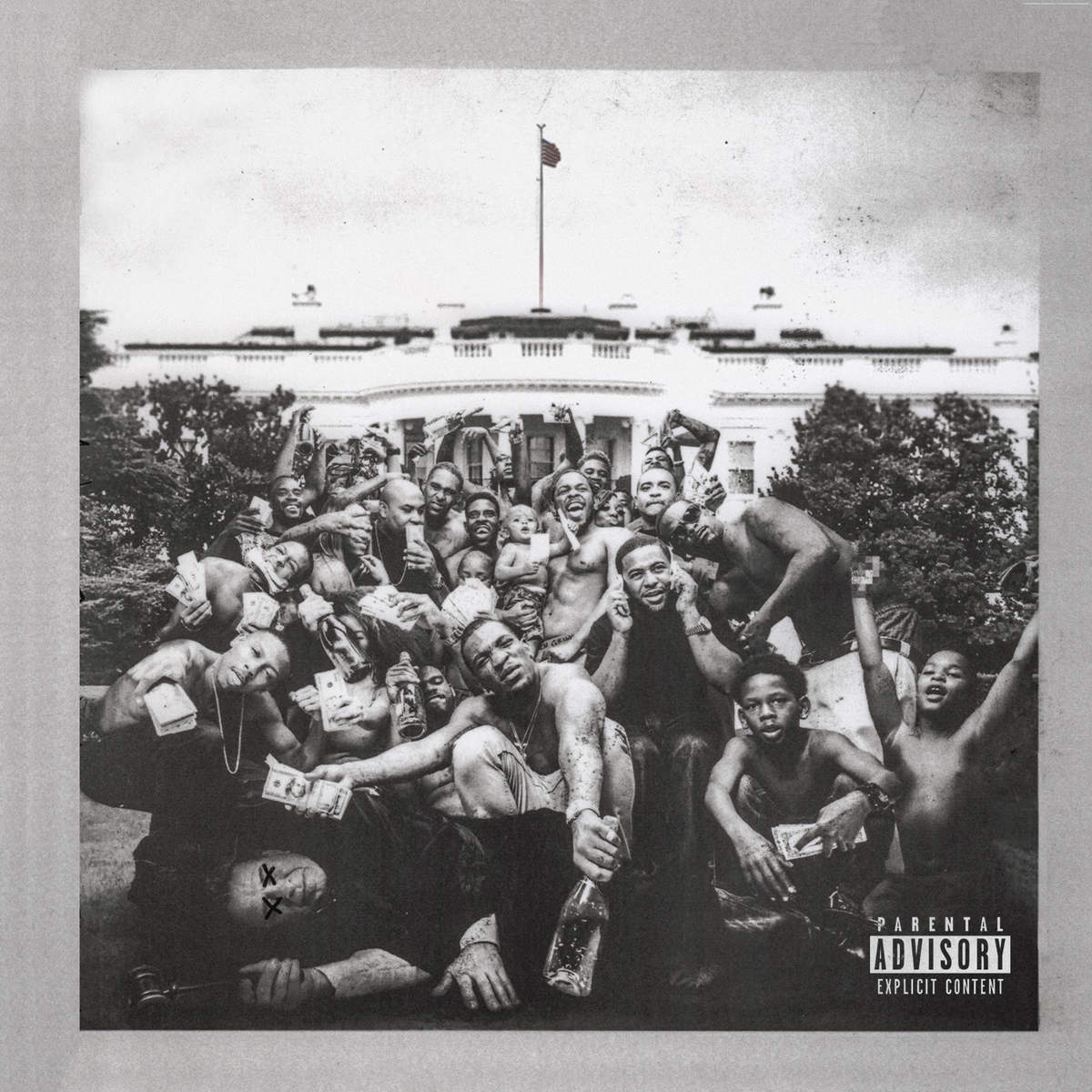
Kendrick Lamar's 2015 album, cut down from dozens of tracks and mixed to tape on Dr. Dre's old desk. It's filed as rap's jazz record; it's really West Coast funk played by a jazz band.
- Released
- 15 March 2015 (digital, US, eight days ahead of schedule); 16 March 2015 (UK)
- Label
- Top Dawg Entertainment · Aftermath · Interscope
- Producer(s)
- Sounwave, Terrace Martin, Taz Arnold, Rahki, LoveDragon, Larrance Dopson, Flying Lotus, Pharrell Williams, Boi-1da, Knxwledge, Tae Beast, Thundercat and others; executive producers Dr. Dre and Anthony Tiffith
- Runtime
- 78:51 (16 tracks)
- Chart peak (US)
- #1 (Billboard 200), 2 weeks at the top, April 2015
- Chart peak (UK)
- #1 (Official Albums Chart), 1 week, March 2015
- Certifications
- RIAA Platinum (1 February 2016); BPI Platinum (17 February 2023); Music Canada 2× Platinum (13 April 2021)
- Awards & honours
- Grammy for Best Rap Album, 15 February 2016. The album and its songs won 4 of 7 nominations that night, and lost Album of the Year to Taylor Swift's 1989. #19 on Rolling Stone's 500 Greatest Albums (2020)
Lamar's band gave his argument with himself a body, and the result is one of the best rap albums ever made. It runs long, and its closing Tupac conversation says what the music had already shown.
Derek Ali mixed To Pimp a Butterfly on a desk with a past. The SSL console at No Excuses, an Interscope-owned studio in Santa Monica, had belonged to Dr. Dre. It was the last of its series, built in 1991, and Dre had mixed The Chronic on it. Ali printed every mix to half-inch tape, and the album was mastered from the reels. Lamar had asked for a vintage, 1970s sound. Ali also spent three 18-hour days on the drums of the opening track alone. For a rap album, that's a lot of care to lavish on drums.
The New York Times described the production as jazz- and funk-inflected, and the album is usually filed as the record that took rap into jazz. That's half right. The jazz players are real: Terrace Martin on alto, Robert Glasper on keys, Thundercat on bass. But Kamasi Washington plays tenor on only one song, 'u', and arranged strings. Sounwave, TDE's in-house producer, is credited with production or additional production on 9 of the 16 tracks. A Times profile said the music was influenced in equal parts by Miles Davis and Dr. Dre. That's the better description. To Pimp a Butterfly is a West Coast funk record, played by a jazz band, about a man arguing with himself. It's long and sometimes preachy. It's also one of the best rap albums anyone has made.
It took a long time to find. Work began at the end of 2012, straight after the tour for good kid, m.A.A.d city. Ali told Sound On Sound that they recorded 60 to 80 tracks. The final direction, he said, began to emerge only in the last year and a half or so. The turn came in 2014, on a trip to South Africa that took Lamar to Mandela's cell on Robben Island. According to Ali, it led Lamar to scrap two or three albums' worth of material. Lamar began listening to Sly Stone, Donald Byrd and Miles Davis, GRAMMY.com reported. Sounwave dates the real start of the record to that trip. Lamar told GRAMMY.com he'd wanted to make this kind of album for his debut, but hadn't been confident enough.
Ferguson is the obvious context. Michael Brown was killed there on 9 August 2014. Sounwave told the New York Times that the world's problems had rubbed off on the music, and the paper took him to mean the unrest in Ferguson. Lamar's own account is more careful. He told GRAMMY.com that he had the beat for 'The Blacker the Berry' first. The Trayvon Martin and Michael Brown cases then made him feel he had to address them. He also told the Times that calling it a political record would sell it short. He was right. The person this record argues with hardest is Lamar himself. He told GRAMMY.com that 'u' grew out of a dilemma: cheered on stage, he felt he wasn't saving lives back home.
The way it was made explains the way it sounds. Ali names a core team who were there throughout: Lamar, Ali himself, Terrace Martin, Rahki, Tae Beast and Sounwave. Most songs started from drums and bass. Lamar would mumble a rough melody, the band would build on it, and he'd write and recut the real vocal last. Sometimes he wrote to whatever Thundercat was playing in the studio lounge. The usual hip-hop method of producers sending beats didn't work here, Ali said. Only a couple of songs came from beats sent in, and 'Momma' was one: Lamar found a Knxwledge beat in his email. That's why the album sounds like a group rather than a rapper with guests. Even its guests, George Clinton and Ronald Isley among them, sound like members.
Listen to how it opens. 'Wesley's Theory' began as a Flying Lotus beat. Lamar told GRAMMY.com he was on tour with Kanye West and had Flying Lotus with him to make beats in the bus studio. He heard a few seconds of one beat that Flying Lotus had skipped, and was told he couldn't rap on it. It felt like a dare. Thundercat says the track started with him and Flying Lotus sitting on a couch, analysing George Clinton, and Lamar flew south to record Clinton himself. The Boris Gardiner sample that now opens it wasn't there at first. In the Guardian, Alexis Petridis heard P-Funk all over the album. Here it's literal. Then 'King Kunta' brings it home to West Coast rap. Sounwave's first version was jazzy, with flutes. Lamar asked for something nastier and pointed him to a DJ Quik record with Mausberg, 'Get Nekkid', which the finished track interpolates. It's the funkiest thing here, and it owes more to Los Angeles than to Miles Davis.
'For Free?' is the clearest look at the band. Martin arranged it for a live jazz group: Glasper on piano, Brandon Owens on bass, Robert 'Sput' Searight on drums. Lamar's voice went through two stacked microphones for a warm sound close to distortion. Greg Tate heard bebop changes under it in Rolling Stone. It lasts 2:10, and with no loop beneath him Lamar has to keep up with the players. 'These Walls' shows the other method. It was a Pro Tools session of about 90 tracks, with parts programmed in Ableton. In its third verse Ali ran Thundercat's bass through a doubler to make it sound underwater. It's a small touch, and it rewards headphones.
Then comes 'u', the hardest 4:28 on the record. Ali says Lamar wrote it in the booth and recorded it with the lights off. The Guardian heard it as drunk and tearful, and Pitchfork heard shouting give way to sobs. Behind him is a saxophone trio: Terrace Martin, Kamasi Washington and Adam Turchin. It's hard to sit through, and the album would be smaller without it. 'Alright' follows straight after, and the order is the point. According to HotNewHipHop, Pharrell Williams made the beat in 2014, first for Fabolous. Sounwave says he and Martin added the drums near the end of the sessions. The title line arrives 17 seconds in.
Sounwave told GRAMMY.com he never expected 'Alright' to become a protest song. By late July 2015 it was being chanted at a Black Lives Matter conference in Cleveland. In October it was chanted again at the Million Man March anniversary in Washington. As a single, it peaked at #81. Its hope works because 'u' comes first. Played alone, it's a chant. In sequence, it's an answer. Ali built the segues in Pro Tools with help from the mastering engineer, Mike Bozzi, and the album plays as one piece. Few records this long hold together this well.
The late songs widen the argument. 'How Much a Dollar Cost' tells of a beggar who turns out to be God, and Barack Obama named it his favourite song of 2015. 'Complexion' nearly had Prince on it. He was lined up to sing the hook, but he and Lamar talked more than they recorded, and time ran out. 'The Blacker the Berry' ends each verse on the same self-accusing turn. Sounwave said its last line was meant to make listeners uncomfortable. Then 'i' takes apart its own hit. The single had won two Grammys in February 2015. On the album it's a new, live-sounding recording that halts for a fight in the crowd and turns into a speech. Making the radio song argue with itself is the album's method in miniature.
Not all of it works. Jon Caramanica wrote in the New York Times that Lamar was still prone to clutter. He called the album's 79 minutes a test, or a reflection of Lamar's faith in his followers, and he found its jabs at other rappers unnecessary. He had a point about the length. The bigger problem is the ending. 'Mortal Man' closes with Lamar putting questions to Tupac Shakur, whose answers come from an interview Mats Nileskär recorded for Swedish radio in November 1994. Lamar's questions were recorded later and edited in. Nileskär has said the edit alters the original slightly. Petridis called the section earnest and hard to imagine replaying. He's right. The idea is strong, and it was there from the start: the album's first title, To Pimp a Caterpillar, abbreviated to Tupac's name. But the staged conversation runs for about 7 minutes, and it's the one stretch of the record that sounds rehearsed.
Commercially, it did what good kid hadn't. It sold 324,000 copies in its first week and went to #1 in America and Britain, his first #1 in both. In Britain it beat Sam Smith to the top by 572 copies. In America, only Drake had had a bigger week in 2015 so far. It lost Album of the Year at the 2016 Grammys to Taylor Swift's 1989, though it won Best Rap Album. Its standing has risen since: Rolling Stone placed it at #19 on its 500 Greatest Albums in 2020. Its influence is harder to pin down than its reputation. It's tempting to credit it with a Los Angeles jazz revival, but the dates don't allow it. Kamasi Washington's The Epic came out of sessions in December 2011, and Glasper's Black Radio was released in 2012. One outside voice on record is a surprise. Tony Visconti said he and David Bowie were listening to a lot of Lamar before they began recording Blackstar. He said they loved that Lamar hadn't made a straight hip-hop record. He didn't name this album, but the remark fits it.
So the reputation is right about the quality and loose about the reasons. To Pimp a Butterfly isn't great because it's a jazz record, or because it became a protest record. It's great because a band spent years building music that could hold one man's argument with himself. Then Ali finished it with a craftsman's patience. It runs long, and its final 7 minutes talk where the rest of it plays. Its influence is real but narrower than the legend. None of that moves it far. It's one of the best rap albums ever made.
Pressing guide — the one to own
The original to own is the 2015 US double LP, TDE/Aftermath/Interscope B0023464-01, in a gatefold. The vinyl came six to seven months after the digital release: 25 September 2015 in Europe, 23 October 2015 in the US. There's no single first state. Some US-sleeve copies carry GZ Media matrices beginning 4731100, and others carry US-cut runouts beginning B0023464-01. The inner gatefold swaps the credits for 'Momma' and 'Hood Politics' on several 2015 pressings. It was mastered at Bernie Grundman, and the cover photograph is by Denis Rouvre.