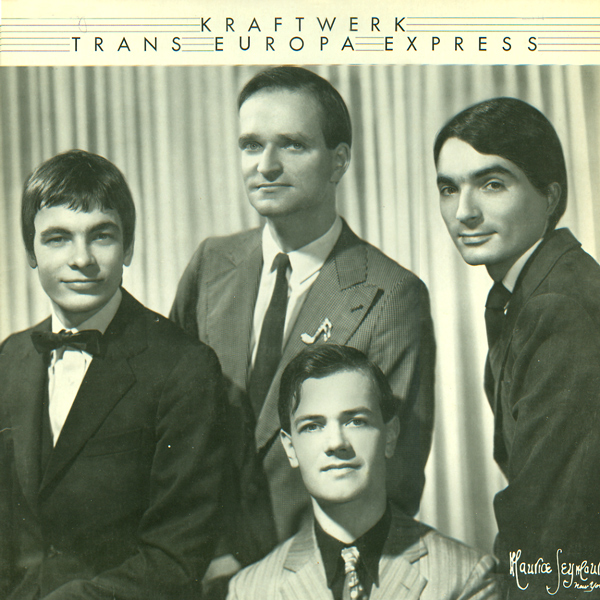
Kraftwerk's sixth album, released in March 1977. Synthesizerstudio Bonn says the sequencer took the lead for the first time here, and Bartos says the band bent a train rhythm so people could dance.
- Released
- March 1977 (West Germany, Kling Klang/EMI Electrola); spring 1977 (US and UK, Capitol), with the US edition reviewed on 25 April 1977
- Label
- Kling Klang/EMI Electrola 1C 064-82 306 (West Germany); Capitol E-ST 11603 (UK); Capitol SW-11603 (US)
- Producer(s)
- Ralf Hütter and Florian Schneider
- Runtime
- 42:52 on the 2009 remaster (8 tracks); 42:17 on the 1977 English LP (7 tracks)
- Chart peak (US)
- #119 (Billboard Top LPs & Tape, autumn 1977)
- Chart peak (UK)
- #49 (Official Albums Chart, 20 February 1982); it didn't chart in Britain in 1977
- Certifications
- BPI Silver (22 July 2013)
- Awards & honours
- #238, Rolling Stone's 500 Greatest Albums (2020); #6, Pitchfork's Top 100 Albums of the 1970s (2004); #30, Village Voice Pazz & Jop poll (1977)
The usual story says 'Planet Rock' sampled it and hip-hop made it matter. Nothing was sampled, and New York's discos had found it 5 years earlier. At its best it's exact and physical; elsewhere it leans on Autobahn's old method.
Karl Bartos remembers standing on railway bridges. He'd joined Kraftwerk in 1975, aged 23. In 2009 he told The Quietus how the title track of Trans-Europe Express got its beat. The band went to listen to real trains. Bartos described the sound of the wheels crossing a gap in the rails, “but of course you wouldn't be able to dance to that!” he said. “So we changed it slightly.” That small change, a train altered for dancers, is the whole record in miniature. It's a machine record, and it was meant to move people.
That part of the story tends to get lost. In the familiar version, Afrika Bambaataa's 'Planet Rock' sampled the album in 1982, and hip-hop made it matter. The Guardian's report of Florian Schneider's death, on 6 May 2020, said the title track “was sampled in 1982”. Nothing was sampled, and New York's discos had found the record 5 years earlier. This is music built on a machine's pulse and aimed at the body, and the body answered first. At its best, in 'Europe Endless' and the run from the title track into 'Metal on Metal', it's exact and physical at once. Elsewhere it repeats the band's last big idea, and its closing pieces are sketches.
The train was a way out of a trap. After Autobahn and Radio-Activity, Bartos said, the band had had enough of creating from a German heritage. In Britain and America, people kept putting them in the frame of Nazi Germany. He remembered an NME centrefold that was “really no fun”. The Trans Europ Express, a European rail service, offered another identity. It let Kraftwerk present themselves as European musicians. In Pascal Bussy's biography of the band, the idea of a song about the train comes from Paul Alessandrini. Work began in mid-1976, on an album then called Europe Endless.
What changed in the music came from Bonn. The sleeve credits Matten & Wiechers of Bonn for the Synthanorma sequencer, and the Synthesizerstudio Bonn website says Kraftwerk's was a special version. Its Intervallomat let them dial in exact semitone and octave steps, so a pattern could be set and recalled precisely. A tempo display running from 000 to 999 let them lock a sequence to an Eventide digital delay. The same page says Autobahn and Radio-Activity were still played by hand. It says the sequencer took a leading musical role for the first time on this album.
It's also where the record's weakness starts. A sequenced pattern doesn't lean into a beat or drag behind it, as a drummer's playing can. That suits 'Showroom Dummies', a song about looking stiff. It suits the long pieces less. Bartos and Flür are credited with electronic drums, and Bartos told The Quietus he got no writing credit on this album. Pascal Bussy calls the vocal on 'The Hall of Mirrors' deadpan. Across the long tracks, we hear a band content to let the machine set the pace.
The plainness took work. The album was recorded at Kling Klang, the band's own studio in Düsseldorf, with Peter Bollig engineering. The 1977 sleeves name two more studios: Rüssl Studio in Hamburg, with Thomas Kukuck, and the Record Plant in Hollywood, with Bill Halverson. The 2009 reissue credits both with the mixing. In Bussy's account, Hütter and Schneider went to Los Angeles to mix. They then dropped parts of those mixes, which had the vocals further forward, and finished the work in Düsseldorf and Hamburg. Two complete versions came out of it, one in German and one in English. Pulling the voices back was the right call. It's the record's character in a single decision.
'Europe Endless' opens the album, and it's the best thing on it. It runs 9:41 on the 2009 remaster. The first sung line comes at about 1:59, and between about 3:57 and 5:46 there's no singing for almost 2 minutes. That patience is the point. The song lets its music carry the weight, and that's the album's method at its best. Q's review of the 2009 reissue picked it, not the title track, as the album's finest piece. Pitchfork praised its “spacious motorik” in 2004. Both were right. 'The Hall of Mirrors' is the first sign of strain. Its first sung line comes at 1:22, about stars studying themselves in a mirror. Over nearly 8 minutes the singing comes and goes, and to us the song stays in one place.
'Showroom Dummies' answers an insult. According to Bussy, the idea came from a British concert review that compared Bartos and Flür to showroom dummies. The band made a song of it, bouncier and more melodic than the rest, as AllMusic hears it. Capitol released it as a single in August 1977. In France it became 'Les Mannequins', with French words by Maxime Schmitt and Hütter. Its long instrumental break, from 2:45 to about 4:07, is the album's patience again. Here, with a tune to come back to, it pays off.
Side two is where Bartos's train runs. The title track goes at least 39 seconds before anyone sings. Its words name Düsseldorf, Station to Station, Iggy Pop and David Bowie, whom Hütter and Schneider had met before recording. It runs straight into 'Metal on Metal'. Not everything here was programmed. Asked how they made the rhythms of 'Metal on Metal', Bartos answered: “With a hammer! On pipes.” Pitchfork called the result “stark, industrial funk”, which is exactly right. The best moment on side two is a person hitting something. Bartos later saw people outside a New York record shop breakdancing to loops of it. He says that was when the band realised it had access to that culture.
Then the record begins to lean on what the band had already done. When The Quietus pointed out the echo of Autobahn's transport theme, Bartos agreed. “In a way it was a repetition of Autobahn,” he said. That was about the concept. AllMusic's Stewart Mason hears the same method in the music: side two lays a chant over a running rhythm, as 'Autobahn' did. Robert Christgau saw the link in April 1977. He wrote in the Village Voice that the album shared with Autobahn a “simple-minded air of mock-serious fascination with melody and repetition”. He still gave it a B+, and his grades page now has it at A−. The weakness is in what follows the title track and 'Metal on Metal'. 'Abzug' is the back two-thirds of the English LP's 'Metal on Metal', and it runs nearly 5 minutes. 'Franz Schubert' is a sequenced figure that we find pleasant and slight. 'Endless Endless' is under a minute of the opening theme, a bow rather than an ending.
Its first real audience wasn't the rock press at all. On 22 October 1977, Billboard reported that the album had broken through with disco and R&B listeners. A Capitol advertisement in the same issue named Studio 54, the Tramps chain and Chapter 2 in Washington among the places playing it. Capitol pressed a 12-inch of the title track for the clubs, backed with 'Metal on Metal'. A month before the report, Kraftwerk had won honours at the Pop Music Disco Awards in New York. The album's US chart run came that autumn, after the clubs, and peaked at #119. Britain was slower still. The album didn't chart there until 6 February 1982, and got no higher than #49.
New York kept listening. The producer Arthur Baker heard 'Trans-Europe Express' constantly on lunch breaks by the projects in Long Island City. He thought its beat was too slow. When he and Bambaataa made 'Planet Rock' at Intergalactic Studio, John Robie replayed its melody by hand. A hired programmer copied the beat of 'Numbers', from Computer World, on a TR-808, after first copying a beat from 'Super Sperm'. “We borrowed the melody,” Baker said in a Red Bull Music Academy lecture. Kraftwerk were angry. Tommy Boy paid them a dollar a record, and raised the 12-inch's list price from $4.98 to $5.98. What crossed into hip-hop was a tune, played by a person. The sound itself went to court. In 1997 a 2-second rhythm from 'Metall auf Metall' was sampled and looped for the song 'Nur mir'. Hütter and Schneider sued and won twice. On 31 May 2016 the Federal Constitutional Court sided with the makers of 'Nur mir' on grounds of artistic freedom and sent the case back. On 29 July 2019 the EU's Court of Justice ruled that a producer can stop another artist using even a very short sample, unless it's changed beyond recognition.
Its standing has grown since. Slant put it at #1 on its 2002 list of the 25 greatest electronic albums of the 20th century. Pitchfork ranked it #6 of the 1970s in 2004. In 2014 Randall Roberts of the Los Angeles Times called it “the most important pop album of the last 40 years”. Rolling Stone had it at #238 of its 500 greatest albums in 2020. Some of the case made for it rests on stories that don't hold. Juan Atkins did hear Kraftwerk on the Electrifying Mojo's radio show in Detroit, and Mojo played its title track. But Atkins says it was 'The Robots' that stopped him. He says Kraftwerk influenced his sound, but no more than funk did, P-Funk especially, and that he wasn't copying them. The reputation is roughly right. Some of the reasons given for it are wrong.
So this is a great record with a real flaw. 'Europe Endless' and the run from the title track into 'Metal on Metal' still sound precise, and they still move a room. They showed what a dance record could be built from, and the clubs heard it first. 'Showroom Dummies' turns an insult into a proper tune. Around them sit the weakest of the long tracks, 'The Hall of Mirrors', a second lap of Autobahn's method and two slight closing pieces. In those stretches you can hear a band trusting the machine to carry the music and not asking more of it. That keeps it a step below the very best. It doesn't stop it being a record that other records are built from.
Pressing guide — the one to own
The German original, Kling Klang/EMI Electrola 1C 064-82 306, titled Trans Europa Express and sung in German. It's a single sleeve with a printed inner sleeve and a separate poster, not a gatefold. The runouts are machine-stamped 82306A-1 and 82306B-1, with nothing else. Two 1977 states exist. One has a debossed EMI stamp on the back and a poster numbered 1C 064-82 306. The other has no stamp, and its poster is numbered 1C 062-82 306. Nothing documents which came first.