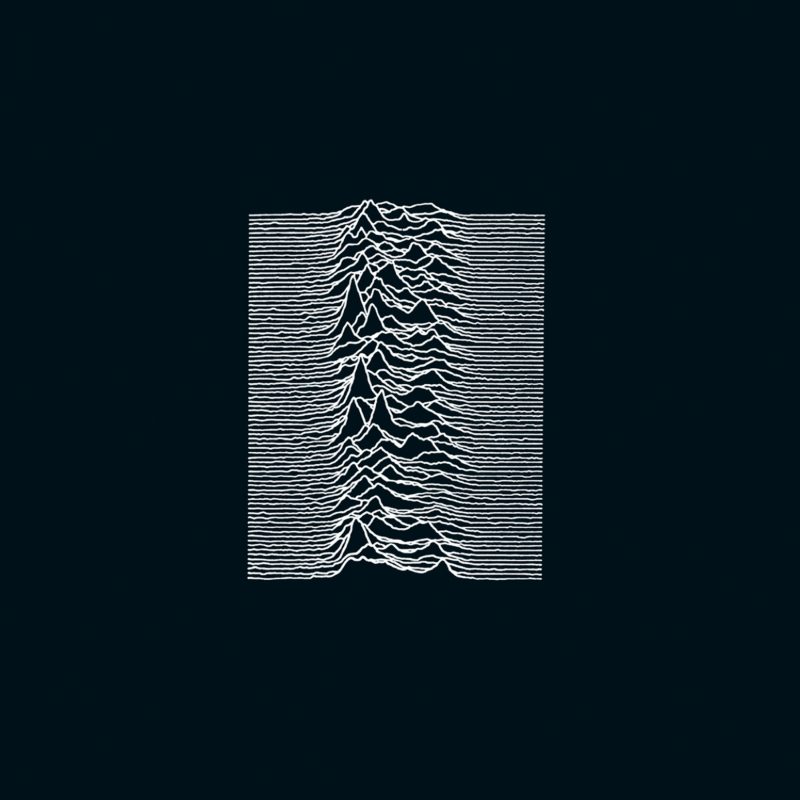
Joy Division's debut, made in three weekends in April 1979, is as much Martin Hannett's record as the band's: space, cold and drums played one at a time.
- Released
- June 1979 (the catalogue notes give 14 or 15 June), Factory Records
- Label
- Factory Records (UK, FACT 10)
- Producer(s)
- Martin Hannett (engineer: Chris Nagle)
- Runtime
- 39:20 (10 tracks)
- Chart peak (US)
- Not listed on the Billboard 200 in the standard discographies. US release: October 1980, on Factory (US)
- Chart peak (UK)
- #5 (Official Albums Chart, 27 June 2019). First charted at #71 on 30 August 1980
- Certifications
- BPI Platinum (23 December 2022); Gold (22 July 2013); Silver (3 July 2009)
- Awards & honours
- Third in NME's 1979 critics' poll. Included in Rolling Stone's 500 Greatest Albums list (2020)
Two of the band disliked it when it came out, and the sound they distrusted, Martin Hannett's space and echo, is why the record lasts. The songs under it are good, and a step below the ones on Closer.
Two of the four men in Joy Division disliked Unknown Pleasures when they first heard it. Peter Hook wrote in 2012 that he and Bernard Sumner found it too weak. Ian Curtis and Stephen Morris loved it. Sumner's complaint was that Martin Hannett had toned the music down. Hook thought it sounded like Pink Floyd. Hook and Sumner had wanted a loud, heavy record, closer to the band's aggressive live sound, and what came back had space in it. Hook said that on the record he could hear Curtis's words and Sumner's guitar parts for the first time, because the band played too loudly at gigs. He came round in the end. He said he could see that Hannett had done a good job and had created the Joy Division sound.
That split is the best way into the record. The sound the band distrusted is the thing the record is known for. Unknown Pleasures is a producer's record in a way that few great debuts are. Hannett supplied the echo and the odd, separated drums. Four players from a loud live act came out the other side sounding like something else. That's why production scores 9.6 here, level with influence. It's also the root of the reservation. The sound is more finished than the songs. Closer, made less than a year later, is the stronger record, and the case for that comes mostly from people who admired both.
Hannett had a theory about punk. Simon Reynolds reports that he thought it sonically conservative, because it refused to use the studio to make space. He was disappointed that the Sex Pistols' album came out with 17 guitar overdubs. That was studio work, but not the kind that makes space. The records he named as influences were Joe Gibbs's dub, Patsy Cline and the Doors' Strange Days. None of those is punk. He'd also tried the idea on the band already. In autumn 1978 he produced their two tracks for the compilation A Factory Sample. He said he'd had his new AMS digital delay for about 2 weeks when he made one of them. So the sound didn't arrive by accident in April 1979. It was a plan, and the band were the material. Hannett told Mojo in 1994 that the band were a gift to a producer, because they "didn't have a clue" and didn't argue. Hook and Sumner's reaction suggests they had more opinions than he noticed.
The money shaped the sessions too. In May 1978 the band recorded for RCA, disliked the Grapevine label head's insistence on adding a synthesiser, and asked to be dropped. They bought themselves out and joined Factory in late 1978, on terms that were barely terms. Hook says there was a sheet of paper saying the masters would revert after six months if either side wanted out. The profit split was 50/50, which Rob Gretton argued could earn as much as a major's deal. Hook has said Factory had little money for studio time, so there were few takes. The sessions ran from 1 to 17 April 1979, over three weekends at Strawberry Studios in Stockport. Gretton expected the album to cost £8,000. Tony Wilson said in 2006 that the up-front cost ended at £18,000.
Start with the drums, because Hannett did. He wanted each drum separated, so Morris played them one at a time, as he told the Electricity Club in 2011. A Marshall Time Modulator went on the toms to stop them sounding like toms. MusicTech counts three AMS delay units in use. NME's 2019 account adds a microphone in a bathroom, with the sound run back through a digital delay. The result is drums that sound made rather than played. 'Disorder' puts them first. It opens on an echoing tom-tom pattern, and Curtis doesn't sing for about 29 seconds. Morris has described himself as aspiring to be a drum machine, and the studio took him at his word. He says he used a Synare on 'She's Lost Control' and 'Insight'. The kit was played.
The bass is the lead voice, and that was partly an accident. Sumner has said Hook played high on the neck because Sumner's amp only worked at full volume and Hook couldn't hear himself playing low. Hook played with a pick. He admits to missing high notes on the A and D strings in 'Disorder', and says he can't now imagine the song without them. NME in 2007 heard Hook's rumbling bass lines, Sumner's eerie guitar shrieks and Morris's machine-like drumming. With the bass carrying the line, the guitar is free to add texture. 'New Dawn Fades' shows the plan at its barest: one progression that grows, an ascending guitar over a descending bass line, and nothing fancier. Curtis doesn't sing until 1:17.
Curtis worked in the dark. Chris Nagle remembered that he'd hear a song once and sing it in a single take with the lights off. Hannett put his 'Insight' vocal down a telephone line to give it distance. Then came the found sounds. Jon Savage's 2007 booklet essay mentions a smashed bottle, someone eating crisps and a studio lift with a Leslie speaker whirring inside it. Sumner played a kit-built Powertran Transcendent 2000 synthesiser. On 'I Remember Nothing', Hook's account has it competing with the sound of Gretton smashing bottles, with Morris and a replica pistol. Curtis sings his last line at about 4:28 of 5:52. From there the album runs on for another 1:24 without a voice.
Now the case against it, which has respectable names behind it. Joshua Klein called Closer more inventive and more beautiful in Pitchfork in 2007. NME made Closer its album of the year for 1980. Morris says Closer holds his best drumming, and describes his work here as a bit of a punky crossover. Hook called Unknown Pleasures easy for the band to make and Closer more complex. Mary Harron wrote in Melody Maker in September 1979 that at least half of this one was turgid and monotonous. Robert Christgau gave it an A-. He called the music clumsy, but said Curtis's gravity made it convincing. He also sorted the three songs he named. 'She's Lost Control' was a "songwriting stroke". 'Candidate' and 'I Remember Nothing' were "gothic atmosphere". Our reading, not his, is that this sort is the reservation in small. Hannett's room is finished, and on much of the record it does more of the work than the writing. It's why songwriting is the lowest of the six scores, at 8.7.
Some of the songs would survive any treatment, and other artists noticed. Grace Jones covered 'She's Lost Control' in 1980, on the B-side of her single 'Private Life'. Moby covered 'New Dawn Fades' for the Heat soundtrack in 1995. The Killers recorded 'Shadowplay' for the film Control in 2007. 'She's Lost Control' is the clearest case. Curtis wrote it about a young woman with epilepsy whom he'd met through his job in Macclesfield. The band were playing it live by June 1978, about six months before his own first severe seizure. Klein noted in 2007 how many songs on the record fade in like something emerging from the shadows. He set 'Disorder' and 'She's Lost Control' against heavy songs such as 'Day of the Lords' and 'Shadowplay', calling them "glorious anomalies" in precision and concision. Our reading is that songs this exact and concise need the room least.
What it changed is easier to document than to argue. Hannett carried the method on. He produced Closer, recorded in March 1980 at Britannia Row in London, and New Order's first album, Movement, in 1981. Mikal Gilmore's Rolling Stone review of the US release, in May 1981, named Section 25, Crispy Ambulance, Mass, Sort Sol and the Names as Joy Division imitators. Hannett produced two of those, Section 25's Always Now in 1981 and the Names' Swimming in 1982. That makes it hard to say how much of the imitation was of the band and how much was of him. Vince Staples has said Unknown Pleasures inspired his 2015 album Summertime '06, whose sleeve is based on the same pulsar plot. Reynolds named Interpol, Bloc Party and Editors as heirs of the band in the New York Times in 2007. He was writing about Joy Division as a whole, not this record alone.
The reputation has drifted from the facts in a few places. NME didn't name it album of the year for 1979. That was Talking Heads' Fear of Music, and Unknown Pleasures came third in NME's critics' poll, behind Metal Box. It didn't reach the UK Albums Chart in 1979 either. Chris Ott's book puts early sales at 5,000 in the first 2 weeks, with about 10,000 more over the next six months. MusicTech says early sales were weak and that interest picked up with the single 'Transmission' in November 1979. According to the chart history in Cherry Red's Indie Hits, it reached #2 on the first UK independent chart in January 1980. It first entered the UK Albums Chart on 30 August 1980, at #71, after Curtis had died and Closer was in the shops. Its best position came much later. It re-entered at #5 on 27 June 2019, higher than Closer's #6 in 1980.
Curtis died on 18 May 1980, on the eve of the band's first American tour, and the record has been heard through that ever since. Some of the gloom was already there in 1979. Smash Hits gave it 8 out of 10 that September and called it a "bleak nightmare soundtrack", eight months before his death. By 1983 NME's Richard Cook heard desire drained out of the songs, with only the aftermath of passion left. The man who sang them was 22. His epilepsy had been diagnosed less than three months before the sessions began, and his daughter Natalie was born on 16 April, in the middle of them. Hearing a farewell in that is hindsight.
Hook and Sumner were wrong about the sound. Hannett's room is why the record lasts, and it earns the top marks for production and influence. The songs earn less. Three or four would survive any room, and the covers of 'She's Lost Control', 'Shadowplay' and 'New Dawn Fades' suggest which. The rest lean on an atmosphere that Hannett supplied and that Curtis's death later deepened. It's a great record with a real flaw: it's better produced than it is written. Closer, with the same producer, shows the band doing both. Play this one for the room. Play Closer for the songs.
Pressing guide — the one to own
The copy to own is the 1979 UK first pressing, Factory FACT 10, in a textured sleeve with Peter Saville's pulsar plot. It was pressed at the WEA plant in West Drayton, in a first run of 10,000. The lacquers were cut by George 'Porky' Peckham, who signed the runouts 'A Porky Prime Cut'. The sides are named Outside (black label) and Inside (white label). The runouts cross the letters A and B, which the catalogue notes put down to a mix-up after the cut, at the plating or pressing stage.