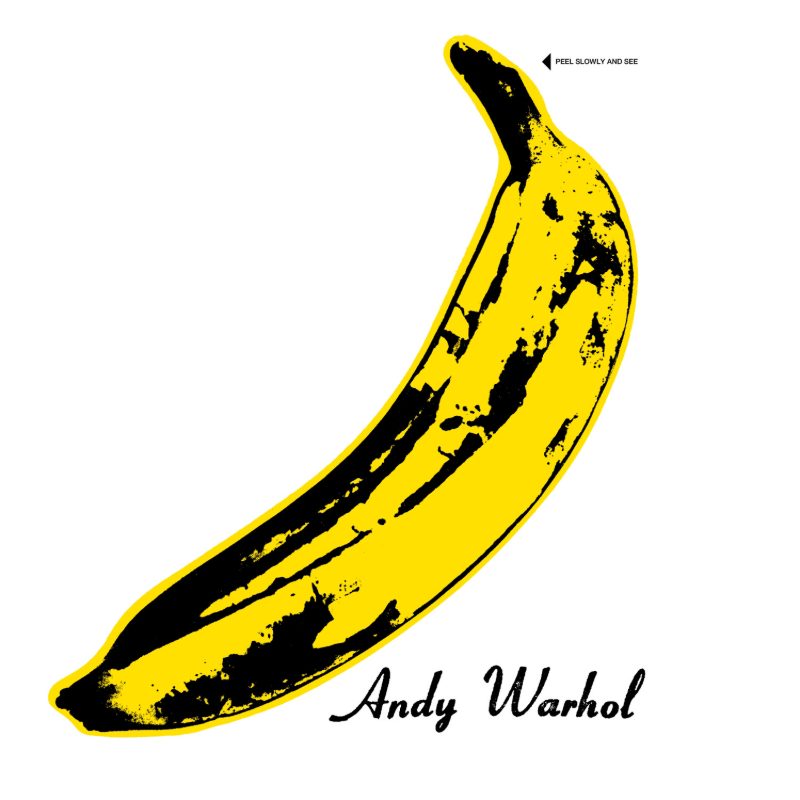
It sold 58,476 copies in its first two years. The drones and feedback made its name, and Lou Reed's songs are why people still play it.
- Released
- March 1967 (US, Verve). 12 March is the date usually given, though reviews appeared in the first week of the month
- Label
- Verve Records (MGM)
- Producer(s)
- Andy Warhol (credited); edited and remixed under the supervision of Tom Wilson
- Runtime
- 47:51 (11 tracks, LP label times; the CD and streaming versions run up to about 13 seconds longer a track)
- Chart peak (US)
- #171 (Billboard albums chart)
- Chart peak (UK)
- #43 (Official Albums Chart, chart dated 2 August 2014); #59 (chart dated 6 July 2002)
- Certifications
- BPI Platinum (22 July 2013)
- Awards & honours
- Library of Congress National Recording Registry (2006 list); Grammy Hall of Fame (2008); #23 on Rolling Stone's 500 Greatest Albums list (2020)
Lou Reed wrote plain, strong songs, and Cale, Morrison and Tucker made them strange. The drone gave the record its reputation and the songs give it its replay value, while the thin finish holds it back.
Brian Eno made a remark by phone to the Los Angeles Times in 1982 that has followed this album for more than 40 years. The number in it came from Lou Reed. Everyone who bought one of those 30,000 copies, Eno said, started a band. Later retellings use 10,000 or 60,000 in place of 30,000. The line set the terms of the legend: a record nobody wanted, far ahead of its audience, heard only by people who'd go on to make music themselves.
The legend gets the sales wrong. MGM's royalty statement shows 58,476 copies sold by February 1969. Billboard reported on 28 October 2013 that Nielsen SoundScan, which tracks sales since 1991, counted 560,000 copies. That is a poor start for 1967 and a steady seller since. Aidan Levy, writing for the Library of Congress, calls the album the most critically influential commercial flop in rock history. The legend also puts the record's power in its noise: the viola drone, the feedback, the drummer at a bass drum. This essay argues for a division of labour. Cale's drone gave the songs their shape and the record its reputation. Reed's writing is why people replay it. The weakness is the finish: a thin, rough sound, and two tracks that are gestures more than songs.
Reed arrived with the songs and John Cale arrived with the sound. Reed was a staff songwriter at Pickwick Records, a budget label, and in December 1964 he recorded 'The Ostrich' there under the invented band name the Primitives. Cale was Welsh and classically trained, and he'd played in La Monte Young's group. He'd also taken part in a 19-hour performance of Erik Satie's 'Vexations', which he performed alongside John Cage. Reed told David Fricke, in an interview Levy quotes, that he wanted the Great American Novel in a rock song. Levy also quotes him on Chandler, Burroughs, Ginsberg, Selby and Schwartz. Cale wanted the density of a Phil Spector record from as few instruments as possible. A writer after a novel and a violist after a wall of sound: that pairing is the record.
The songs predate Warhol. In July 1965 Reed, Cale and Sterling Morrison made demos at 56 Ludlow Street, folk-leaning versions of 'I'm Waiting for the Man', 'Heroin', 'All Tomorrow's Parties' and 'Venus in Furs'. Warhol's circle came to see the band at the Café Bizarre that December. The band was fired from the booking for playing 'The Black Angel's Death Song' after being told not to. Warhol took them on, proposed adding Nico, and the band agreed reluctantly. The sleeve credits him as producer. Cale said Warhol did nothing in the studio, and Reed called Tom Wilson the real producer. Reed also said that in a sense Warhol did produce it, because he took the attacks the band was too small to draw. What Warhol supplied was a patron, a singer and a cover, and Reed said later that the cover helped get the band signed. That is patronage, and it counts for a lot. It's a different job from producing.
Levy counts about five days of recording sessions, spread between April and November 1966. Columbia, Atlantic and Elektra all passed on the band, and Verve signed it with Wilson's help. The first sessions came in April at Scepter Records' studio on West 54th Street, with Norman Dolph supervising and John Licata engineering. Dolph was a Columbia sales executive who knew Warhol, and he took a Warhol painting as his fee. In May, while the band was in California, three songs were remade at T.T.G. in Hollywood in about two days: 'I'm Waiting for the Man', 'Venus in Furs' and 'Heroin'. The last song, 'Sunday Morning', was recorded in November at Mayfair on Seventh Avenue. Wilson wanted a single with Nico singing lead. Five days is a short time, and the record reads like a band's live set caught in a few sittings.
Levy says the band sought to replicate what it did at the Dom. He quotes Reed on playing into one very cheap microphone, and adds that the record is less lo-fi than its legend implies. The sleeve complicates the one-microphone story. It credits an edit and remix by Gene Radice and David Greene under Wilson's supervision. Robert Christgau grades the album A and credits its narcotic drone with unifying the record. He also writes that it sounds 'intermittently crude, thin, and pretentious at first', but that it never stops getting better. That was a first impression, and he moved past it. This essay doesn't move past all of it: the sound is thin in places where the writing deserved a fuller one.
'Heroin' shows the division of labour best. It has two chords and runs more than 7 minutes. Reed's first line comes after a long instrumental opening. After that the tempo builds twice, with Cale's electric viola and feedback rising alongside, and falls back each time. The lyric describes the rush and the nod, which Levy reads as a metaphor for emotional highs and lows. The playing rises and falls along with them. The version on the album was recorded at T.T.G. in May 1966. A faster take from Scepter, about a minute shorter, stayed unreleased until the 2012 box set. Richard Goldstein, reviewing the album in the Village Voice, found the studio version more compressed and more restrained than the live performances he'd seen. Maureen Tucker has said that once it got loud and fast she couldn't hear the others, so she stopped playing for several seconds.
The strangeness has a paper trail. Cale filed down the bridge of his viola and played it on three strings. He said later that it sounded as if an aircraft was in the room. On 'Venus in Furs' Reed tuned his guitar down, and Tucker kept a slow backbeat of two bass-drum beats and one tambourine hit. On 'All Tomorrow's Parties' Cale played a piano with paper clips woven through the strings, and Reed tuned every string of his guitar to D. Cale says that guitar made a horrendous noise, and that this is the sound of the track. Tucker played standing up, hitting an upturned bass drum and toms with mallets and rarely touching a cymbal. Every one of these tricks is cheap. Each is also a decision about what a rock band could do without.
The gentler songs show where the real writing is. 'Femme Fatale' runs 2:35 on the LP label, and Nico is singing by 0:10 with no long instrumental break to follow. Reed said he wrote it at Warhol's request, about Edie Sedgwick. 'I'll Be Your Mirror' came from a remark Nico made to Reed after a show in 1965. So the two tenderest songs on the record were both prompted by someone else. Christgau hears a vocal variety in the contrast between Nico's voice and Reed's chant, one he says the band would never duplicate. Even the single began as a commission: Wilson asked for one with Nico singing, and Reed sang it. 'Sunday Morning' opens the album, and it was the last song recorded. Reed could write to order, a skill the noise story hides.
The weak spots are there for anyone to hear. Goldstein, in the Village Voice on 13 April 1967, found some lead vocals Dylan-like. He heard the progression of 'There She Goes Again' as lifted from the Rolling Stones' 'Hitch Hike', and he called the last two tracks 'pretentious to the point of misery'. The riff charge holds up. Howard Sounes traces the riff to Marvin Gaye's 'Hitch Hike' of 1962, and the song never gets far beyond it. The last charge is harsh on 'The Black Angel's Death Song', which leans on Cale's electric viola. Reed's own note says its words were strung together for their sound, not their meaning. It is fairer to 'European Son'. Reed sings for about half a minute, from 0:21. His last line starts at 0:48, and after that nobody sings. By Cale's account he hurled a chair into a pile of aluminium dishes, and the crash comes about a minute in. The noise runs on for nearly 7 minutes. As the end of an album, it's a gesture more than a song.
The documented influence runs through a handful of named people. Cale went on to produce The Stooges, recorded in April 1969, and Patti Smith's Horses. David Bowie says his manager, Kenneth Pitt, gave him a pre-release copy in December 1966, and that his band Buzz was playing 'I'm Waiting for the Man' within a week. Hunky Dory carries a handwritten note on its back cover acknowledging the Velvets, and 'Queen Bitch' was written as a tribute. Levy lists Smith, Debbie Harry and David Byrne among the people who started bands after hearing the record, and Thurston Moore covered 'European Son' in 1988. Beyond that, much of the family tree is a critic's reading. Julian Cope has heard the bassline of 'European Son' in Can's 'Father Cannot Yell'. He may be right, but no credit says so.
The 1967 reviews were mixed. Goldstein called the group important, if hard to like. Billboard praised Nico and the lyrics before release, and the American Record Guide praised Reed's lyrics in May. Newspapers in Tampa and Asbury Park dismissed it. The record reached #171 on the Billboard albums chart in December 1967, after a recall that followed Eric Emerson's threat to sue over his image on the back cover. Critics have rated it highly since: Christgau grades it A, and Rolling Stone ranked it #23 in 2020. Sales caught up slowly. The BPI certified it Platinum on 22 July 2013, three months before Reed died. The reputation is right about the direction. The record itself has limits that the legend leaves out.
This is a very good record with clear limits, and it's easier to admire than to love from end to end. The scorecard rates its novelty and its influence above its songwriting, and that order is fair. A drone under a pop song, a drummer at a bass drum and a second singer from outside the band all lasted. What you replay is Reed's writing. 'Heroin', 'Femme Fatale' and 'I'm Waiting for the Man' still work as songs. 'There She Goes Again' and 'European Son' are smaller than their reputations. The sound is thin in places, and the weakest tracks lean on gesture. Admire the record for what it started and replay it for Reed's songs.
Pressing guide — the one to own
The original to own is the 1967 US mono LP, Verve V-5008, in a gatefold with the banana sticker and the Eric Emerson 'torso' image on the back cover. The catalogue entry calls it the first pressing. The vinyl can't prove it: a sticker-back mono copy shares its runout numbers with one variant of the torso copy, so the back cover decides the state. The stereo twin is V6-5008. The UK original is a different object, catalogue VLP 9184 (mono) and SVLP 9184 (stereo). Its catalogue entries describe the US back cover as its front, though one sleeve history says only that its banana wasn't peelable.