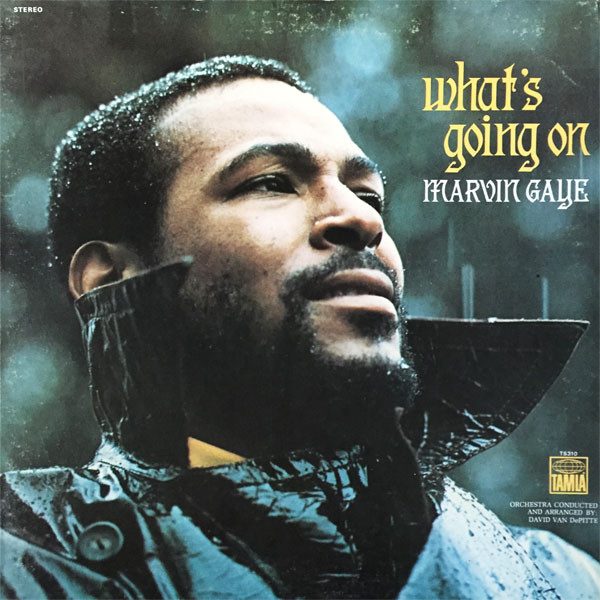
A soul album built as one piece, from a single its own label tried to stop. Marvin Gaye's best-made record, and stronger as a whole than in any one song.
- Released
- 21 May 1971 (US, Tamla TS 310)
- Label
- Tamla (a Motown label)
- Producer(s)
- Marvin Gaye
- Runtime
- 35:31 (sum of the 2002 Deluxe Edition CD1 timings for the original LP mix)
- Chart peak (US)
- #6 (Billboard Top LPs, now the Billboard 200, 31 July and 7 August 1971); #1 on Billboard's Soul LP's chart (24 July 1971)
- Chart peak (UK)
- #56 (Official Albums Chart, 8 and 15 April 2000). It didn't chart in Britain in 1971; the first entry was 7 February 1998
- Certifications
- RIAA Gold (20 December 1993); BPI Platinum (22 July 2013)
- Awards & honours
- Grammy Hall of Fame (1998); National Recording Registry (2003 class); topped Rolling Stone's 2020 list of the 500 greatest albums
Marvin Gaye produced it himself, over his label's objection. Its authority comes less from any one performance than from the way it is put together: doubled voices, named players, songs that lead into each other. That is also where its soft spots show.
On 20 January 1971 Tamla released a single that Motown's founder hadn't wanted out. It was 'What's Going On', with 'God Is Love' on the other side. Berry Gordy's objection survives in several versions. Far Out and GRAMMY.com both report him calling it the worst thing he'd ever heard. In a 2016 Motown documentary he recalled being in the Bahamas when Gaye phoned, and asking why Gaye wanted to ruin his career. Sound On Sound has him calling it too jazzy, and telling Harry Balk, who ran Motown's Creative Division, that it sounded old. The accounts differ on where: Wikipedia, citing Lynskey's 2011 book, has Gaye taking the song to Gordy in California that September. Whatever was said, the single went out anyway.
The album that followed came out on 21 May 1971, and this essay's claim is about how it was made. What's Going On is one of the best records of its kind, and the kind is the album built as a single piece. Its authority doesn't come from one great song or one great performance. It comes from construction: doubled voices, a house band named on the sleeve, and a sequence in which songs lead into each other. Vince Aletti, reviewing it in Rolling Stone, said careful transitions made the cuts nearly seamless. It was the first album credited to Gaye as the sole producer. That matters more than any single track on it.
The song at the centre came from outside him. Renaldo 'Obie' Benson of the Four Tops had seen police violence in the Bay Area in 1969. Record World reported in February 1971 that Benson took a melody to Al Cleveland, who took it to Gaye. Later retellings have Benson offering it to Gaye directly. The Four Tops and Joan Baez passed on it, according to Sound On Sound. Benson later said Gaye added lyrics and made the song visual. Gaye had his own reasons. Sound On Sound quotes him telling Rolling Stone that he began to re-evaluate his music in 1969 or 1970, moved partly by his brother's letters from Vietnam. It adds that Tammi Terrell's death in March 1970 sent him into a depression. Frankie Gaye's stories inspired 'What's Happening Brother'. The label's refusal came after the title song was recorded. It shaped the fight over the record, not its making.
Gordy wasn't alone in saying no. Quality Control, including Billie Jean Brown, disagreed with releasing the single. Ben Edmonds writes that it had turned down three of Gaye's most important records: 'I Heard It Through the Grapevine', 'Baby I'm for Real' and this one. Each time, he says, the company's hand had to be forced. Gaye's reply, in Edmonds's account, was an ultimatum: he'd record nothing more until the single was out. Balk pushed for release in January 1971 and Barney Ales, Motown's sales vice-president, sided with him. Sound On Sound reports that 100,000 copies were pressed, that they sold out within 24 hours, and that 100,000 more followed. By the week of 10 April the single stood at #2 on the Hot 100, behind the Temptations' 'Just My Imagination'. The strike is usually told as a gesture. It worked because the record sold.
The title song was already recorded by then, and the rest came in a rush. Motown's archive notes date its basic tracks to 1 June 1970, its voices to 6, 7 and 10 July and its strings to 21 September. Sound On Sound dates Gaye's arrival at Studio A to 10 June instead. The other eight songs followed in 1971. Basic tracks were cut on 17, 19 and 20 March, with strings, horns and voices on 24 March and 26 to 30 March. Gaye added more on 5 May in Los Angeles. Retellings say he cut the album in 10 days. That is roughly right for the eight songs' session days and wrong for the album as a whole. Even the mix is disputed. Motown's notes put the released mix in Los Angeles on 6 May. Ken Sands, the engineer, says the released mix was his, made in Detroit. The speed may be part of why eight songs sound like one.
Start with the voice. Sands recorded two lead vocals so Gaye could compare them. He put both on one stereo tape, one on the left and one on the right, and the double effect was an accident. Gaye kept it, and later layered up to three leads. He sang in Studio B, into a Neumann U87, wearing a knitted skull cap. The doubling is the album's method in miniature. The lead never sounds finished. It sounds like a man talking, then thinking again. Play the title song and wait for the first sung line at 0:17. Before it come the party chatter that the Lions players Lem Barney and Mel Farr added, and a saxophone.
The saxophone shows the same method. Eli Fontaine's alto introduction wasn't in Gaye's plan. Sound On Sound says Gaye loved the hook. When Fontaine said he'd been just goofing, it reports, Gaye told him he'd goofed off exquisitely. The opening of the title song was unplanned, and Gaye had the sense to keep it. The sleeve names the players one by one, from the bassists James Jamerson and Bob Babbitt to the percussionists and the Detroit Symphony strings under David Van DePitte. A 2000 Detroit Free Press piece calls it Jamerson's first credit on a major Motown release. The 2001 Deluxe Edition credits put him on seven of the nine songs. They give Babbitt 'Mercy Mercy Me' and 'Inner City Blues'. The title song's bass has a legend attached. In the 2002 film Standing in the Shadows of Motown, fellow Funk Brothers said Jamerson was found after a search of bars. They said he played the part drunk, lying on his back. The producer Eric Valentine, who has played back the song's multitrack, says Jamerson was fetched from a jazz-club gig and made to lie on the floor. Sound On Sound's 2011 telling has Gaye finding him at a local club. The accounts differ on where he was found and agree on the floor. Valentine calls the lines fluid.
Then the shape. Side one holds six tracks in 19:24 and side two holds three in 16:07. The shortest track, 'God Is Love', runs 1:42 and comes fifth. The 45's B-side of the same name is a different recording, 2:50, whose basic tracks were cut in 1968 and whose vocal was added on 7 October 1970. The album cut is short enough to work as a hinge. Side two is looser. 'Right On' runs 7:32, nearly half of it. Whether that looseness works is the album's open question.
The credits show how much was packed in. There are bongos and congas from two players, a vibraphone, a celeste, a harp, two flutes, trumpets and a trombone, and Gaye himself on piano. David Van DePitte arranged and conducted, and his name is on the front cover as well as inside. Christgau disliked the strings. They are the layer a reader can test. The 2022 reissue's bonus LP has a no-strings-or-horns mix of the title song alone. Play it beside the album version and decide what the strings add.
Critics found different things in it. Billboard's review in June 1971 heard a cross between Curtis Mayfield and the old Motown sound, and named 'Right On' among the tracks where Gaye outdid his earlier work. Vince Aletti, in Rolling Stone that August, thought it more supple and conversational than Stevie Wonder's Where I'm Coming From. He admitted the sameness of sound was boring at first and that the lyrics weren't brilliant on the page. Then, he wrote, the concept took shape and its wholeness became affecting. His complaint is the right place to start. The album's wholeness is the point, and its songs, taken one at a time, are not. The public didn't mind. It entered the Top LPs at #187 on 12 June 1971, reached #6 by 31 July, and produced three Top 10 singles.
Its influence can be traced in a few places. The clearest case is There's a Riot Goin' On, released by Sly and the Family Stone in November 1971. Miles Marshall Lewis's 2006 book on that album is the source cited for the claim that its title answers Gaye's. Treble's entry on Stevie Wonder's Innervisions lists Gaye's fight for creative freedom among the Detroit developments that preceded it. That is a critic's reading, not Wonder's own statement. Donny Hathaway opened his 1972 live album with the title song, and Aretha Franklin recorded 'Wholy Holy' in January 1972. The strongest effect was inside Motown. It showed that an artist could win an argument with the company and be paid in sales.
The reputation is enormous. The NME's writers put it first in 1985, and the Guardian's 100 best albums did in 1997. Rolling Stone ranked it No. 6 in 2003 and No. 1 in 2020, above Pet Sounds. The magazine's reviews editor, Jon Dolan, told NPR that its relevance in 2020, and people playing it for solace, helped. Those are facts about 1985 to 2020, not arguments. The doubters are worth hearing. Robert Christgau gave it a B+, found three tracks outstanding, and thought Van DePitte's strings the weakest part. Ed Barrett argued in spiked in 2021 that it had filler and that 'Save the Children' was the low point.
I'd put the weak spot elsewhere. The synced timings for 'Right On' show no sung words from 3:40 to about 5:00. On a 7:32 track that's 80 seconds the band has to carry, and it's where the album's grip loosens. Billboard liked the track, so this is a judgement, not a consensus. 'God Is Love' is a fragment, and Christgau's complaint about the religious songs is easiest to understand there. On our scorecard the two lowest marks are for performance and songwriting, and both are still very high.
So it's one of the best records of its kind: a soul album built as a single statement, by an artist who had to win the right to make it. The scorecard agrees. Influence, production and cohesion carry its three highest marks. Its soft spots are real, and small beside the whole. Not every song matches the title song, and the singing and the writing, excellent as they are, aren't what set it apart. The construction is. Play it as one piece, once, and the fight over it makes sense.
Pressing guide — the one to own
The original to own is the 1971 US Tamla TS 310, a stereo gatefold LP released on 21 May 1971. The spine reads TS310, and the labels carry HS-1867 (side one) and HS-1868 (side two). The earliest copies are on Dynaflex vinyl, with an inner sleeve promoting other Motown releases. Early copies came from more than one plant: the catalogue lists Superior in Somerdale, New Jersey, and RCA in Indianapolis. The 1974 repress carries the same runout codes, A4RS-2682-2-D and A4RS-2684-2-D, so the runouts don't tell the two apart. Its spine and rear cover read T6-310S1, and the gatefold interior has a blue background behind the lyrics.