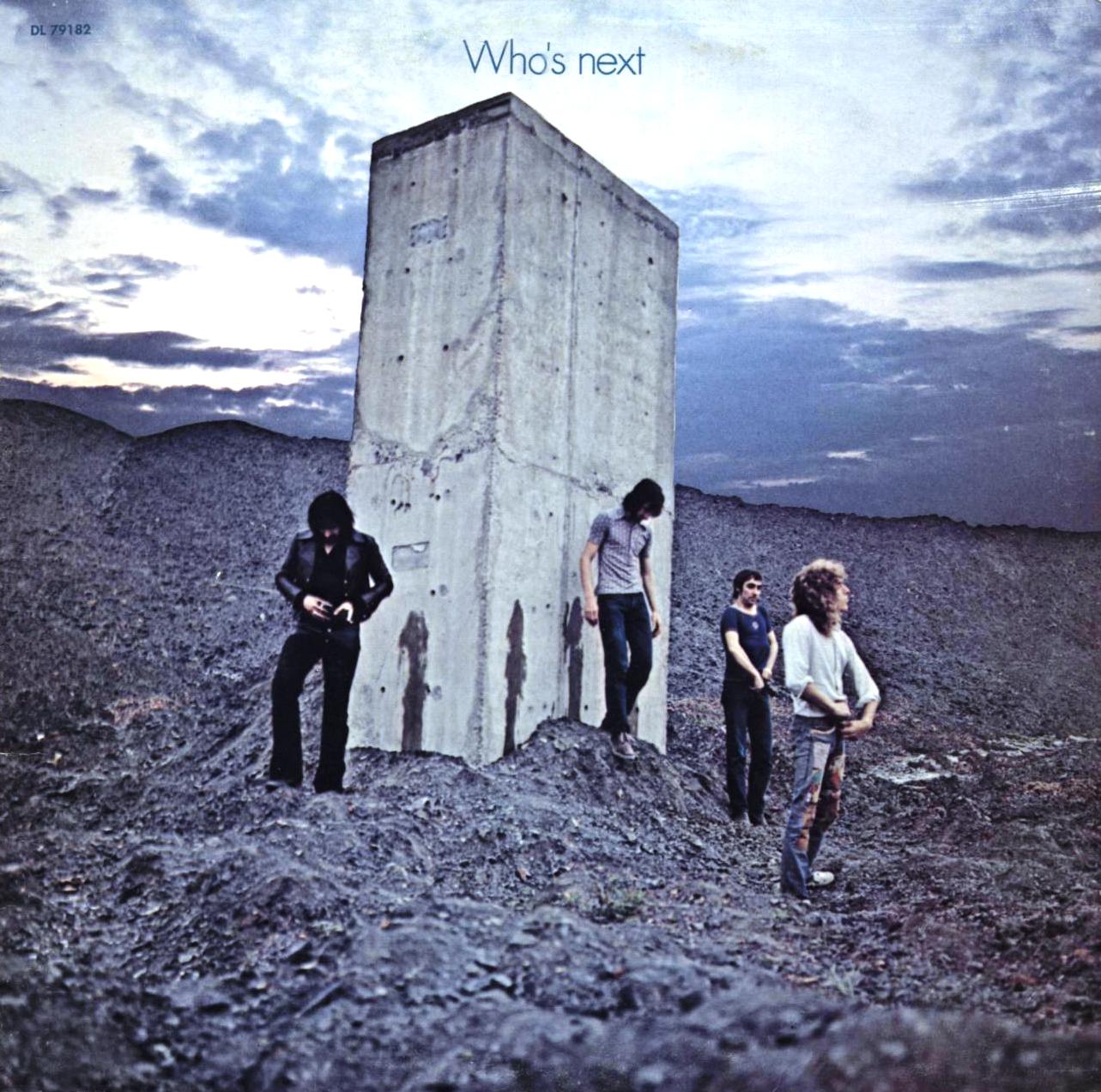
Eight songs from Pete Townshend's abandoned Lifehouse, plus one by John Entwistle, played by the Who at full strength. A great-sounding record with one structural flaw.
- Released
- 27 August 1971 (UK, Track 2408 102; some catalogue entries say 25 August) · 2 August 1971 (US, Decca DL 79182; some catalogue entries say 14 August)
- Label
- Track (UK, marketed by Polydor) · Decca (US)
- Producer(s)
- The Who; Glyn Johns (associate producer, recorder and mixer)
- Runtime
- 43:33 on CD-era track times (the 1971 LP labels add up to 43:14)
- Chart peak (US)
- #4 (Billboard 200), on the charts of 11 and 18 September 1971; 41 consecutive weeks
- Chart peak (UK)
- #1 (Official Albums Chart), 1 week, on the chart of 18 September 1971; 18 weeks in all
- Certifications
- RIAA 3× Platinum (8 February 1993); BPI Platinum (15 June 2018)
- Awards & honours
- #1 in the 1971 Pazz & Jop critics' poll; #15 on Pitchfork's best albums of the 1970s (2004); #28 on Rolling Stone's 500 Greatest Albums (2003 and 2012), #77 in 2020
The playing and the production are superb, and the sound is the only thing that makes Who's Next a unit. Eight of the nine songs were salvaged from Lifehouse, and the story meant to hold them was dropped.
The opening sound of this record is often credited to a synthesiser. It's an organ. Pete Townshend played a gated Lowrey organ on 'Baba O'Riley', using its Marimba Arpeggiator to stand in for a sequencer. He has called the method a cheat, because he couldn't work the ARP's sequencers fast enough. The organ went to tape in stereo, through a rotating-speaker output. A workaround became the opening of the album. That suits a record that was itself a workaround.
Who's Next is a great record with one structural flaw, and the flaw comes from how it was made. The playing and the sound are the best the Who ever got on tape. The sequence is a salvage job. Eight of the nine songs belong to Lifehouse, the multimedia project Townshend couldn't finish. The ninth, 'My Wife', was written for a solo project. What's left is a set of superb tracks with no argument holding them together. The rest of this essay tests that claim.
Lifehouse began in public. Townshend floated it in Melody Maker columns in August 1970, then described it to Disc and Music Echo on 24 October. It was meant as a film and a live project, the follow-up to Tommy. The story ran about 30 years ahead, in a polluted world where people shut themselves into 'experience suits'. Audience members' personal data, such as astrological charts, would feed a synthesiser. The machine would turn each person into a piece of music. The synthesiser was the story's engine before it was anyone's sound.
The idea didn't survive an audience. The Who announced a Young Vic residency on 13 January 1971 and played the first show in February. According to Dave Marsh, the crowds wanted the hits and a smashed guitar, not a collaboration. Townshend fell out with Kit Lambert, the Who's executive producer. Lambert suggested New York, and in March the band cut tracks at the Record Plant, with Al Kooper, Leslie West and Ken Ascher guesting. Those sessions were abandoned. Townshend later wrote that the failure took him to the verge of a nervous breakdown. At the time, Roger Daltrey said the Who had never been nearer to breaking up.
Glyn Johns picked up the pieces. Townshend had written to him asking for help, and the sessions moved to Olympic, in Barnes. Johns later said he had no idea the band had tried New York until the album was finished. He pushed for a single disc, and Marsh says he assembled it in whatever order he chose. The sleeve credits the Who as producers and Johns as associate producer, recorder and mixer. Johns himself said he acted mainly as an engineer and built most of the arrangements on Townshend's demos. That qualifies any claim that he produced it alone. 'Let's See Action', recorded in the same sessions, stayed off the album. It came out as a UK single that autumn and reached #16.
The first session was at Stargroves, Mick Jagger's house, in early April 1971. The band spent 2 days tracking 'Won't Get Fooled Again' in the entrance hall, on the Rolling Stones' mobile studio. The first session at Olympic followed on 9 April, with a basic take of 'Bargain'. Most of the rest was cut there in May. Olympic's Studio A was a former cinema with a very high ceiling. The band played in a line facing the control room. On 'Baba O'Riley' the headphone playback was organ and piano tracks Townshend had made at home on 8-track, with no click. Johns mixed on the same console, with an EMT plate for reverb and a Revox with varispeed as a tape delay. John Atkins's liner notes say most of the synthesiser tracks were recorded at Townshend's home studio and brought in as finished tracks.
The synthesiser backing shaped the playing. In Fletcher's 1998 account, Keith Moon's drumming is more formal and leans less on fills than before. Fletcher credits the synthesiser backing and Johns's no-nonsense approach. On 'Won't Get Fooled Again', Moon synchronised his playing to the synthesiser part. Robert Christgau heard the result in 1971: a studio sound with the immediacy of the live band. The synthesiser parts gave the band a fixed pulse to play against. Townshend's main guitar was a Gretsch 6120, a gift from Joe Walsh, through a Fender Bandmaster. Entwistle played his 'Frankenstein' Fender Precision through a Hiwatt rig.
'Baba O'Riley' shows what the method buys. The first sung line doesn't arrive until 1:15. Before that the record is an instrumental, and it holds you with a pattern rather than a melody. The ending is the surprise. From about 3:28 the singing stops, and a violin carries the rest. Moon suggested the violinist, Dave Arbus of East of Eden. The tempo lifts for his part, and Johns said Moon handled it well. The organ track came from a longer demo. Townshend later said it took two or three thousand edits.
'Won't Get Fooled Again' is the same trick at full scale. The backing is the Lowrey organ again, this time run through the gated filter of an EMS VCS3, with no sequencer. At 8:32 it's the longest track on the record, and the voice doesn't enter until 0:44. From about 5:36 there's no singing for roughly 2 minutes, until the vocal returns at 7:44. Daltrey's scream sits at the end of that stretch, and the song needs the 2 minutes to earn it. The song was a hit as well, reaching #9 in Britain and #15 in the US.
'Behind Blue Eyes' works the other way, and the quiet carries it. Townshend wrote it for Jumbo, the villain of Lifehouse. Daltrey, Townshend and Entwistle sing three-part harmony. Moon doesn't play on the first half. When the band comes in, the song changes size. The Who had already tried it in New York on 18 March, with Kooper on organ. The album take was their second. 'Bargain' is the other track that earns its length. Townshend has said its subject is God, not a woman, and that it's about losing the ego as a follower of Meher Baba.
The seams show elsewhere. 'Love Ain't for Keeping' is 2:10 of acoustic-based rock, reworked from a harder arrangement, and John Mendelsohn thought it negligible in Rolling Stone in 1971. 'My Wife' isn't a Lifehouse song at all. John Entwistle wrote it after an argument with his wife and exaggerated the quarrel. It was added very late, having been meant for a solo project. Its brass was overdubbed in a single half-hour session. It's good fun, and it belongs to a different record. 'The Song Is Over' closes side one with Nicky Hopkins on piano and a coda that quotes a Lifehouse song left off the album. Mendelsohn called it beautiful. Side two's 'Getting in Tune' has Hopkins at the front too. The Who played it only sparingly after the Young Vic. Marsh says abandoning the story let the band maximise individual tracks and give them a unifying sound. That's what happened. The sound unifies the record. Nothing else does.
The first reviewers heard the sound. Christgau gave it an A+ in the Village Voice on 19 August 1971 and called it the best hard-rock album in years. He counted Townshend's political disengagement as a plus. In Sounds on 28 August, Billy Walker singled out 'Baba O'Riley', 'My Wife' and 'The Song Is Over'. He praised the band for choosing a straight album over a sequel to Tommy. Mendelsohn praised it as intelligent, well performed and brilliantly produced, while noting some seriousness and artificiality. In the first Pazz & Jop critics' poll the record finished first with 540 points. Sticky Fingers had 332. Christgau cooled later. His 1981 Record Guide dropped the grade to an A. In later comments he found the album less tasteful, citing Daltrey's histrionic singing and the synthesiser noodling. Rolling Stone ranked it #28 in 2003 and 2012, then #77 in 2020. The 2020 poll used new voters, so that fall tells you less than it seems to.
What it left behind is easier to document than to measure. Terry Riley's A Rainbow in Curved Air (1969) is cited as the inspiration for the organ parts, and its composer is half the opener's title. Big Audio Dynamite II sampled the keyboard part of 'Baba O'Riley' for 'Rush' in 1991. Labelle opened their 1972 album Moon Shadow with a soul version of the closer. In 2004, Pitchfork's Rob Mitchum traced the 1980s keyboard revolution back to the Who. That's a critic's reading. John Atkins went further in his liner notes. He claimed this is where pre-programmed synthesisers and sequencing first appeared on record. That's his claim, and Townshend's own account of the closer doesn't support it, because he says it used no sequencer. The master tapes had a rougher history than the record. The Olympic masters are believed lost, after Virgin threw out old recordings when it bought the studio in the 1980s. The 16-track tapes for the closer and the 8-track tapes for most of the rest have since turned up.
At its best, Who's Next is as good as rock records get, and the reputation is right about that. The playing, the production and the best songs are the Who at full strength. The reputation goes wrong only when the record is read as a statement. Townshend's story is gone, the sequence is an engineer's, and the middle of side one is slight beside the rest. Buy it for 'Baba O'Riley', 'Behind Blue Eyes', 'Bargain' and the closer. It earns its place among the great records on playing and sound, and loses a little of it on cohesion.
Pressing guide — the one to own
The original to own is the 1971 UK Track Record, catalogue 2408 102, pressed by Phonodisc Ltd. and marketed by Polydor. The labels read 2408 102, and the spine reads 'Deluxe 2408 102' and the back cover '2408 102 Deluxe'. The runouts follow a pattern: side one starts 2408102 A//1 and ends MG-12888, and side two starts 2408102 B//2, with a stamper count in between. The stamper count differs from copy to copy, and the labels come in at least two layouts. Some sleeves have a pleated spine, which is a variant rather than damage. The US original is Decca DL 79182.