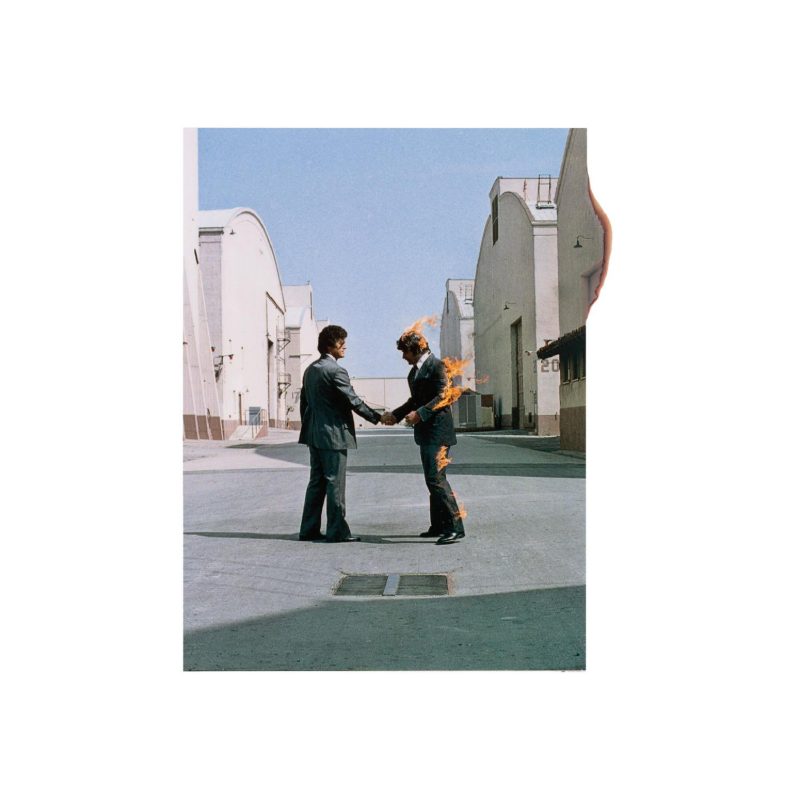
Pink Floyd's follow-up to The Dark Side of the Moon: a record about absence, made in 1975 by a band that kept coming and going from its own sessions.
- Released
- 12 September 1975 (UK, Harvest); mid-September 1975 (US, Columbia)
- Label
- Harvest (UK); Columbia (US)
- Producer(s)
- Pink Floyd
- Runtime
- 44:08 (5 tracks)
- Chart peak (US)
- #1 (Billboard 200), 2 weeks from the chart dated 4 October 1975
- Chart peak (UK)
- #1 (Official Albums Chart), for the week of 28 September to 4 October 1975 and again in the week to 25 December 2025
- Certifications
- RIAA 7× Platinum (12 December 2025); BPI 3× Platinum (2 January 2026); Music Canada 3× Platinum (1 July 1979)
- Awards & honours
- #264 on Rolling Stone's 500 Greatest Albums of All Time (2020 list)
Roger Waters gave a stalled band a subject, absence, and a way to arrange it: one long lament split around three songs. That's the record's best idea, though not a new form. The weak point is the sneering song that opens side two.
The first track Pink Floyd worked on for Wish You Were Here was 'Shine On You Crazy Diamond', and they recorded its backing track three times. The first attempt took several days and wasn't good enough. The second took one day and went better, until playback showed that someone had switched the echo returns from the monitors to tracks one and two. The echo was now printed on the tom-toms, guitars and keyboards, and nobody could take it off. So they did it again. The engineer, Brian Humphries, blamed a guitarist with sticky fingers who liked to try things out. Four against one, he said, so he took the blame. It's a fair picture of the sessions. Humphries remembers a dartboard, an air rifle, word games and drink. 'There were days when we didn't do anything,' he told Sound on Sound in 2014.
What fell into place was a subject. Roger Waters decided the album should be about absence, and about the music business that had made the band rich. He suggested dropping two songs they'd played live in 1974, because neither fitted. He also suggested splitting 'Shine On You Crazy Diamond' so that it opened and closed the record. Until then the band had given long pieces whole sides, as with 'Atom Heart Mother' and 'Echoes'. David Gilmour disagreed. Waters, Richard Wright and Nick Mason outvoted him. The split is the record's best idea, though it rearranges an old form rather than inventing a new one. Three songs now interrupt a nine-part lament, and you wait for the second half. The weak point comes when you flip the record: the first thing on side two is 'Have a Cigar', the album's sharpest sneer.
The sessions that led to that vote had started badly. Mason said in 2025 that the band weren't 'the lovable mop tops' any more. They were around 30, and some had children. On Dark Side four of them had been in the studio most of the time. This time they came and went, and Gilmour was left to carry on with the guitar parts. Mason laughingly calls the mood 'relaxed desperation'. Their first plan was an album made only from household objects, such as wine glasses, rubber bands and brooms. Mason says it went 'absolutely nowhere'. The wine-glass sound survived to open 'Shine On'. The press hadn't helped. Nick Kent's NME review of the 1974 shows, which came before the sessions, called the band tired and short of ideas. Mason said later that it may have sent them back to the studio in the first week of 1975.
Then Syd Barrett walked in. The date is disputed. Sound on Sound dates it to Thursday 5 June 1975, during the final mix of 'Shine On'. Other accounts say 7 July, the day of Gilmour's wedding, and the Sound on Sound account has Barrett attending the reception in the studio canteen. The accounts agree on how he looked. He was overweight, with a shaved head and almost no eyebrows, in a white trench coat. Nobody knew him. Wright took him for a friend of Waters. Gilmour thought he was EMI staff. Then Gilmour worked out who it was. Gilmour and Waters both cried. Barrett's only comment on the song was that it sounded 'a bit old'. He left without saying goodbye.
The visit is usually told as the moment the album found its subject, and the album as a funeral for Barrett. Neither is quite right. Barrett was alive, and 'Shine On' had been played live, with words, in late 1974. The Guardian's account of its interview with Mason says the visit led Waters to refocus lyrics he'd already begun on Barrett's lost promise. Waters himself has wavered. In 2001 he said 'Shine On' wasn't really about Syd, who was only a symbol of withdrawal. In the 2012 documentary he called it his homage to Syd and said it was about him. Mason's reading is wider. He told the Guardian that the true subject is 'distance and absence'. That explains why the business songs belong. It doesn't make them better songs.
Alan Parsons, who had engineered Dark Side, had left to start his own project. So Humphries, a freelance who'd been mixing the band's live sound, took over. He says he was the first outside engineer working at Abbey Road. Studio Three had just installed a 24-track Studer A80 and an EMI-modified Neve desk that, he says, nobody knew how to operate. He calls himself the main guinea pig. Yet listening again to the 2025 vinyl, Mason singled out the quality of the recording and the care the Abbey Road technicians had taken. Production is where the record is strongest, and the chaos around it never shows.
The best of 'Shine On' is its patience. Nobody sings for the first 8:42 of Parts I to V. The track opens on a loop of wet fingers rubbing wine-glass rims, a leftover from the abandoned Household Objects project. Wright builds on it with Hammond organ and three synthesisers. Gilmour's first long solo, a G-minor blues on a Stratocaster, comes in Part I. Mason and Waters bring in Part II, and Gilmour takes a second solo. Wright follows with a Minimoog solo in Part III, with a Steinway grand overdubbed. The four-note phrase that inspired Waters's words arrives just before the 4:00 mark. Ben Edmonds of Rolling Stone thought Gilmour overstepped with protracted solos. He had it backwards. Gilmour replaced Barrett in the band, and here his guitar speaks for the man he replaced. Wordless for nearly 9 minutes, it's the right way to write to someone who isn't answering.
'Welcome to the Machine' is cold by design. An industrial hum carries it over from 'Shine On'. Gilmour sings it over acoustic guitar and banks of synthesiser, with Waters on bass and the EMS VCS 3, and Wright on the VCS 3, Hammond organ and Minimoog. Mason plays timpani and cymbals, and Pitchfork heard a track that's largely drumless. Waters's demo, 'The Machine Song', came out on the 2025 box set, and it shows that most of the finished song was already there. The first line arrives at 1:03. From about 2:18 to 3:58 only instruments play. Paul Stump complained in 1997 that the synthesisers made the album sound like a display of Wright's new equipment. As a complaint it's fair. As a verdict on this song it misses. A song about a machine should sound like one.
'Have a Cigar' is where the record sneers, and it's the weak spot. It's the only track that starts abruptly, on a churning riff for guitar and bass, and its arrangement is plainer rock than anything else here. Roy Harper sings lead because Waters and Gilmour weren't happy with their own attempts at it. Harper, who was making his own album in another Abbey Road studio, says the key was two semitones too high for both. Gilmour loved the result. Waters later said he'd wanted something more vulnerable and less cynical. He was right. The target is a record executive who doesn't care, and that's an easy one. The band had signed a new contract with CBS, and Columbia held more than 900,000 advance orders for this record, among the largest in its history. Satire needs a writer with something at risk. Here, nothing was.
The next track fades in as if someone had turned the radio dial. 'Have a Cigar' ends on a guitar solo cut off by a filter sweep, and then comes the tuning. The radio is Gilmour's car radio, and Tchaikovsky's Fourth Symphony is among the stations. Gilmour plays a twelve-string guitar treated to sound as if it's coming through an AM radio, then adds a fuller acoustic part. He sings lead on Waters's words. The title phrase doesn't arrive until 3:16. Stéphane Grappelli played violin, but it was mixed so low that Waters said crediting it would be insulting. Edmonds heard the full band's entrance as the point where the song turned ordinary. It's better heard as the song's whole idea: one man alone with a radio, then other people arriving.
The last 12 minutes bring the lament back. Wind links the title track to Part VI. Gilmour plays bass, Waters adds a riff, and Wright's synthesisers sit under an ascending lap-steel solo from Gilmour. Waters's voice returns at about 4:55, in Part VII. A Gilmour riff leads into Part VIII, with Wright on Minimoog and Hohner clavinet. Part IX is Mason, Hammond organ, Steinway and synthesisers, and at the fade there's a short quotation of the melody of 'See Emily Play', a Barrett song from 1967. The record ends by letting Barrett's own tune speak for a few notes. It's the best moment on the album, and the quietest.
The 1975 reviews were mixed. Edmonds wrote in Rolling Stone on 6 November that the band's treatment of Barrett was too matter-of-fact, the effects gimmicky and the solos too long. He found the band 'devoid' of passion. Robert Christgau, in his 1981 guide, gave it an A−, and liked the synthesiser used for texture and the guitar for comment. By 2024 Pitchfork was calling it the band's most cohesive record. These verdicts aren't as far apart as they sound. Edmonds objected to the long solos and the effects, and Pitchfork praises how the whole record hangs together. Both are describing a record built to be heard as one piece. The band's own view is clearer. Mason told the Guardian it's 'a musician's record', and put Dark Side below it. The Guardian adds that Gilmour and Wright have called it their favourite Pink Floyd album.
Its documented influence stays mostly inside the band. The two songs set aside in these sessions came back as 'Sheep' and 'Dogs' on Animals in 1977. Mason calls the themes here a prelude to the thinking behind The Wall. Outside the band, the clearest reaction on record is hostile. In August 1975 Bernie Rhodes spotted John Lydon in a Pink Floyd T-shirt with 'I Hate' written above the band's name. Lydon auditioned for the Sex Pistols soon after, and Steve Jones recalls him wearing a shirt that said 'I Hate Pink Floyd'. Pitchfork suggests that the groove of 'Have a Cigar' may have sounded to the punks like the industry gloss the song mocks. The ideas weren't new either. 'Echoes' had shown how to fill a side, and Roxy Music's Country Life, sold in green cellophane, gave Hipgnosis the idea of hiding the sleeve. What this record added was the arrangement.
So this is a great record with two reservations. As playing and as recording it's superb, and its running order holds it together. The first reservation is 'Have a Cigar': a sneer the band hadn't earned, placed first on side two, and sung in a way Waters later wished had been different. The second is that two of its best-known ideas were borrowed: the long form from 'Echoes' and the hidden sleeve from Roxy Music. Outside the band, its documented influence is thin. What it added was the split, and the patience to wait for the second half. The two halves of 'Shine On' and the title song are the reasons to own it. A record this good needs one skipped track, not a defence.
Pressing guide — the one to own
The prize is the UK first pressing on Harvest, catalogue SHVL 814, issued on 12 September 1975. It's a single-pocket sleeve, not a gatefold, sold in black shrink-wrap with a round sticker of two mechanical hands. The catalogue entry lists first-press runouts of SHVL 814 A-1 and SHVL 814 B-3, a die-cut lyric inner sleeve and a postcard of the diving man with jagged edges. The side-one label credits Part 5 of 'Shine On' to Waters-Gilmour-Wright, where later labels credit Waters alone. The lacquers were cut at EMI Studios.