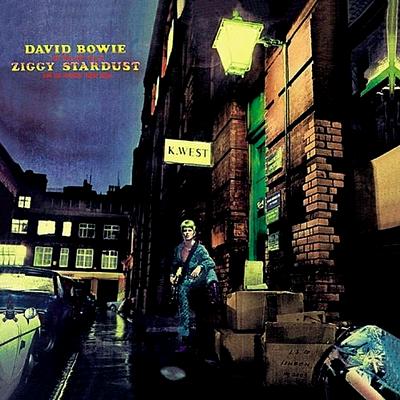
David Bowie's fifth album gave pop an alien rock star, and its best songs outlive the story built around them. The record was in the UK top 10 within a month of release.
- Released
- 16 June 1972 (UK, RCA)
- Label
- RCA Records (RCA Victor on the labels)
- Producer(s)
- Ken Scott and David Bowie
- Runtime
- 38:29 (11 tracks, by the label times)
- Chart peak (US)
- #75 (Top LPs & Tape, 1973); #21 on the Billboard 200 dated 30 January 2016
- Chart peak (UK)
- #5 (Official Albums Chart, 10 February 1973); its best position in 1972 was #6, on 23 September
- Certifications
- BPI 2× Platinum (29 September 2017); RIAA Gold (12 June 1974)
- Awards & honours
- Added to the Library of Congress National Recording Registry (announced 29 March 2017). Rolling Stone's 500 Greatest Albums: #35 in 2003 and 2012, #40 in 2020
The usual account says an alien rock star rose and fell across 11 tracks. In fact many of the songs came first, and the story was fitted around them. What lasts is the writing and the band.
When Bowie played 'Starman' on Top of the Pops, the single stood at #29. The programme went out on Thursday 6 July 1972, 20 days after the album's release. He wore a rainbow jumpsuit, put his arm around Mick Ronson's shoulders and pointed at the camera. What people remember is true. Bowie's official site says the performance launched him to stardom. But the charts show a record that was already selling. The album had entered at #15 the week before the broadcast, and it stood at #9 on the chart current that week. 'Starman' took 4 weeks to climb from #41 to #10. The album's UK peak, #5, came on 10 February 1973, nearly 8 months after release.
The legend runs ahead of the record in a second way. Standard descriptions call it a concept album, even a rock opera: an alien rock star arrives to save a doomed Earth and is brought down by his own fame. That story is the thinnest part of it. Many of the songs existed before the story did, and the story was fitted around them. Set the plot aside and you have a set of songs, played by a band, that are better than their frame. The character sold the record. The writing is why it lasts.
The record before it had done badly. Hunky Dory came out on 17 December 1971 and sold about 5,000 copies in its first 3 months. It didn't reach the chart until 23 September 1972. It's tempting to read Ziggy Stardust as a repair job, but the dates don't allow it. The sessions began on 8 November, more than 5 weeks before Hunky Dory reached the shops, so the failure wasn't known yet. In Woodmansey's account, the need was practical. Hunky Dory wasn't live material, so the band wanted songs they could take on tour.
Many of the songs were older than the character. Arnold Corns, a short-lived band that Bowie sang on, cut 'Moonage Daydream' and 'Hang On to Yourself' on 25 February 1971. They came out as a single on 7 May. A demo of 'Ziggy Stardust' and 'Lady Stardust' dates from February or March 1971. Woodmansey and the author Chris O'Leary both say that much of the story was written after the album was recorded. 'Star', 'Moonage Daydream' and 'Hang On to Yourself' were among the songs rewritten to fit it. Meanwhile the character went public first. Melody Maker ran its interview on 22 January 1972, and the tour opened on 29 January. Ziggy was first shown to an audience on 10 February, about 60 people at the Toby Jug in Tolworth. The album followed on 16 June.
The band was the Hunky Dory band without Rick Wakeman. Ronson played guitar and piano, Trevor Bolder played bass and Woodmansey played drums. Bowie sang and played 12-string acoustic guitar and saxophone, and Ken Scott engineered and co-produced at Trident in Soho. The first block of sessions fell in November 1971, on the 8th, 11th, 12th and 15th. Mix magazine says the album was recorded over a 2-week period that month. Rehearsals followed at Blackheath from 4 to 6 January 1972, and the last session was on 4 February. Three songs were cut that final day: 'Starman', 'Suffragette City' and 'Rock 'n' Roll Suicide'.
Scott recorded it on a single 16-track machine. Bass and drums went down live, with the drums mixed to 2 or 3 tracks and the kick drum on its own. Ronson played a Les Paul through a wah-wah pedal into a 100-watt Marshall, with one microphone about a foot from the cabinet. The wah was swept up slowly until Scott called stop. Bowie's vocals were mostly first takes: about 95% across the four albums Scott made with him. Ronson often finished his string arrangements on the morning of the session. The orchestra wouldn't wear headphones, so the backing track came through speakers and leaked into their microphones. That's how a band record is made, and it suits these songs.
'Five Years' shows what the band could do. It opens on Woodmansey's slow-quick-quick drum figure, before any voice. Acoustic guitar and strings join the autoharp at the second verse. Bowie's voice rises from calm to a scream on the title as the band joins him. 'Starman' shows what the record company wanted. RCA's Dennis Katz complained that the album had no single, and Bowie wrote one. It took the place of a Chuck Berry cover, 'Round and Round', and was cut on 4 February. The leap on its title is an octave, as in 'Over the Rainbow', a link the biographer Peter Doggett draws. The record's only 1972 single was written to answer a complaint from the label, near the end of the sessions. No plot needed it.
Ronson's guitar carries the songs that rock. In 'Moonage Daydream', his solo was mostly improvised, after Bowie had drawn its shape on paper. The phased, swirling strings in the fade-out were Scott's idea. 'Suffragette City' was cut on the last day as well. The line that sounds like a saxophone under its guitars is an ARP synthesiser: Scott found the sound, Ronson played it and Bowie wrote the riff. According to Kevin Cann, Bowie sent Mott the Hoople a demo of the song, and their bassist Pete Watts turned it down in late March 1972. Bowie then wrote them 'All the Young Dudes', which reached #3 in September 1972. Richard Cromelin, reviewing the album for Rolling Stone, called 'Suffragette City' Bowie's best moment as a rock and roller.
'Rock 'n' Roll Suicide' closes the record on its biggest sound. Ronson arranged strings and brass for more than 20 players. Bowie plays 12-string acoustic guitar. The song ended the Ziggy shows on tour, and as a single in April 1974 it reached #22. Bowie compared it to a chanson, and biographers hear Jacques Brel in it. Here the story and the orchestra finally agree.
The weak points are the story and one song. 'It Ain't Easy' is a Ron Davies song from his 1970 album U.F.O. Bowie cut it on 9 July 1971, with Rick Wakeman on harpsichord, during the Hunky Dory sessions, and left it off that record. It has nothing to do with an alien. It closes side one as a guest among Bowie's own songs. Ronson's electric guitar dominates it. The sequence invites a plot more than it tells one. Trynka reads the album as snapshots arranged into a sequence afterwards. Wolk, in Pitchfork in 2015, called the concept incoherent and the songs great. Doggett and Pegg, by contrast, trace a story through several of the songs. Robert Christgau gave it a B+. He called it audacious, right down to the stubbornly wispy sound. He wondered for a long time who cared, then decided that people like Bowie himself did.
Critics split in 1972, and the split still holds. Cromelin liked the record but doubted that the style would last. A writer for Sounds heard a competent plagiarist. Nick Kent, in OZ, thought Bowie was over-reaching. Dave Marsh, in Creem, called it his best so far. The sales tell a mixed story too. In Britain it reached #6 in September 1972 and fell to #37 by mid-December, then climbed back to #5 in February 1973. In 1973 it peaked at #75 in America, and the RIAA certified it Gold on 12 June 1974. The BPI gave it Gold and Platinum together on 25 January 1982. The chart run shows a record that sold at once, fell back and came back.
The effect on Bowie's career is easier to measure than the effect on the sound. Hunky Dory, which didn't chart until 23 September 1972, peaked at #3 in August and September 1973. Aladdin Sane went in at #1 on 5 May 1973, Bowie's first UK #1 album. Ziggy Stardust's own peak, #5, is lower than both. The character did for Bowie what the record couldn't do alone. He retired it at Hammersmith Odeon on 3 July 1973, about 12 and a half months after release. Ronson had been told beforehand. Bolder and Woodmansey had not. Ronson and Bolder then played on Pin Ups, and Aynsley Dunbar took Woodmansey's place. The Spiders the legend says vanished that night were still recording that summer, minus their drummer.
Its influence is the best-documented thing about it. Pegg judges it not Bowie's best work but the one with the greatest cultural impact. In August 1972, Bowie and Ronson co-produced Lou Reed's Transformer in London, with Ronson on guitar, piano and strings. Bauhaus took the title song to #15 in 1982, although it was never a single in 1972. Seu Jorge sang 3 of the songs in Portuguese for The Life Aquatic in 2004. Bowie praised the Portuguese versions in the liner notes of the 2005 album The Life Aquatic Studio Sessions. Bowie's official site lists Bono, Robert Smith and Morrissey among those who watched the Top of the Pops broadcast. Those are the links the record supports. The larger claim, that every pop persona since descends from it, is an argument and not a documented fact.
So this is a great record with real limits. The plot is thin, and little in the parts is new. Biographers hear Little Richard, Chuck Berry and the Velvet Underground in it. What Bowie did was turn those borrowings into songs that last, and put a character in front of them. 'Five Years', 'Starman' and 'Suffragette City' are among the best songs he had written. The band plays them with conviction, and holds the sequence together better than the plot does. Play the record for the songs, and for how a band sounds when it believes in them.
Pressing guide — the one to own
The original to own is the first UK issue, RCA Victor SF 8287 (with LSP 4702 as a second catalogue number), pressed at RCA's plant in Washington, UK. The label credits 'A Gem Production' and Titanic Music and carries no Mainman credit. The front cover is the US artwork with the RCA Victor logo and US catalogue number overprinted, and the inner sleeve holds the lyrics and band portraits. Initial copies carry a tour sheet covering 2 to 25 June 1972. The first listed variant has BGBS 0864-1E and BGBS 0865-1E in the runouts, and the same catalogue entry lists 30 runout variants in all, including 1E/2E, 2E/2E and 6E/4E pairings.