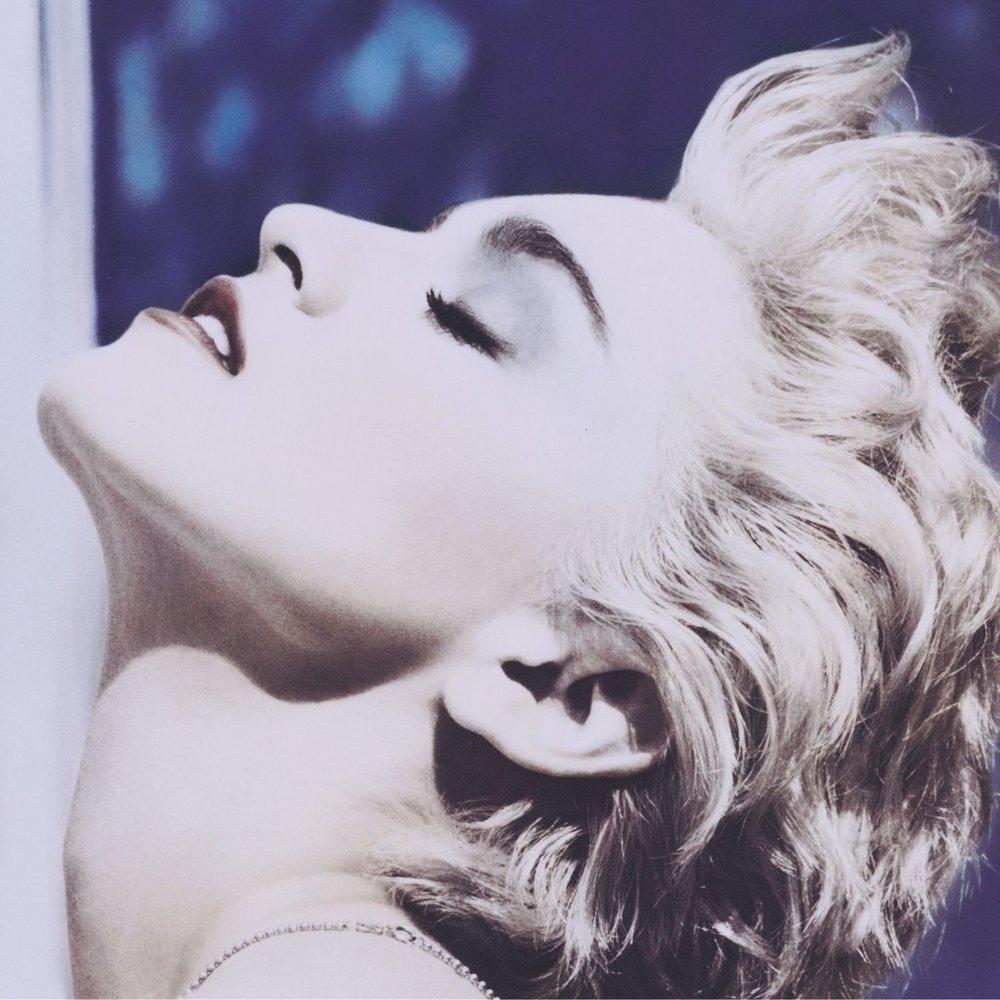
Madonna's third album, made in about 5 months with Patrick Leonard and Stephen Bray. It entered the UK chart at #1 and had 3 US #1 singles. The tracks between them are uneven.
- Released
- 30 June 1986 (the date the BPI gives, and on the US CD); 25 July 1986 in Japan
- Label
- Sire Records, marketed by Warner Bros. Records
- Producer(s)
- Madonna, with Patrick Leonard (6 tracks) and Stephen Bray (4); both are credited on 'Where's the Party'
- Runtime
- 39:47 across 9 tracks
- Chart peak (US)
- #1 (Billboard Top Pop Albums, on the chart dated 16 August 1986, its 5th week)
- Chart peak (UK)
- #1 (Official Albums Chart, on entry on 12 July 1986; 6 weeks at #1)
- Certifications
- BPI 7× Platinum (1992) · RIAA 7× Platinum (9 February 1995) · Music Canada Diamond (11 June 1987)
- Awards & honours
- 'Papa Don't Preach' nominated for the Grammy for Best Female Pop Vocal Performance
Five singles and a voice that now carries the production, then a side two that doesn't keep up. True Blue is a very good record with clear limits: her biggest-selling studio album in Britain, and not her best.
Paramount passed on it. Patrick Leonard had written the music for the studio's film Fire With Fire. The song went into At Close Range, Sean Penn's film, instead. Leonard told Music Business Worldwide that Madonna wrote the lyric in minutes and sang it once. Tom Breihan of Stereogum says that quick demo vocal is the one on the record. 'Live to Tell' reached #1 on the Hot 100 on the chart of 7 June 1986, weeks before True Blue came out. A film-score ballad, sung once, had become the first single from her third album.
True Blue is very good, and its limits are clear. Five of its 9 tracks were singles, and 3 of them went to #1 in America. Those five are the reason to own it. Between them sit weaker tracks, mostly on side two, that critics were already picking at in 1986. Its newest idea, in our reading, was Madonna herself: a pop star who co-produced every track. Its sound looks back, by the critics' own account, to Motown, the girl groups and 1950s R&B. That's a record to admire. It isn't one to revere. Reverence would need a record as good at track 8 as it is at track 1.
The record was made against a backlash. Like a Virgin had taken 11 weeks to reach #1 in America and had sold 6.5 million, by the New York Times's count. Robert Hilburn opened his Los Angeles Times review by asking whether 1986 wasn't supposed to be the year pop said goodbye to her. He blamed the hype of 1985. Davitt Sigerson's Rolling Stone review began with how she'd worked her fame, and reached the Playboy and Penthouse spreads by its third paragraph. Neither critic could talk about the new record without the old noise. True Blue took 5 weeks to reach #1, and Billboard's Paul Grein noted the gap in August 1986. It's the quickest way to see what the album did for her.
Her partners came from two chapters of her life. Stephen Bray had been her bandmate in Emmy in 1980. Leonard was musical director of her 1985 Virgin Tour, a job he took after she told him he'd be in charge. During a gap in the tour dates he held a barbecue at his house. There he played her the track that became 'Love Makes the World Go Round', and they performed it at Live Aid. After the tour she asked him to write with her. A third figure runs through the record: Sean Penn. She married him on 16 August 1985, and the sleeve dedicates the album to her husband. The title is a favourite expression of his. Our reading is that True Blue is partly a change of image. In June 1986 she described her new look, with short hair and less jewellery, as innocent and feminine, and Peter Piatkowski calls the record her first bid for artistic credibility.
Work began in December 1985 with 'Open Your Heart' and took about 5 months, according to Classic Pop. The routine was simple. Leonard sketched a song on piano. Madonna arrived around 11am, wrote the words and sang them. They finished about one song a day. Leonard has said that, for most of the songs, the vocal on the record was the only time she sang it in the studio. Leonard and Bray took turns as her co-producer, and 'Where's the Party' is the one track that credits both. The common line is that she co-wrote and co-produced every track. The sleeve bears it out, with one qualification. 'Papa Don't Preach' is Brian Elliot's song, written for Christina Dent, and she's credited only with additional lyrics. 'Open Your Heart' began with Gardner Cole and Peter Rafelson, who wrote it with Cyndi Lauper in mind. Her name sits beside theirs. That's the record's real method. She chose well, and she shaped what she chose.
'Papa Don't Preach' is the better of the two outside songs. Michael Ostin of Warner sent it to her. Stephen Holden of the New York Times reported that her changes to the words were minor. Sigerson heard its hook as the only one on the record to match her earlier hits. She knew enough to leave it alone. Bill Meyers arranged the strings, and the sleeve credits Bray, its co-producer, with keyboards and drums. Breihan hears a baroque string intro, a synth bass, a drum machine and a quasi-Spanish guitar solo. She doesn't sing until 0:31. The title phrase waits until 1:19, and she sings it 10 times in all. The song is about a pregnant teenager, and in June 1986 she predicted that people would take it the wrong way.
'Live to Tell' is the best thing here. It runs 5:45, and she doesn't sing until 0:53. Holden said it showed she could carry a weighty ballad. Sigerson heard a rewrite of 'Both Sides Now'. Slant's Sal Cinquemani called it a brave first single. In 2009 she told Rolling Stone that the song is true but not necessarily autobiographical. The voice is the point. The Evening Standard hears the high, sugary tone of her first 2 albums give way here to more personality and emotional depth. Hilburn wrote in 1986 that her singing had gained control and character, and now carried the production instead of leaning on it. That's the change that counts on this record. Her voice was now the main instrument.
'Open Your Heart' shows the method at its cleanest. Cole and Rafelson wrote it as 'Follow Your Heart'. Cole's second demo was sung by Donna De Lory, whom Madonna later hired for her 1987 tour. Madonna and Leonard remade it as dance-pop, and she rewrote enough of the words to earn a credit. Hilburn counted it among the flat spots in 1986. Breihan gave it 10 out of 10 in 2021. Breihan is closer to right. The production around it is plain on purpose. Sigerson wrote that the record avoids Nile Rodgers-style showpieces, and Holden found it less sleek than Like a Virgin. Plain production leaves a song nowhere to hide, and that's why the weak ones show.
The two other big singles look backwards. 'True Blue' was written and produced by Madonna and Bray. Holden heard Motown and the girl groups in it and named 'Chapel of Love'. Hilburn heard 1950s R&B crossed with Phil Spector and named 'Be My Baby'. Sigerson thought it wasted its beat. Classic Pop says Leonard first offered 'La Isla Bonita' to Quincy Jones for Michael Jackson's Bad. Jones turned it down, and Madonna took it. Piatkowski takes seriously the charge that it borrows from another culture. Both were #1 in Britain, and both are craft, not invention. That's the record's limit on novelty.
The weak spot is side two, and its closer shows it. Hilburn called 'Love Makes the World Go Round' a flat spot in 1986. Cinquemani called it a clunker in 2003. It has defenders. Piatkowski granted in 2021 that some hear it as filler, then called it excellent filler. We side with Hilburn: the message weighs the song down. Critics pick at its neighbours too. Sigerson said 'Where's the Party' starts well but doesn't ignite. Cinquemani put 'Jimmy Jimmy' beside the closer as clunkers. Side two holds 2 of the 5 singles, but it opens and closes on the tracks the critics single out. A record built around hits can survive a weak closer. It's harder to survive 'Jimmy Jimmy' and the closer back to back.
The record also started an argument. In the summer of 1986 the attorney Gloria Allred demanded a public statement or an answer record from Madonna, and said anti-abortion groups were using 'Papa Don't Preach'. Tipper Gore, whose Parents Music Resource Center had singled out Madonna's songs before, called it "an important song, and a good one". The columnists Mick LaSalle and Judy Markey attacked it. Elliot said right-to-life groups had called him, and that people told him he was a voice of the New Right. He said he'd had no agenda. Madonna said in 2009 that she liked that nobody could tell where she stood. Robert Christgau, who graded the album a B, called the song's ambiguity a cop-out. He had a point. A song that never says where it stands can't be pinned to a side, and that's what kept the argument going.
What the album changed is easier to measure than what it influenced. It entered the UK albums chart at #1 on 12 July 1986, and the Official Charts Company says no US artist had done that before. It spent 6 weeks at #1 and was Britain's biggest-selling album of 1986. In America it reached #1 on the chart dated 16 August 1986, the week 'Papa Don't Preach' topped the Hot 100. That was her first simultaneous #1 album and single. Songs travelled further than the album. Breihan traces the strings of 'Papa Don't Preach' into Brazilian baile funk and M.I.A.'s 'Bucky Done Gun'. Kelly Osbourne's cover entered the UK chart at #3 in 2002. The influence is real, but it lives in songs.
Later critics have been harder on the album than on its singles. Cinquemani said in 2003 that its keyboards and drum machines date it. Stereogum ranked it 6th of her 13 albums in 2015 and called it disjointed. Spin's Al Shipley wrote in 2024 that it's by far the least fun of her 1980s albums. He also wrote that the title song of Like a Prayer found the gravitas she'd been reaching for here. We'd split his first verdict. The singles are fun. The album isn't, because side two takes the fun away. Shipley also picked out 'White Heat', which opens with dialogue from the 1949 film of the same name and is dedicated to Jimmy Cagney. It's the deep cut worth finding.
So True Blue is two things. It's a set of singles that justify the fame, and an album that doesn't quite justify itself. Breihan rates 3 of the singles 9 or 10 out of 10, and he's right to. The voice is better than it was. But the sound looks back, side two sags, and the hits sit unevenly across the running order. It's a very good record with clear limits. Admire it for 'Live to Tell', 'Open Your Heart' and 'Papa Don't Preach'. Don't mistake it for her best. On our scorecard it sits below Like a Prayer, made 3 years later with the same two partners.
Which pressing to own
The pressing to own is a clean US original, Sire 1-25442, with its colour poster and lyric inner sleeve. On 16 October 2026, 14,477 collectors recorded owning it in its catalogue entry. More own the European 925 442-1, at 20,884, and 4,813 own the UK-cut WX 54. The catalogue entry shows 11 US runout variants and nothing to say which came first, so there's no first-state story to chase. Buy on condition.