
Deep Dive · Beyond the Hundred
Back in Black
Back in Black by AC/DC (1980) — what a copy is worth and which pressing to own, in a full Lead-In dossier: AC/DC lost their singer in February 1980 and had a finished album by May.
Back in Black by AC/DC (1980) — what a copy is worth and which pressing to own, in a full Lead-In dossier: AC/DC lost their singer in February 1980 and had a finished album by May.
AC/DC lost their singer in February 1980 and had a finished album by May. Bon Scott was dead at thirty-three; Brian Johnson had been in the band a matter of weeks; the sleeve was painted black as a headstone. It went on to outsell every rock record ever made.
AC/DC's seventh studio album and first without Bon Scott, who died on 19 February 1980 just as the band was about to begin it. Ten tracks, 42 minutes, cut in 7 weeks in the Bahamas with Mutt Lange and a singer who had been in the band for days. The all-black sleeve was a sign of mourning. The record became the biggest-selling rock album ever made.
On 19 February 1980, Bon Scott was found dead in a car parked in East Dulwich, south London, after a night of heavy drinking. The coroner recorded death by acute alcohol poisoning; he was 33. AC/DC had spent six years and six albums clawing toward the front rank, and had finally arrived: Highway to Hell, released in July 1979 and produced by Robert John "Mutt" Lange, had reached US #17 and turned a relentless Australian touring act into an international one. Scott's death came weeks before sessions for the follow-up. The surviving members — brothers Angus and Malcolm Young at the centre — seriously considered ending the band.
They decided to continue, and they decided fast. Lange was in London producing a band called Broken Home at Battery Studios when the call came through about Scott. Within weeks the Youngs were auditioning singers and couriering cassettes to Lange for his verdict. The man they chose was Brian Johnson, a thirty-two-year-old from Newcastle who had fronted the glam-era band Geordie and was, by his own account, fitting industrial windscreens for a living when AC/DC called. He was hired almost immediately. The lyrics he would sing were written in the Bahamas, often through the night, and he recorded them in fragments — a verse here, a chorus there — frequently without hearing a finished song. "That's the way Mutt keeps you interested," Johnson said later.
The album was recorded over roughly 7 weeks in April and May 1980 at Compass Point Studios in Nassau, Chris Blackwell's facility on the Bahamian coast. The band had wanted to work in Britain; no studio was free, and the Bahamas carried a tax advantage. The room itself was unglamorous — Johnson described "little concrete cells" run by a formidable landlady who warned them to lock their doors against night-time robbers — and the band's gear was briefly impounded by customs as a hurricane passed through. They worked late, fuelled (Malcolm Young's recollection) by rum cut with coconut milk, and the album that came out of it is the most disciplined AC/DC ever made: space where lesser bands would have crammed in notes, Phil Rudd's drums sitting dead on the beat, Cliff Williams's bass locked to them, and the Young brothers' guitars arranged by Lange into something that hit harder for hitting less often.
It opens with a funeral. "Hells Bells" begins with the slow toll of a two-thousand-pound bronze bell, cast by John Taylor Bellfounders of Loughborough in Leicestershire and recorded — because the bell the band had ordered for touring had not yet been delivered — by engineer Tony Platt using Ronnie Lane's mobile studio after the Bahamas sessions wrapped. From there the record is a study in controlled menace: the title track built on one of Angus Young's most-quoted riffs, "Shoot to Thrill" and "Have a Drink on Me" driving on the same locked groove, and "You Shook Me All Night Long" reaching for a melodic pop appeal the band had only flirted with before. Initially only nine songs were written; "Rock and Roll Ain't Noise Pollution" was added to finish the record, and it became, at UK #15, the highest-charting single the album produced.
Atlantic released Back in Black on 25 July 1980. It went straight to #1 in the UK and reached #4 in the US, where it stayed on the Billboard 200 for 131 weeks. The singles barely registered by the standards of the sales that followed — "You Shook Me All Night Long" became, at #35, AC/DC's first US Top 40 hit, and the band remains one of the major classic-rock acts never to land a US Top 20 single. The album did not need singles. It sold on album-rock radio, on word of mouth, and on the live show, and it kept selling: an estimated fifty million copies worldwide, the best-selling rock studio album in history and, on most counts, the second best-selling album of any kind behind Michael Jackson's Thriller. The RIAA certified it Diamond and, by July 2024, 26× Platinum in the United States alone.
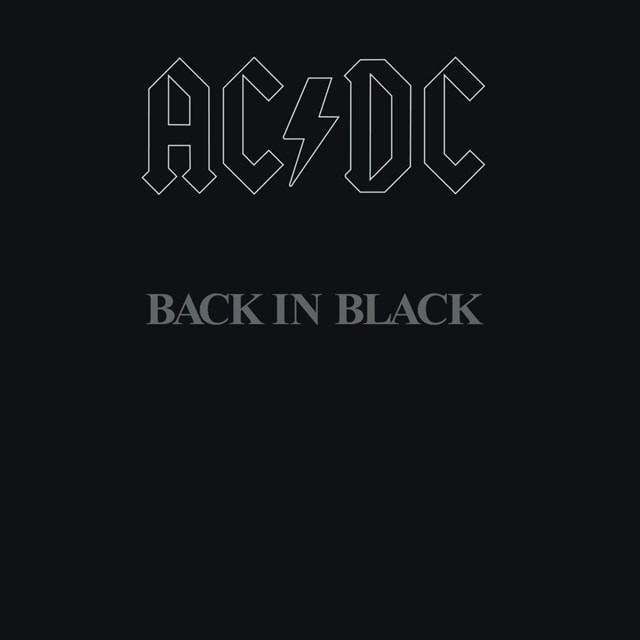
Back in Black is not in our hundred, and the only reason is that the hundred is closed at a hundred. By any other measure it belongs in the conversation. It is the rare album that turned catastrophe into definition: a band that had literally lost its voice produced, within months, the record that would define it forever and would set the commercial template for hard rock as a stadium-scale mass form. Every Metallica, Guns N' Roses, and Foo Fighters arena moment that followed is downstream of the proof Back in Black offered — that heaviness and enormous popularity were not opposites. And the sleeve, black on black with the embossed logo barely catching the light, remains one of rock's great pieces of grief-design: a headstone you could buy in a record shop.
The origin grail is the 1980 Australian first pressing on Albert Productions, APLP.046 — red label with yellow strobe marks, embossed logo and title on the all-black sleeve, with the fold-out picture/credits insert, made by EMI (Australia) Ltd, Sydney. Its runout carries the stamped 'APLP 046 A / B MAXICUT' from EMI Australia's in-house Maxicut lathe technology; this is an EMI Australia cut, not Robert Ludwig's. The audiophile alternative is the US Atlantic SD 16018 'RL' cut, Ludwig's mastering identified by the etched 'RL' and 'MASTERDISK' stamp in the deadwax, which collectors prize over the more common later US pressings that dropped it.
© The Lead-In · an independent, reader-supported music publication.