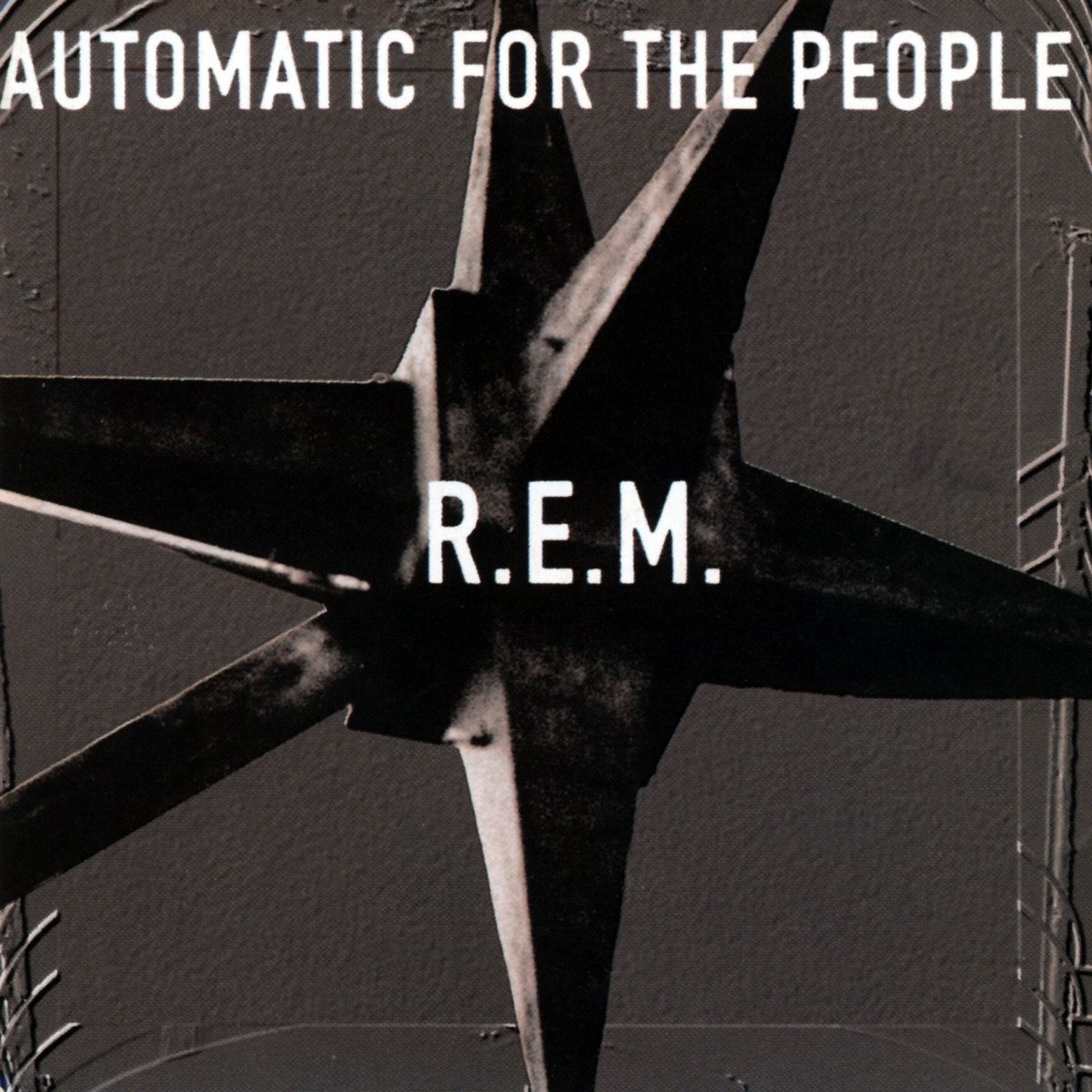
R.E.M.'s eighth album, made at the height of their fame and never toured: 12 mostly slow, plain songs about death and memory, four of them scored by Led Zeppelin's John Paul Jones.
- Released
- 5 October 1992 (UK and Europe); 6 October 1992 (US)
- Label
- Warner Bros.
- Producer(s)
- Scott Litt and R.E.M. (engineer: Clif Norrell)
- Runtime
- 48:52 (12 tracks)
- Chart peak (US)
- #2 (Billboard 200), behind Garth Brooks's The Chase
- Chart peak (UK)
- #1 (Official Albums Chart), 4 weeks at #1 in four separate runs
- Certifications
- BPI 8× Platinum (January 2025); RIAA 4× Platinum (February 1995)
- Awards & honours
- #3 in the Village Voice Pazz & Jop critics' poll for 1992. Four MTV Video Music Awards for the 'Everybody Hurts' video
R.E.M. set out to follow Out of Time with a loud record and made a quiet one about mortality instead. It holds the best songs they wrote, and it falters only where the band tried to lighten the mood or raise its voice.
Peter Buck didn't expect it to be a huge hit. Looking back in 2017, he called Automatic for the People "kind of a down record with a lot of minor keys", made while Michael Stipe was thinking a lot about mortality. It went in at #1 in Britain in October 1992. It returned to #1 three more times, the last in May 1993. In America it reached #2, behind Garth Brooks's The Chase. By Billboard's count in 2017, it had sold 18 million copies worldwide.
Buck's description is accurate, and it's also why the record works. Its songs are about dying, grieving and remembering, and nearly all of them move slowly. What keeps it from sinking is how little each song asks for: a plain tune, a small arrangement, room left empty. This is the best set of songs R.E.M. wrote. It slips twice, on a song included to lighten the mood and a song left over from a louder plan. Members of the band later doubted both.
The quiet wasn't the plan. From June 1991, Buck, Mike Mills and Bill Berry met in their rehearsal room on West Clayton Street in Athens, Georgia. They did it largely without Stipe, and the three swapped instruments. Buck remembers a list of about 25 songs. The first were hard, fast rockers like the ones on Document, and only 'Ignoreland' made the album. As the work went on, Buck told the biographer Tony Fletcher, the songs they kept were "discordant, almost morose". Some of that tone predates the rehearsals. Buck remembers Stipe and Mills doing 'Nightswimming' while Out of Time was being mixed, and there were already demos of 'Drive' and 'Try Not to Breathe'. He says those three set the direction.
Nobody had to play these songs in an arena, either. After an 11-month world tour for Green, R.E.M. came off the road in 1989. They didn't tour Out of Time, and they didn't tour this. Their manager, Bertis Downs, said in 2017 that skipping tours for your two biggest albums was "not in the playbook". The band's only show of 1992 was a benefit at the 40 Watt Club in Athens on 19 November. You can hear the freedom in the songs, which rarely reach for a crowd. The absence had a cost. After Freddie Mercury's death, tabloids speculated that Stipe, who was very thin, had AIDS. A dark album and no tour fed the rumour. Mills dismissed it, and Buck said the whole band had been tested.
It was built in pieces. The main demos were cut at John Keane's studio in Athens in February 1992. Early that year the band spent about a week at Daniel Lanois's Kingsway studio in New Orleans, where much of 'Drive' was played live to tape. The sleeve lists five recording studios in four states, with Bearsville in upstate New York and Criteria in Miami doing the heavy lifting. Scott Litt, who co-produced with the band, mixed it with the engineer Clif Norrell at Bad Animals in Seattle. Some of the finished tracks barely left the demo stage. Mills said 'Sweetness Follows' is "mostly a demo", and it's one of the best things here.
The one grand gesture is the strings, and even they are rationed. Litt had heard string arrangements John Paul Jones wrote for Herman's Hermits in the 1960s, so the band got in touch with Led Zeppelin's bassist about scoring four songs. Four demos went to him, with a handwritten letter from Stipe. A 12-piece string section, conducted by George Hanson, recorded the parts at Bosstown in Atlanta. Rolling Stone says the players came from the Atlanta Symphony Orchestra. They're on 'Drive', 'The Sidewinder Sleeps Tonite', 'Everybody Hurts' and 'Nightswimming', and nowhere else. Its reputation as a string record rests on four of its 12 songs. That restraint is the point: the strings arrive as an event, not a coating.
The opening pair sets the terms. 'Drive' is a strange first single: slow, in a minor key, its refrain nodding to David Essex's 'Rock On'. Both Paul Evans in Rolling Stone and Richard Cromelin in the Los Angeles Times caught the reference in 1992. It has the patience of a band in no hurry. Then 'Try Not to Breathe' puts Stipe in the voice of an old person deciding how to die. He later tied it to his grandmother. Evans read it as an allusion to Jack Kevorkian, whom he called the "suicide doctor". Either way, two songs in, the record has told you what it's about, and it hasn't raised its voice to do it.
'Everybody Hurts' shows how little the band needed. Berry wrote most of it, Mills said, yet he barely plays on the album version: a drum machine keeps time. Mills says the model was an Otis Redding ballad with Steve Cropper's arpeggiated guitar. Evans heard spare electric-piano triplets carrying the melody. Nothing in the arrangement competes with the vocal. After Stipe's last line at 4:36, the song plays on for about 40 seconds without him. The plainness is the point.
'Sweetness Follows' is harsher, and better for it. It has no bass at all, Mills said. Knox Chandler's cello, played through an amp, does that job, with Buck's feedback underneath. Buck said the song would be "too saccharine" without that discordant cello. He was right. The noise is what makes the title's promise of comfort sound fought for rather than handed out. 'Star Me Kitten' gets its strangeness another way. Mills wanted the backing-vocal sound of 10cc's 'I'm Not in Love'. Litt's idea was to sample him singing seven notes and give each note its own fader on the mixing desk. Mills then played his own voice by moving the faders. It's a studio trick, and the most inventive sound on a record that mostly avoids them.
'Man on the Moon' was the last piece in place. The music began as an instrumental called 'C to D Slide', after a chord change that was apparently an accident of Berry's. The band loved it, but Stipe had nothing. He asked for a couple of days walking around Seattle with headphones on, and came back with a song about Andy Kaufman. The vocal was recorded on the day the album went to the label. It's the warmest song here, and the funniest. 'Nightswimming' is its opposite: Stipe had the words first, and Mills won the contest to set them. Mills says he wrote the piano part on the Criteria piano that Jim Gordon played on the coda of 'Layla'. That doesn't fit Buck's memory of the song existing during the Out of Time mix, and the sources don't reconcile the two. Buck tied the lyric to skinny-dipping after Athens shows. Stipe says most of it is made up.
The two weak spots are the two songs that do a different job. 'The Sidewinder Sleeps Tonite' was put there, Buck wrote, to break the album's prevailing mood. In the same note he said the band's consensus was that it "might be a little too lightweight". That's kind to it. It leans on 'The Lion Sleeps Tonight', and Jones's strings dress up what is really a novelty. You can hear Stipe laugh at his own fluffed line at 2:33, which is charming once. 'Ignoreland' has the opposite problem. It's the last survivor of the planned rock record, a Neil Young-tuned attack on 12 years of Reagan and Bush. Stipe later called it a barely adult reaction to Iran-Contra, and within a couple of years he and Mills wished it off the album. Its anger is real, but the song never gets further than being angry.
What it changed is harder to pin down than its reputation suggests. We found no musician naming it as the model for a record of their own. Its working method, swapping instruments in rehearsal, was tried on Out of Time first. Richard Cromelin, reviewing it for the Los Angeles Times, heard the band going further into the "rusticated chamber music" of that record. So this is a refinement more than an invention. What it proved was commercial. A slow, mostly acoustic record about death spent 245 weeks in the UK Top 100 across its runs. In America it had sold 3.52 million copies by 2017, by Nielsen SoundScan's count. 'Everybody Hurts' reached #7 in Britain, and in February 2010 a charity version for Haiti went to #1.
Its standing has barely moved since 1992. US critics put it third in that year's Village Voice Pazz & Jop poll, behind Arrested Development and Pavement. Robert Christgau gave it only a three-star honourable mention. Pitchfork scored the 2017 reissue 9.3. The most interesting doubt comes from inside the band. Buck said in 2017 that it's a strong record, but he's "a little confused with what we came up with". He stopped short of calling it his favourite. All their records mean different things to him, he said, and Murmur was the childhood dream he'd had since he was seven. You can see why this one puzzles him. With America's #2 album, R.E.M. had made a record whose best moments rest on a piano, a drum machine and a cello through an amp.
So this is a great record with two wrong turns, and the wrong turns show why the rest is right. When R.E.M. trusted slow songs and small arrangements, they wrote 'Everybody Hurts', 'Nightswimming', 'Man on the Moon' and 'Sweetness Follows'. When they worried that the mood was too heavy, they made 'Sidewinder'. When they reached back for the loud plan, they made 'Ignoreland'. Neither sinks the album, and the sequence carries both, but they're the two songs here you'd least miss. It didn't reinvent the band, and it didn't need to. As a set of songs it's the best thing R.E.M. made, and 34 years on the quiet ones still hold the room.
Pressing guide — the one to own
The two originals most buyers meet are easy to tell apart. The UK and European LP (Warner Bros. 9362-45055-1, order number WX 488) was pressed in Germany at WMME Alsdorf. The US LP (9 45055-1) was cut with Direct Metal Mastering and pressed by Specialty Records. The trap is the 1999 European repress, made from the original stampers: its runouts add the code B922353, and the original's don't. On the US side, a 1992 copy has DMM in the runout and the 1999 reissue doesn't. For a modern copy, the 2017 Craft Recordings 180g LP (CR00046) was cut by Chris Bellman at Bernie Grundman and pressed at RTI. Smaller 1992 LP runs also came out in Brazil, South Korea, Colombia, Guatemala, Ecuador and Croatia.