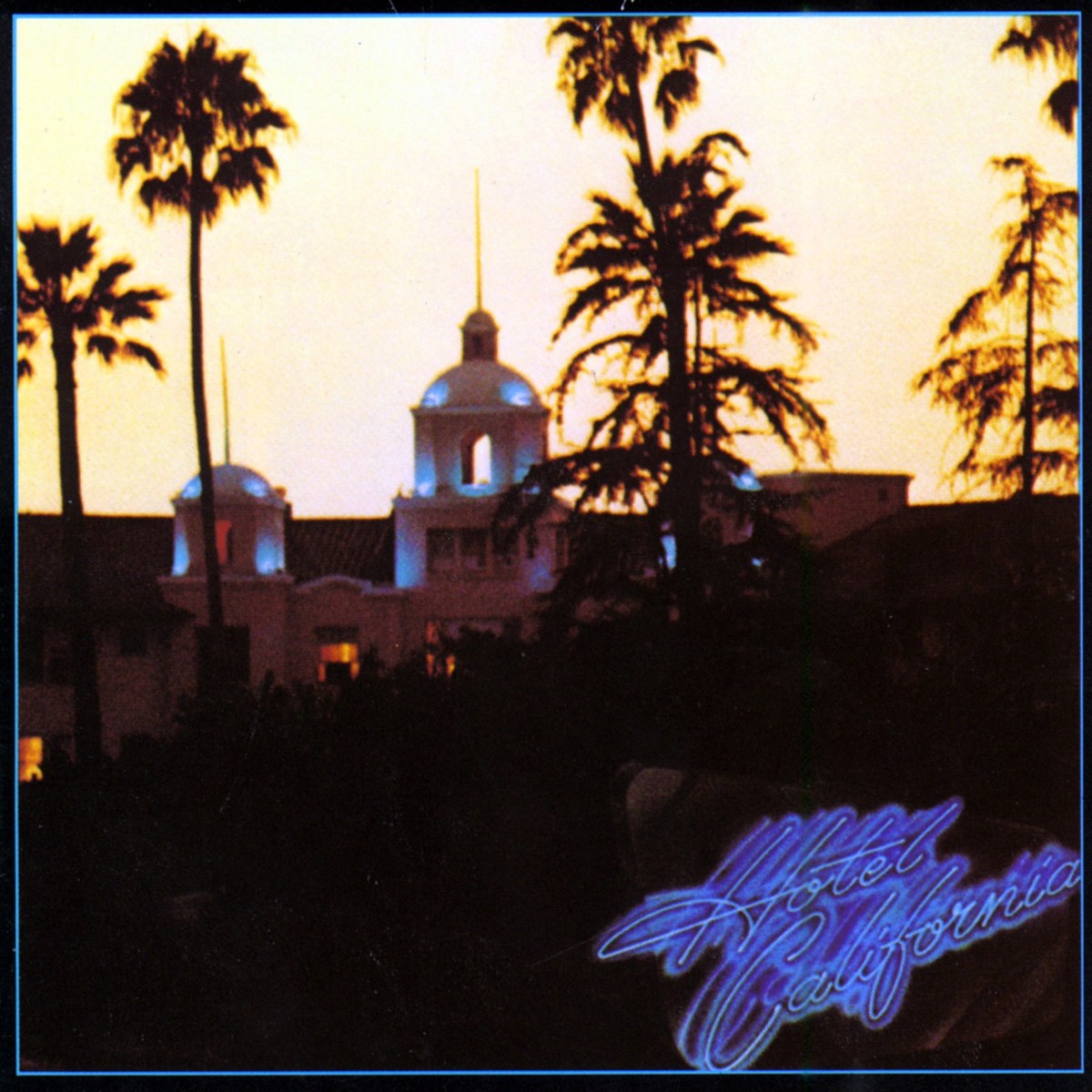
The Eagles' fifth album, the first with Joe Walsh and the last studio album with Randy Meisner: a bicentennial-year warning about California, made in two cities over most of 1976.
- Released
- 8 December 1976
- Label
- Asylum Records (US 7E-1084; UK K 53051, through WEA)
- Producer(s)
- Bill Szymczyk
- Runtime
- 43:28 across 9 tracks
- Chart peak (US)
- #1 (Billboard 200), 8 weeks at the top, first reached on the chart dated 15 January 1977
- Chart peak (UK)
- #2 (Official Albums Chart), 5 weeks at #2 behind ABBA's Arrival
- Certifications
- RIAA 28× Platinum (22 January 2026), the RIAA's third-highest-certified album; Music Canada Diamond (12 January 1988)
- Awards & honours
- Record of the Year ('Hotel California') and Best Arrangement for Voices ('New Kid in Town') at the 20th Grammy Awards, 23 February 1978. Nominated for Album of the Year, which Rumours won
Hotel California is an album about excess made with almost total control, from a title track spliced from 33 edits to a coda Henley wanted played as on the demo. The control makes it sound superb, and it's why the record rarely surprises.
At Criteria Studios in Miami, in 1976, Don Felder and Joe Walsh started jamming over the end of 'Hotel California'. By Felder's account, Don Henley stopped them. He wanted the guitar parts played just like Felder's demo. Felder had made that demo a year earlier, and he couldn't remember what was on it. The cassette was at his house in Malibu. So his housekeeper put it in a tape player and held the phone up to it, and Felder played what he heard down the line. Walsh copied the answering phrases, which Felder had played on the demo in Walsh's style. The result, Felder says, was close enough to the demo to make Henley happy.
That phone call is the whole record in small. Hotel California is an album about getting trapped by excess, and it was made under something close to total control. The producer, Bill Szymczyk, remembers the coda differently. In his account it took about 2 days, with a guitarist either side of him, punching in parts that hadn't really been written. Our reading is that both men are right: the demo was the map, and the details were found in the room. What nobody disputes is the care. Szymczyk had built the basic track from 33 edits before a lead guitar went on. The control is why the record still sounds so good. The production and the playing are the best the Eagles ever managed. It's also the record's limit. It polishes what the band already did well more than it finds anything new. And when it turns from describing excess to judging it, it can sound like a lecture from the penthouse.
The pressure was commercial before it was artistic. One of These Nights had given the band three Top 10 singles. Their Greatest Hits 1971–1975 came out in February 1976, and work on the next album began the following month. Glenn Frey later said the band felt under the microscope, and that he and Henley kept telling each other it had better be good. Szymczyk said the same thing in different words. The line-up had changed as well. Bernie Leadon, the founder most tied to the country side of their sound, left in December 1975, and Walsh replaced him. Felder has said they were trying to get heavier, away from country rock.
Szymczyk had a condition of his own. He was living in Miami and wanted to work at Criteria, while the band preferred Los Angeles. So they split the album down the middle. Half was cut in Studio C at the Record Plant, half in Studio C at Criteria. They'd spend a month in one city, take 3 or 4 weeks off to write lyrics, then spend a month in the other. The sleeve dates the sessions from March to October 1976. The mix stayed in one place, at Criteria. Splitting an album between two cities could have made it patchy. It didn't, because the method went wherever Szymczyk went.
Henley gave the clearest account of what they were making. He told the Dutch magazine ZigZag, shortly before the album came out, that it was a concept album, set in the city rather than the old West. It was the country's bicentennial year, and he wanted a statement about America, with California as a small model of it. The aim was to warn people that things had to change. Frey's idea was more cinematic: one shot after another, like an episode of The Twilight Zone, with listeners left to draw their own conclusions. He said Steely Dan's willingness to put anything in a song pushed them towards the bizarre. That's the right way to hear the title song. It's a sequence of images, not a puzzle with an answer, and decades of argument about its meaning come from treating a film as a riddle.
The record's real strength is how Szymczyk built its basic tracks. The band always recorded together, playing live in the room. He'd keep the five or six best takes, pick the best intro, the best verse and so on, and join them on the tape by hand. While he cut, he sent the band off to play pool. The title song took three versions. The first was just a riff. The second was in the right key but too fast. The third, cut in Miami, was the one, and by Szymczyk's count its two-inch master holds 33 edits. Even the key took work. Felder's demo was in E minor, and Henley sounded too high on it. They tried D minor, C minor and A minor before settling on B minor.
You can hear what all that care bought. The song lets its 12-string introduction run for 52 seconds before Henley sings a word. Felder thought the song was the wrong shape for a single. The intro was too long, the drums dropped out in the middle and the guitars ran for 2 minutes at the end. Henley announced it as the single at the label's playback party anyway, and it went to #1. The reggae lilt from the working title, 'Mexican Reggae', is there but folded in. Reviewing the album for Rolling Stone in February 1977, Charley Walters said you felt it more than heard it. At 4:17 the last line is sung, and the coda takes over for a little over 2 minutes. Felder played a 1959 Les Paul through a 1950s Tweed Deluxe, and Walsh a Telecaster. Wherever its phrases came from, the demo or those two days, the coda sounds composed. Each answering phrase lands where you expect it, which is why it thrills on a first hearing and rarely surprises after that.
The rest of the album shows the same care in different ways. 'Life in the Fast Lane' grew from a riff Walsh played at a band rehearsal, and Frey already had the title, from a ride with his drug dealer. Frey said later the song was meant to show that cocaine turns on you. Near the fade, Szymczyk phased the end of the track by running two tape machines against each other, a trick Gary Kellgren had taught him. Henley and Frey worried it would sound like 'Itchycoo Park'. It stayed. 'Victim of Love', on side two, runs the other way. Its instrumental track was cut by all five players at once and kept with no overdubs; only the vocals went on later. Szymczyk etched V.O.L. IS FIVE PIECE LIVE into the run-out groove. Rolling Stone later read it as an answer to critics who called the band clinical in the studio. On an album whose title song holds 33 edits, it's a telling thing to be proud of.
That song also shows the cost of the control. The lead vocal was Felder's at first. Henley says Felder sang it many times over a week without getting it up to the band's standard. Irving Azoff, their manager, broke the news to Felder over dinner, and Henley's vocal went on instead. Felder later called it a bitter pill, though he said he couldn't argue with the result. Listen to it and he's right. Henley's voice is the album's main instrument, and he sings five of its eight songs. But the record that came out of those rooms is a record run by two writers. Henley and Frey share the credit on 7 of its 9 tracks.
The album's weak point is the stretch either side of the turn. 'Wasted Time' closes side one as a big Henley ballad, with strings arranged and conducted by Jim Ed Norman. Walters called it over-arranged in 1977, and he was right. The song is sturdy. The arrangement keeps telling you how to feel about it. Then side two opens with 82 seconds of the same strings and no voice at all. After 'Victim of Love' the album loosens its grip. 'Pretty Maids All in a Row', Walsh's only lead vocal, is gentle and slight. 'Try and Love Again' is Randy Meisner's song, on his last studio album with the band; he left in September 1977, citing exhaustion. Both are good songs. Neither has the drive of side one.
'The Last Resort' is where the argument gets fierce. It runs 7:25, Henley's long song about the settlement of the West and what the settlers ruined. It had to be recorded several times at Criteria because Black Sabbath, making Technical Ecstasy next door, came through the wall. Walters praised it in 1977. In his Consumer Guide, Robert Christgau called it 'pretentious and condescending'. The music sides with Walters, and the long instrumental break from 3:06 gives the final verse at 4:19 room to land. But Christgau's charge isn't wrong. The song describes a ruined country from a long way above it, and it never doubts its own narrator. Christgau's wider complaint was that Henley can't convey self-criticism. Here he doesn't try.
Commercially, nothing about it stayed uncertain for long. It reached #1 on the Billboard 200 on 15 January 1977 and spent 8 weeks there. 'New Kid in Town' and the title song both topped the Hot 100. At the Grammys on 23 February 1978 it won Record of the Year and lost Album of the Year to Rumours. The band stayed away. Rolling Stone reported that Azoff wouldn't let them play, or even attend, without a guaranteed win. In January 2026 the RIAA certified it 28× Platinum, which makes it the third-biggest album in its records. Only the band's own Their Greatest Hits and Michael Jackson's Thriller are higher. The worldwide figures are softer. The 42 million you'll often see quoted rests, as usually cited, on a 2018 newspaper preview of a tribute concert.
What it changed is harder to show than what it sold. Billboard's own review in December 1976 heard layered harmonies and soft rock, and no new departures apart from the title track. That still sounds fair. The record finishes a move the band began on On the Border, when Szymczyk replaced Glyn Johns because Henley and Frey wanted more rock. Its documented afterlife belongs mostly to one song. The Gipsy Kings recorded it in 1990, and the Coen brothers used their version in The Big Lebowski. In 2011 Frank Ocean sang a new song, 'American Wedding', over the Eagles' master recording, and in 2012 a spokesman for the band called it illegal. Critics have cooled. Rolling Stone ranked the album #37 among the 500 greatest in 2003 and 2012, then #118 in 2020.
So it's a very good record with clear limits. Its best songs are as carefully made as anything in 1970s American rock, and the production still sounds expensive in the right way. But almost everything on it is the band doing what it already did, only better. Its strings get heavy on 'Wasted Time', and its conscience gets heavy on 'The Last Resort'. The cooling of its reputation is a fair correction. Admire the craft, play side one loud, and don't let 28× Platinum talk you into reverence.
Pressing guide — the one to own
The 1976 US original is Asylum 7E-1084: a gatefold with a printed inner sleeve of credits, and in initial copies a fold-out black-and-white poster of Norman Seeff's band portraits. Several plants pressed it in 1976, including Columbia's Santa Maria plant (CSM) and Specialty (SP), and no source says which came first. The runouts are the fun part. Retail copies carry etched messages: 'IS IT SIX O'CLOCK YET?' on side A and 'V.O.L. IS FIVE PIECE LIVE' on side B. They also carry a stamped STERLING and an etched LH, for Lee Hulko, though some genuine originals lack one or the other. The copy to know is the RCA Music Service club edition. It shares the catalogue number, but its stamped R 130030 runouts and missing messages give it away.