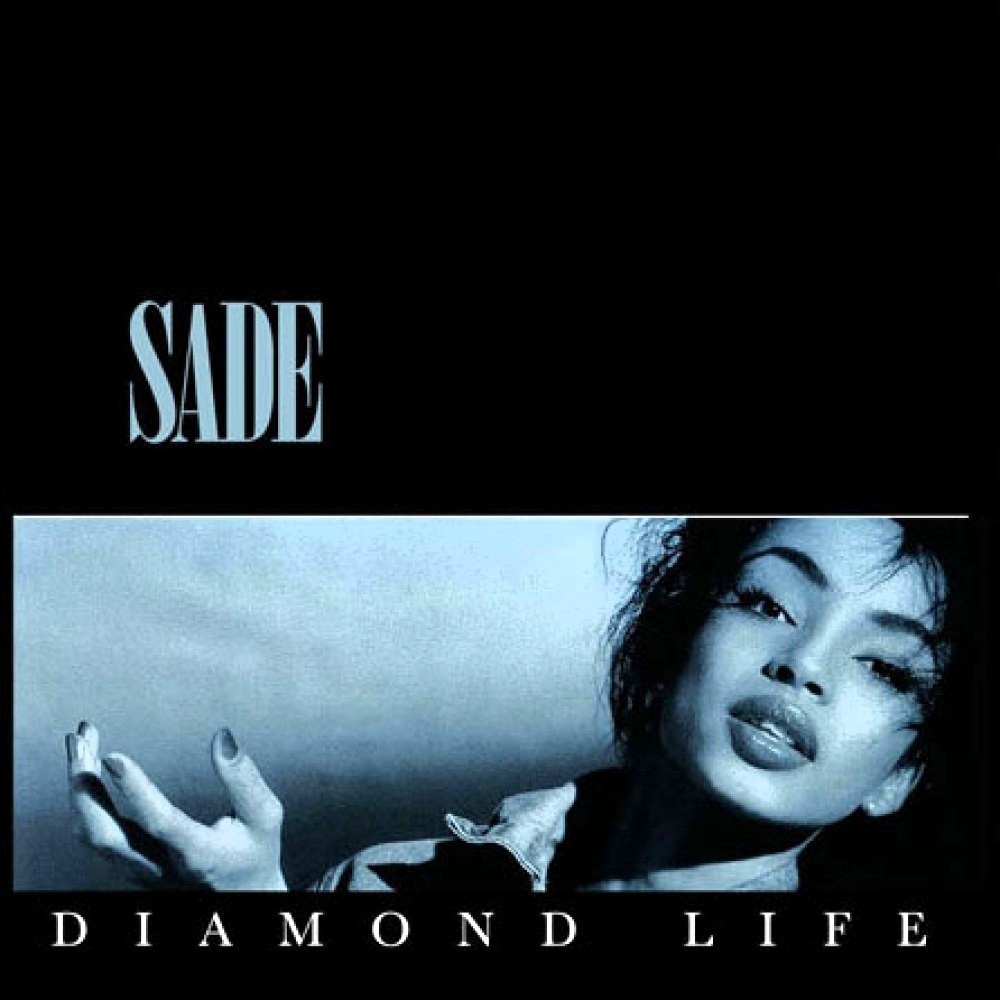
Sade's debut is remembered as a quiet stand against 1984's machines. Its two best-known songs have a sampled kick drum, and the people who made it tell a plainer story.
- Released
- 16 July 1984 (UK, Epic); early 1985 (US, Portrait), on the Billboard 200 from 23 February 1985
- Label
- Epic (UK and Europe); Portrait (US)
- Producer(s)
- Robin Millar
- Runtime
- 44:25 (UK sleeve timings), 9 tracks
- Chart peak (US)
- #5 (Billboard 200, chart dated 1 June 1985), 81 weeks on the chart
- Chart peak (UK)
- #2 (Official Albums Chart), 99 weeks on the chart; kept off #1 by Legend, Now 3 and The Unforgettable Fire
- Certifications
- BPI 4× Platinum (2 March 1987); RIAA 4× Platinum (2 February 1995)
- Awards & honours
- Brit Award for British Album, 1985. Grammy for Best New Artist, won by the band, at the 28th Grammy Awards on 25 February 1986
Diamond Life's famous space wasn't a manifesto. It came from a band whose saxophonist says none of them were great musicians, a singer who wouldn't push and a producer who knew where to leave the gaps. That makes it lovely, and narrow.
Before Sade had a record deal, Robin Millar fitted them into his studio around paying clients. They worked evenings and weekends, and in that first week they cut two songs, 'Smooth Operator' and 'Your Love Is King'. Those are the versions on the album. Millar told the Guardian in 2011 that they were never remixed. That week a real piano and a Fender Rhodes had to be synced by hand, without MIDI, which forced the band to fix their parts. Every label turned them down. The tracks were too long and too jazzy, the labels said, and "everything is electronic drums now". What the legend leaves out is that the drums on both songs were already partly sampled. Millar had replaced the kick and snare: the bass drum came from a Linn drum machine, the snare from a sample of his own old drum. He left the overhead microphones open, so the drummer's dynamics still came through. He calls it his one concession to the time.
That detail undoes the usual story. Rolling Stone set it out in 1985: a record of simplicity and understatement in a pop scene full of gimmicks fighting for attention. Read that way, Diamond Life is a quiet refusal, made by a band that knew exactly what it was turning down. The people who made it tell it more plainly. Sade Adu told the same magazine that the band didn't sit around deciding to create a sound. Stuart Matthewman says none of them were great musicians, and that 10 or 20 per cent more skill would have been too much. So the space on this record is real, but it came from limits, and from a producer who knew where to put the gaps. That's the case for the album and the case against it. It's a beautifully made debut by a band that hadn't yet learned to vary itself, and across nine songs you can hear the craft and the sameness side by side.
The band was built around Adu before it had a sound. She'd come to London at 17 for a three-year fashion and design course at St Martin's, then designed and sold menswear. Lee Barrett, who managed a band called Pride, asked her to try backing vocals. Matthewman had moved down from Hull and answered an advert for a saxophonist in a fashion-conscious jazz-funk band. That was Pride: a seven-piece with a male singer, playing funk, Latin and a little disco. Barrett suggested Adu and a few of the players do their own set between Pride's. Audiences took to her more than to the main band, and in the end the rest of Pride told them to go it alone. Three of them left: Adu, Matthewman and the bassist Paul Denman, playing their early gigs with a drummer. Andrew Hale joined later on keyboards, because they needed a fuller sound on stage, and by the time they signed the drummer was Paul Cooke. Millar says the name was Adu's own idea, and the others agreed.
Millar met them through a benefit record. He was recording a song about Chile on a Sunday evening, and two of Pride's players came to play. After the labels said no, the press said yes. The Face put Adu on its cover. A hastily arranged gig at Heaven, in Charing Cross, left about 1,000 people outside, and the labels came back. Most of them wanted to send her to America to work with a big producer such as Quincy Jones. She refused. CBS was the only label that agreed she could keep working with Millar, and Barrett signed the band to its Epic label in October 1983. That choice shaped the record more than any arrangement did. Muff Winwood, then head of A&R at CBS, told them not to worry about singles and to make the best album they could.
The rest of the album was made in the same place, Millar's own studio, the Power Plant. By his count the whole job took about 6 weeks. The first song after the two singles was 'Sally'. Millar set the mood by playing records in a darkened control room, until Adu took over the cassette deck and put on Gil Scott-Heron. His own summary of the result is modest. He calls Diamond Life "Robin Millar's bad attempt at making an Atlantic soul meets Philly record". That's closer to the truth than the legend. He added percussion, strings and brass, and gave shape to what he heard as a funk band playing free jazz over the top. Matthewman brought a wah-wah pedal, because he wanted to sound like Wah Wah Watson, who played with Marvin Gaye. The production is the best thing on the record, and most of it is Millar's: not the absence of sound, but the decision about where the sound goes.
You can hear the method in how long the songs make you wait. In 'Smooth Operator', Adu doesn't sing until 0:24. The title doesn't arrive until 1:52, nearly 2 minutes into a hit single. Then the voice drops out from 2:24 to 2:56. The patience suits a song about a con man. Robert Christgau, reviewing the album in 1985, found it warming rather than seductive, and that's fair: nothing in the performance pushes. 'Your Love Is King' is the opposite case. The title is the first line Adu sings, at 0:20, and she sings it 11 times in 3:40. It's the plainest song on the record, and it was the first hit, a UK #6 at the end of March 1984. Under both songs sits Millar's sampled kick, steady in a way a drummer's foot isn't.
The voice is the other half of the sound. Millar said in 2011 that Adu sang slightly flat, as Sinatra did, and that this was where her melancholy sound came from. Adu put it her own way in 1985: she didn't think you had to scream and shout to move somebody. Matthewman is blunter. She had a gorgeous voice, he says, but she wasn't a trained singer. Adu's and Matthewman's accounts describe a voice that works by restraint rather than range. Where the song is plain, as on 'Your Love Is King', that restraint is the point. Where the song needs more, the voice won't supply it. 'Sally' is the clearest case. It was the first album track they recorded, a song about the Salvation Army. Clover Hope, who gave the album 9.6 in Pitchfork in 2020, still called it the rare Sade song that offers the pretence of sentimentality in place of the real thing. She's right. The title returns eight times in 5:20, and the repetition does the work that detail should.
Side two is where the limits show. 'Cherry Pie' opens it, the only song credited to all four members, and at 6:20 the longest. The band found its new arrangement and bassline on the spot in the studio. It was mixed live, before desks had automation, with up to six people at the controls riding echoes, delays and levels. The best passes were then edited together. That's the most exciting idea on the album. But Hope heard the track settling into atmosphere rather than movement by the end, and it's hard to argue. Christgau praised the record for having no excess, not even an excessive tempo. Across 'Cherry Pie', 'Sally' and 'I Will Be Your Friend', 16 minutes in a row, that virtue starts to look like sameness. 'I Will Be Your Friend' doesn't reach its title until 1:05. Together they hold a mood well past the point where it tells you anything new.
The closing cover is the best case for the band as a band. Timmy Thomas recorded 'Why Can't We Live Together' in Miami in 1972 with nobody else on the record. In John Abbey's 1973 interview the organ is the only instrument, and Thomas plays the bass with his foot. Sade had it in the half-hour set they rehearsed in a hurry for the Heaven gig. On the album they play for more than 2 minutes before Adu sings, at 2:07. Christgau preferred their version to Thomas's, which he found just as bare, and naive. We'd put it the other way round. Thomas's record is the stranger and more urgent one, and when Drake built 'Hotline Bling' on the song in 2015, he sampled Thomas. Sade's is the better played, and it's the one place on the album where the band, not the singer, sets the terms.
Its commercial run was long rather than dominant. In Britain it entered the chart at #2 in July 1984 and spent 99 weeks on the chart without reaching #1. Three different albums held it off: Bob Marley and the Wailers' Legend, Now 3 and U2's The Unforgettable Fire. In America it reached #5 in June 1985. It was #1 in the Netherlands, Germany and three other countries. It won the Brit for British Album, and Sade won Best New Artist at the Grammys in February 1986, after Whitney Houston had been ruled ineligible. Its life in hip-hop is real, but smaller than the band's. Most of the famous Sade samples come from later albums. Still, Drake's 'Free Spirit' loops the horn from 'I Will Be Your Friend', and Larry June built 'Tracy, Ca' on the bassline of 'Hang On to Your Love'. Snoop Dogg has borrowed from 'Smooth Operator' twice.
The reputation has risen a long way since. American critics in 1985 were cooler than the charts. Christgau gave it a B. Connie Johnson in the Los Angeles Times heard personal style laid over recycled R&B, with some earthy substance: not much, she wrote, but enough to bring a listener back. The Village Voice's Pazz & Jop poll put it #14 for the year. By 2018 Pitchfork had it at #10 in its list of the 200 best albums of the 1980s. Millar, who has an interest, calls it the best soul record Britain has made. That goes too far, and the reason is innovation. Millar's own reference points were Atlantic and Philadelphia soul. The band's were Adu's records, which Matthewman says included Chet Baker and Nina Simone. What was new was the finish: old soul manners, made clean and exact by a producer who sampled the drums on the first two songs.
So Diamond Life earns admiration rather than reverence. The production is exceptional, and the credit belongs to Millar's structure as much as to the band's restraint. The playing is better than the players thought it was, and the record holds its one mood with real discipline. The songwriting is where the narrowness shows, and the sound refines old soul rather than inventing anything. There are two very good singles, a fine closing cover and a stretch of side two that repeats itself more than it develops. 'Sally' is the weak point, and 'Cherry Pie' is a good idea that runs long. None of that stopped it charting in Britain for nearly 2 years. It's a very good record with clear limits. Play side one whenever you like, and play the whole album when one mood, held well for 44 minutes, is what you want.
Pressing guide — the one to own
This was a BPI 4× Platinum album, so the hunt is for the right variant, not any copy. The UK original is Epic EPC 26044, a single LP in a gatefold sleeve, pressed by CBS at Aston Clinton. Many runouts carry 'timtom' on side A and 'TY' on side B: Tim Young's cuts at CBS Studios, London. Some UK copies carry neither, so read the labels too. The collector's piece is the UK white-label promo, which used a different front photograph.