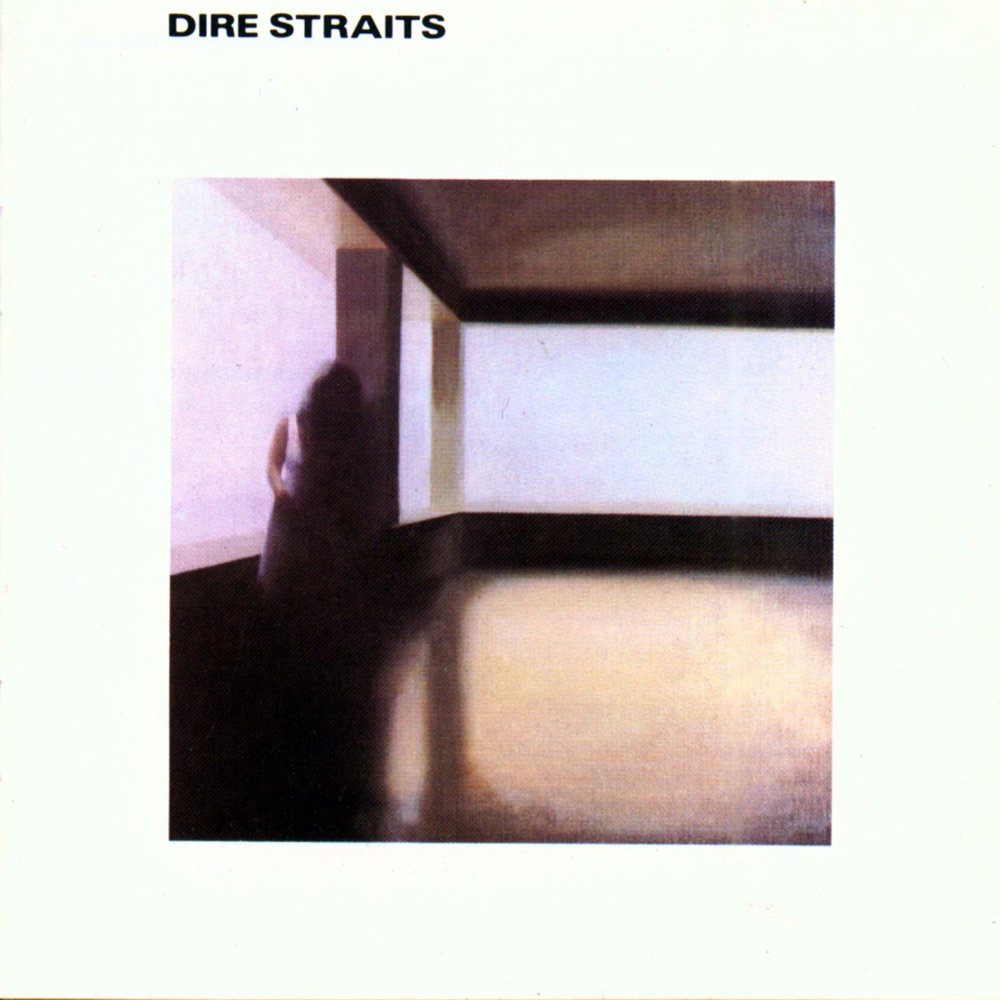
Dire Straits' 1978 debut: four players, nine songs and a producer who changed little. The playing is the strength. Only one song matches it, and the mood rarely shifts.
- Released
- 9 June 1978 (UK, Vertigo) · 20 October 1978 (US, Warner Bros.)
- Label
- Vertigo (Phonogram) in the UK · Warner Bros. in the US · Mercury in Canada
- Producer(s)
- Muff Winwood (engineer: Rhett Davies)
- Runtime
- 41:34 across 9 tracks (US label timings; the UK labels print none)
- Chart peak (US)
- #2 (Billboard Top LPs & Tape, week ending 14 April 1979)
- Chart peak (UK)
- #5 (Official Albums Chart, chart of 21 April 1979); first entry 22 July 1978 at #48
- Certifications
- BPI 2× Platinum (7 February 1986) · RIAA 2× Platinum (6 January 1987)
- Awards & honours
- Band: Rock and Roll Hall of Fame, 2018 (Mark Knopfler, John Illsley, David Knopfler, Pick Withers, Alan Clark and Guy Fletcher)
Dire Straits spent months going nowhere in Britain, then climbed to #5 in April 1979. The record is a road-tested band taped with little interference. That earns real admiration for the guitar and the rhythm section, and real reservations about the songs.
Dire Straits came out in Britain on Friday 9 June 1978, and for months it did very little. The single 'Sultans of Swing' had gone out in May and missed the chart. By a later MusicRadar account, Radio 1 found it too wordy and left it off the playlist. The album entered the UK chart on 22 July at #48. It never rose above #38 that year. Then it came back. The album returned to the chart on 10 February 1979, and the single entered it on 10 March. 'Sultans of Swing' peaked at #8 in April. The album reached #5 in the chart of 21 April.
The slow start suits the record. It's a road-tested band, taped in a London studio in February 1978 by a producer who chose to change little. That's its strength, and it's also its limit. The playing is first-rate, and the mood holds from the first track to the last. The songs aren't equally good, and the mood rarely shifts. Dire Straits is a very good record with clear limits. Critics at the time made both halves of that case.
The songs were older than the studio. Dire Straits began in Deptford in 1977. By the band's own timeline, its first show was on 26 June that year, as the Café Racers at the Crossfield Estate festival. The set included 'Sultans of Swing', 'Down to the Waterline' and 'Southbound Again', alongside covers of Ry Cooder and Brenda Lee. In July the band made a five-song demo at Pathway Studios. It included 'Sultans of Swing', 'Water of Love' and 'Down to the Waterline'. Charlie Gillett played it on his Honky Tonk show on BBC Radio London that summer. The sleeve says 'For Charlie Gillett.' A year of small rooms is audible on the record. These are songs a band already knew how to play, not songs it was still finding.
The business noticed fast. Ed Bicknell, the band's manager, recalled A&R men 'leaping out of their baths'. Muff Winwood saw the band in Aylesbury and wanted to sign it for Island. By then it had already shaken hands with Phonogram, and it signed on 12 December 1977. MusicRadar's account has Winwood as the band's first choice to produce. Island's Chris Blackwell agreed, and the band went into Island's Basing Street studio in February 1978. Phonogram's advert in Music Week on 10 June 1978 leaned on the trade, not the critics. It carried endorsements from five people in the business, among them Winwood, Gillett and Arista's Andrew Bailey. Bailey told the paper a week later that he liked the band and wished Arista had signed it. The industry was sold before the public was.
Winwood's method was to interfere as little as he could. He described the sessions about 33 years later, in a feature now published by MusicRadar. His first thought, he said, was that he didn't have to change a lot. The band had been playing 'Sultans of Swing' live for a year or so and knew it inside out. So he concentrated on getting the bass guitar and the bass drum locked in tight. Mark Knopfler, he said, 'took care of himself'. A guitar-hire company brought in a pile of amps and effects for him to try. Winwood's view was that the sound came from the player's touch, not from the gear. The feature's own account of 'Sultans of Swing' adds that Knopfler played his Stratocaster, with only compression and reverb on the guitar. That restraint is the record's best decision, and also the source of its sameness.
The sleeve credits four players and nobody else. Knopfler sings, plays lead and rhythm guitar, and wrote all nine songs. His brother David plays rhythm guitar, John Illsley bass and Pick Withers drums. No keyboards, horns or guests are credited. It's a guitar record in the plainest sense. Robert Christgau caught its basic move in his Consumer Guide. Knopfler answers his own vocal on the guitar, he wrote, so that one musician sounds like two. Cary Darling, reviewing it for Billboard in January 1979, heard a quick finger-picking style on the electric guitar. That call and answer is the record's real hook, more than any chorus.
Side one shows the method at its most patient. The album opens on what Darling heard as something like a foghorn in the distance. 'Down to the Waterline' then waits more than a minute for its first line. 'Water of Love' sings its title 10 times, the last at 4:26, and the band plays on to 5:23. Darling thought its easy-listening arrangement failed to grab. On 'Six Blade Knife' he heard Knopfler's rasp, a vocal out of Lou Reed, an up-front bass and a loping rhythm. Ken Tucker, in Rolling Stone, heard growling, annoyed singing on 'Setting Me Up'. He also heard a giddy country-guitar solo tacked on at the end. Stephen Thomas Erlewine, writing for Pitchfork in 2020, called it the record's tightest cut. The side works best when the guitar has something to answer, and it drags when it doesn't.
'Sultans of Swing' is the method at its best. Knopfler told an Ultimate Classic Rock radio show in 2020 that the real band was a very average Dixieland group in a Deptford pub. Three or four people were listening. He asked them for 'Creole Love Call' or 'Muskrat Ramble'. The grand name set against that small scene gave him the song. On the record the first vocal comes at 0:13, but the title doesn't arrive until 2:27. Tucker heard a brisk bit of folk-rock with an inescapable hook and a Dylan-like snarl in the voice. Knopfler's last line comes at 4:43, and the band then plays for 64 seconds to the end. MusicRadar's account picks out quick arpeggios in that outro, outlining D minor, B flat and C. Darling thought the song had the band's finest playing. It saves its title for the middle and its best playing for the end. That patience is the whole record's idea, done right once.
The critics agreed on that song and on little else. Darling said 'Down to the Waterline' outshone the other three love songs on side one. He called 'Six Blade Knife' one of the band's many peaks, and 'Sultans of Swing' a likely classic of the 1970s. Tucker called 'Setting Me Up' 'a heavenly number, funny and bitter'. Erlewine called 'Sultans of Swing' the 'snappiest number' by some margin, with 'Setting Me Up' its 'only rival in hooks'. So only 'Sultans of Swing' won all three over. 'Setting Me Up' came closest, but Darling found it short of the opening song's bite. The praise for everything else is spread thin across different songs. That marks an even record with one clear peak, not a deep one.
The weak spots were named at the time, though not always the same ones. Tucker found Knopfler as banal as he was clever. He called 'In the Gallery' a petulant attack on the avant-garde. He heard Springsteen-style street bathos in 'Wild West End' and 'Lions', though he said the band kept everything straightforward. Darling heard those songs the other way. To him 'In the Gallery' was a scathing indictment, and 'Wild West End' had Springsteen's eye for detail. Christgau gave the album a B, and singled out 'In the Gallery' for a streak of philistine ideology. Side two is where our own doubts sit. After 'Sultans of Swing', its three songs run 6:16, 4:42 and 5:05. 'In the Gallery' gives its last line at 5:07 and plays on for 69 seconds. Those songs run longer than their ideas.
There's a second limit, and it's the cost of Winwood's restraint. Darling called the production rich and full. We'd call it sparing to a fault. Erlewine hears vamps that hint at both melody and groove without quite becoming either. He counts that elusiveness a pleasure, and it can be one. He also says Communiqué's producers, Jerry Wexler and Barry Beckett, stripped away some of the slipperiness Winwood had brought. That slipperiness is what lets a side run as one long mood. Nor was the sound new. Darling heard an amalgam of styles forged by Dylan, Talking Heads and the Grateful Dead. He added that it was no shameless copy of any of them.
Its reach is clear. In Britain the album spent 132 weeks in the top 100, 8 of them in the top 10. It's 2× Platinum with the BPI, since 7 February 1986. In the US it was Gold on 21 February 1979 and Platinum on 27 March. On Billboard's album chart for the week ending 14 April 1979 it reached #2, behind the Doobie Brothers. For a debut that sold slowly at home, that's a long tail, and the single did most of the pulling.
The record's documented influence is narrower, and it runs through Knopfler's hands. Pitchfork says Bob Dylan enlisted Knopfler and Withers for Slow Train Coming in 1979, and that Steely Dan hired Knopfler to play on 'Time Out of Mind', from Gaucho, in 1980. 'Setting Me Up' went to country. Albert Lee recorded it in 1979 and again in 2024, and Highway 101 cut it in 1988. The lasting part is 'Sultans of Swing'. A 1988 reissue of the single reached #62 in Britain, and its last week on the chart was 7 January 1989. The song came back at #41 in April 2025, more than 36 years later. In September 2026 it was certified 4× Platinum in the UK.
So the song deserves its reputation, and so does the playing. The rest of the record is more even than strong, and side two's longer songs run slack. Pitchfork scored the debut below Making Movies, Love Over Gold and Brothers in Arms, and above Communiqué and On Every Street. Our own scorecard also puts it below Brothers in Arms. That's the right shelf. Play it for the guitar and for 'Sultans of Swing', and don't expect the rest to match that song. It's a very good debut, built on one great song and four players who already knew it inside out.
Which pressing to own
The British original, Vertigo 9102 021, is the edition this dossier describes. Its runouts are stamped 9102021 1Y and 2Y with the plant mark ▽420, and its sleeve carries a heavy card lyric inner. On 16 October 2026, 25,441 collectors had it in their collections and 5,404 wanted it. The American Warner Bros. BSK 3266 is the other original, in 19,455 collections. No pressing figures have been published for any edition.