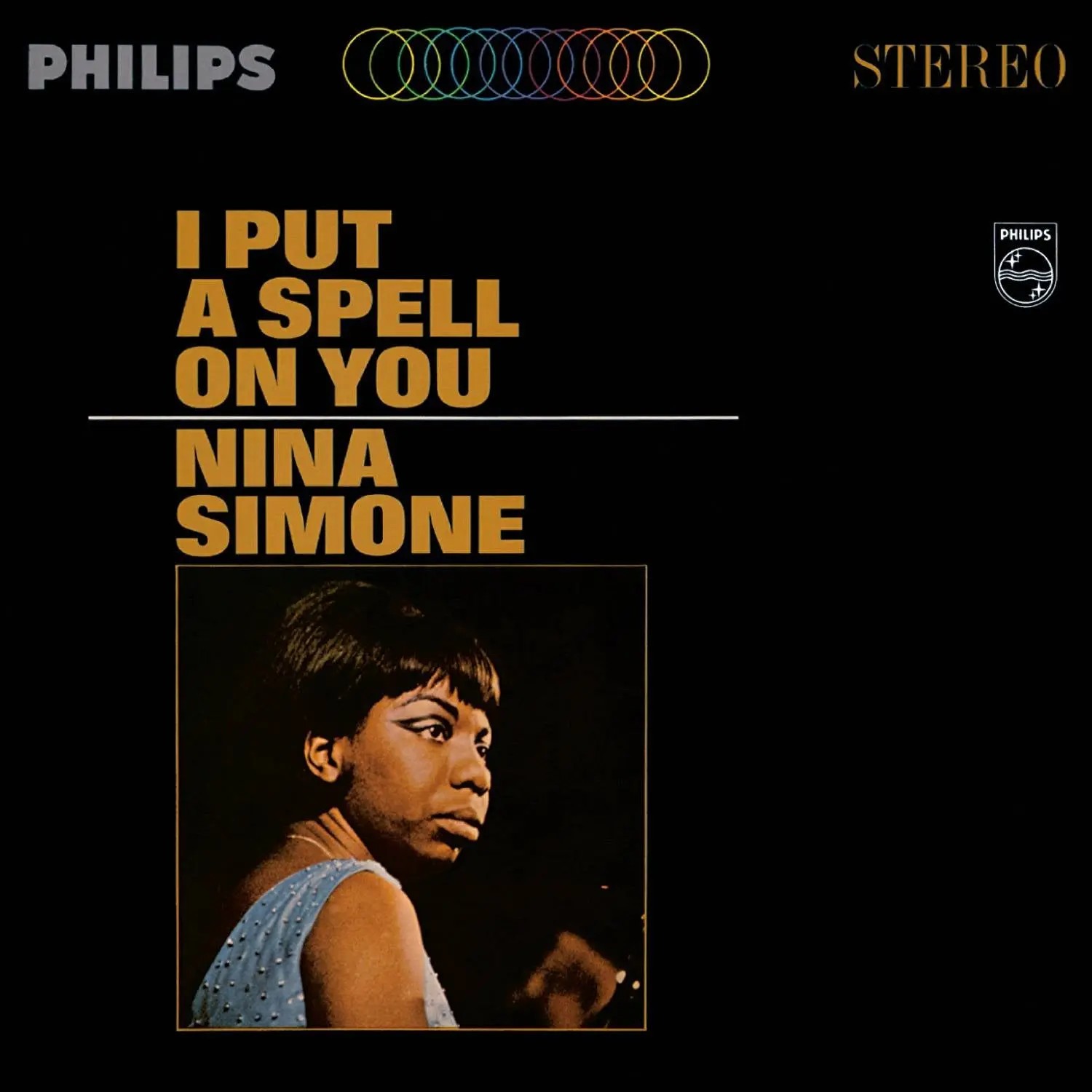
Nina Simone's most pop-facing record, cut in New York in January 1965 while she was channelling the fury of the civil-rights movement into songs like 'Mississippi Goddam'. Twelve interpretations, none of them hers by pen, two of them — the title track and 'Feeling Good' — so completely possessed that the world now hears them as Nina Simone songs.
- Released
- 1965 (Philips Records)
- Label
- Philips — PHM 200-172 (mono) / PHS 600-172 (stereo)
- Producer(s)
- Hal Mooney (arrangers/conductors: Hal Mooney and Horace Ott)
- Runtime
- 33:46
- Chart peak (US)
- Modest on original 1965 release; re-entered the Billboard Jazz Albums chart at #10 in 2021–22
- Chart peak (UK)
- The 'Feeling Good' single later reached UK #40 (1994)
- Certifications
- The 'Feeling Good' single was certified RIAA 2× Platinum (2M units) in September 2025 — reportedly Simone's first such accolade
- Awards & honours
- 'Feeling Good' ranked #1 on American Songwriter's 10 Greatest Nina Simone Songs (2022); the album is a fixture of best-of-1965 lists
Simone's seventh studio album and her most deliberately commercial — twelve interpretations of other people's songs, lavishly arranged by Hal Mooney and Horace Ott, recorded for Philips in New York as the singer's political voice was at its rawest. From it came two of the most enduring recordings she ever made.
By 1965 Nina Simone was recording at a furious pace — three albums in 1964 alone, ten between 1964 and 1967 — and had just become the most uncompromising political voice in American popular music. 'Mississippi Goddam', her response to the 1963 Birmingham church bombing and the murder of Medgar Evers, had made her a figure of the civil-rights movement; she despised conventional protest music for stripping the dignity from the people it claimed to celebrate. So it is a quiet surprise that the record she cut in January 1965 in New York, with the world outside her window on fire, was her most openly pop album.
I Put a Spell on You was made for Philips, the label she'd joined in 1964 after leaving Colpix, with the producer Hal Mooney brought in to polish her style for mainstream radio. Mooney and the arranger Horace Ott wrapped Simone's contralto and her own piano in lush orchestral settings — strings, harp, brass — across twelve tracks, none of which she wrote. Simone called the songs she'd chosen 'heavy': not difficult, she meant, but not to be taken lightly. What she does with them is what all great interpreters do — she crawls inside each one and claims it.
The opener is the clearest demonstration. 'I Put a Spell on You' was written and recorded in 1956 by Screamin' Jay Hawkins as a hog-snorting, demented piece of proto-rock theatre. Simone and Mooney keep the obsession and throw away everything else, rebuilding it as a string-swept ballad of sensual fixation, the insistent saxophone the only trace of the original's wildness. It is one of the great acts of reinvention in recorded music — a novelty shock-rock record turned into a symphony of longing.
The album's other immortal track sits in the middle. 'Feeling Good' came from Anthony Newley and Leslie Bricusse's musical The Roar of the Greasepaint — The Smell of the Crowd, sung in the show by Gilbert Price, whose manager, Andrew Stroud, happened also to manage and to be married to Simone. Her recording — the slow a cappella build into a brass-and-strings explosion on 'it's a new dawn, it's a new day' — wasn't even released as a single in 1965. It simply waited, and became, over the decades, the definitive version of a song hundreds of artists have since attempted.
Around those two are interpretations that show the album's range: Jacques Brel's 'Ne Me Quitte Pas', delivered with a teetering, heartbroken fragility; two Charles Aznavour songs, 'Tomorrow Is My Turn' and 'You've Got to Learn', whose explicit, meaningful lyrics Simone relished; the jaunty swing of 'Marriage Is for Old Folks'; the dramatic, Sinnerman-adjacent 'Take Care of Business' closing the record; and two pieces by her own guitarist Rudy Stevenson, the gentle 'One September Day' and the finger-snapping instrumental 'Blues on Purpose'. Mooney arranged most; Horace Ott handled the rest.
I Put a Spell on You is not in our hundred only because the hundred is closed. It is the record that proves interpretation is composition by other means — that a singer can take a Screamin' Jay Hawkins novelty, a Brel chanson and a West End show tune and make all three sound as though they were always hers. 'Feeling Good' alone has been covered by Sammy Davis Jr., Muse, Michael Bublé, George Michael and dozens more, sampled by Jay-Z and Kanye West, and resurrected by a 1994 car advert — and through all of it, every other version is measured against the one Nina Simone cut, almost as an afterthought, in a New York studio in January 1965.
Pressing guide — the one to own
An original 1965 US Philips first pressing — mono PHM 200-172 or stereo PHS 600-172, both on the period black label with the 'Vendor: Mercury Record Corporation' line, pressed by Richmond and identifiable by the 'RR' etching in the runout (later Mercury-credited copies with 'MR' runouts are represses). As with most mid-1960s vocal records, the scarcer mono is the connoisseur's pressing — fewer copies survive and they command more per copy — while the stereo PHS is the more commonly traded of the two. UK Philips (mono BL 7671) and other territory first pressings are the international alternatives.