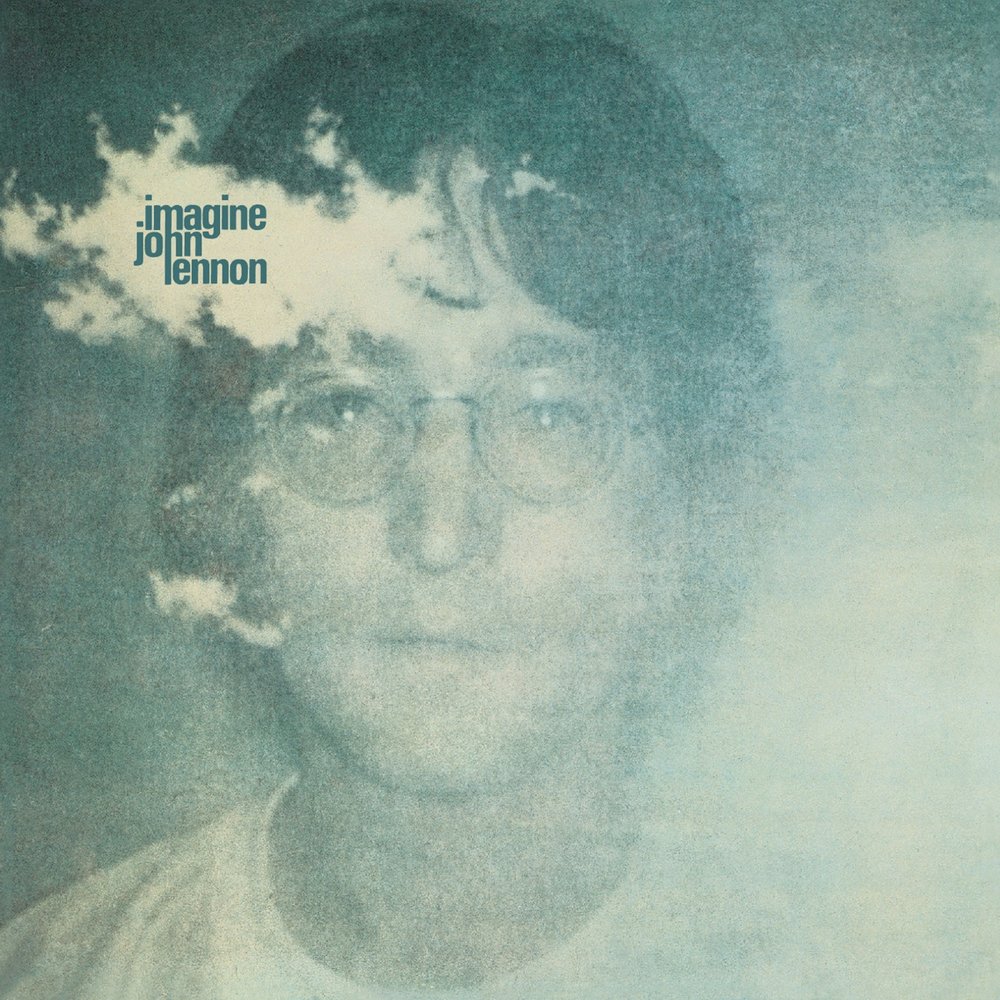
John Lennon's second solo album, made in 9 days by his own count and aimed at the charts. The title song became public property, and the patchier record under it has lived in its shadow.
- Released
- 9 September 1971 (US, Apple SW 3379) · 8 October 1971 (UK, Apple PAS 10004)
- Label
- Apple Records
- Producer(s)
- John Lennon, Yoko Ono, Phil Spector
- Runtime
- 38:30 across 10 tracks on one LP
- Chart peak (US)
- #1 (Billboard 200, 1 week, chart dated 30 October 1971)
- Chart peak (UK)
- #1 (Official Albums Chart, charts dated 30 October and 6 November 1971)
- Certifications
- RIAA 2× Platinum (26 November 1991) · BPI Gold (2013)
- Awards & honours
- The title song, as a single: Library of Congress National Recording Registry, 2023
Imagine is Lennon's bid for the charts: polished, well played and carried by four very good songs. The title track's fame has hidden how uneven the rest is, and some of the record is older than it sounds.
On 30 October 1971, Imagine was #1 on the Billboard 200. The UK Official Albums Chart dated the same day had it at #1 as well. It was the first of Lennon's solo albums to reach #1 in either country, and it spent 101 weeks on the UK chart in all. In the Netherlands it was #1 for 5 weeks. In Britain, though, the song that gave the album its name wasn't a single. It first charted there on 1 November 1975 and reached #6. It didn't reach #1 until January 1981, a month after Lennon's death, when it held the top for 4 weeks.
That order matters. In 1971 people bought Imagine as an album. Now most people know it as a song, and the song has swallowed the record around it. The album under the title track is very good and clearly uneven. Four songs carry it: 'Imagine', 'Jealous Guy', 'Gimme Some Truth' and 'How Do You Sleep?'. The rest is patchier, and the weak songs are spread across both sides. The sound is more polished than new, and the record's fame rests on one track.
Lennon knew what he wanted. In 1971 he described the record as 'commercial with no compromise'. He called it lighter and less introspective than John Lennon/Plastic Ono Band, and better made. That earlier record had the same core of Lennon, Klaus Voormann and Phil Spector, so he was measuring himself against his own work. Spector had produced it, and All Things Must Pass and Let It Be as well. By his count Imagine took 9 days: about 7 at Tittenhurst Park, where Eddie Veale had been building him a studio since August 1970, and 2 in New York putting on strings. The previous album took 10. He said he stopped at 10 tracks because Spector told him there was no more room on the record.
The title song was the sugar. Paul McCartney told Melody Maker on 20 November 1971 that he liked the album but found it less political. Lennon answered in the same paper on 4 December. He said the title song was 'Working Class Hero' with sugar on it for conservatives. On 6 December 1980 he told BBC Radio 1 that its lyric and concept came from Yoko Ono's book Grapefruit, and he blamed his own selfishness and machismo for leaving her off. The labels had credited Lennon alone. When the NMPA gave the song its Centennial Song award on 14 June 2017, the process of adding Ono as co-writer was already under way.
The song itself is plain on purpose. The singing starts about 14 seconds in and carries on almost to the end, with no instrumental break. The title phrase comes round 6 times. Ben Gerson, reviewing the album for Rolling Stone in 1971, heard a melody that was undistinguished apart from its bridge. He wasn't wrong that the tune is easy, and the ease is the sugar working. What carries it is the singing. Lennon doesn't oversell it, and a song that asks for something as large as this one does would collapse if he did.
Not everything was new. 'Jealous Guy' began as 'Child of Nature', whose melody Lennon wrote in India. The US sleeve dates 'Oh Yoko!' to 1968, 2 years before McCartney announced the Beatles' split on 10 April 1970. That isn't a flaw. It does mean the album is less a fresh statement than a good set of songs, some of them older than the sessions and recorded quickly with a changing cast of players.
What it sounds like is mostly a matter of placement. Veale said Spector put every instrument in its own spot, in mono, then maximised the whole. Lennon often asked him to back it off. The strings were kept simple on purpose. On 4 July 1971, 27 New York session players, billed as the Flux Fiddlers, recorded them at the Record Plant. Torrie Zito orchestrated them from Lennon's sung arrangements. Lennon said the violins on 'How Do You Sleep?' that sound eastern are violins playing guitar parts. In 2018 Rob Sheffield called it Lennon's slickest record, and also his toughest. That's craft. It isn't a new sound.
Lennon said he took more care this time. His example was overdubbing Tibetan cymbals alongside real cymbals. Gerson, listening in 1971, heard a record that was technically sloppy. The two views fit together. The care is in the arrangements and the sloppiness is in the playing. Lennon said he liked using different people on each track so that it didn't get stilted. He named three drummers, and by his account Ringo Starr wasn't one of them because he was away filming in Spain. He wanted a saxophonist, and asked Allan Steckler to book King Curtis, who plays on 'It's So Hard'. Curtis was killed in Manhattan on 13 August 1971, 4 weeks before the US release. A record made by a producer and a changing cast, rather than a band, can have colour without a centre.
'Jealous Guy' is where the changing cast pays off. Nicky Hopkins plays the main piano and Jim Keltner the drums. Badfinger's Joey Molland and Tom Evans play acoustic guitars. Ono suggested the intro. Alan White played the vibraphone in the studio toilet, looking through a gap in the door, and his part is credited as 'Good Vibes'. Gerson heard the piano figure as reminiscent of 'A Day in the Life'. What stands out is how little anyone plays. Each part adds one small thing, and the song stays with the singer.
'Crippled Inside' shows the same looseness at its least useful. Voormann fingered an upright bass that Mal Evans had bought for the song. Steve Brendell says he hit its strings with drumsticks, and the engineer Eddie Klein remembers it that way too. Voormann remembers Alan White doing it. Either way it was played live, and take 6 was the one used. George Harrison plays Dobro, and Hopkins plays piano. It's a good idea. Gerson called the result haphazard, and Robert Christgau heard folk-rock with a good-time feel. They're hearing the same thing from two sides. The playing has charm and not much shape, which is the album's trouble in miniature.
'How Do You Sleep?' is the other pole. Gerson called it horrifying and indefensible, and still more compelling than most of the rest of the album. McCartney told Melody Maker it was silly, and his reply was mild. Neither verdict is really about the music. As a performance it's where Lennon's anger and the production's polish agree. The strings give the insult weight. 'Gimme Some Truth' is the plainer anger, with its title phrase coming round 9 times in 3:11, and Gerson counted that one among the album's best too.
The weak songs don't bunch together. They're spread through the record. Gerson's review, published on 28 October 1971, found it technically sloppy and self-absorbed after Plastic Ono Band. He still found plenty of good music on it. He picked 'Jealous Guy', 'Gimme Some Truth' and 'How Do You Sleep?' as the three 'really worthy' tracks. He liked the bridge of 'How?' and little else, and called 'Oh Yoko!' a 'charming bauble'. Christgau, who gave the album an A, found 'How?' dreary. The thin stretches are 'Crippled Inside' at track 2, 'I Don't Wanna Be a Soldier' at track 5 and 'How?' at track 9. At 6:01, 'Soldier' is the longest track. Gerson heard the melody of the Kinks' 'You Really Got Me' in it, and a tune that plain can't hold 6 minutes.
The consensus is kinder. AllMusic gave the album 5 stars. Its review calls it a remarkable collection that Lennon never bettered, then admits it lacks the thematic sweep of Plastic Ono Band. That second clause is the case against it. Record Collector argued in 2018 that Plastic Ono Band is the better album and that the title song outweighs everything after it. Rolling Stone put Imagine at #223 in its 2020 list of the 500 greatest albums. Our view is that the praise is rating the song. The song itself keeps growing. It went into the Library of Congress's National Recording Registry in 2023, and the RIAA has certified the single 3× Platinum. Noel Gallagher told MTV that he took the opening piano of 'Don't Look Back in Anger' from 'Imagine'. Roxy Music took 'Jealous Guy' to #1 in Britain in 1981.
As an album, then, Imagine is very good and no more. Four of its songs are excellent, and the playing is a pleasure, with Voormann on bass throughout and Hopkins on piano on at least 5 of its 10 songs. But the writing is uneven, the cast keeps changing, and the sound is more polished than it is new. The reach belongs to one song, and a record that leans on one song gets judged by its best minute. Keep the four songs close, and don't mistake the title track's fame for the album's.