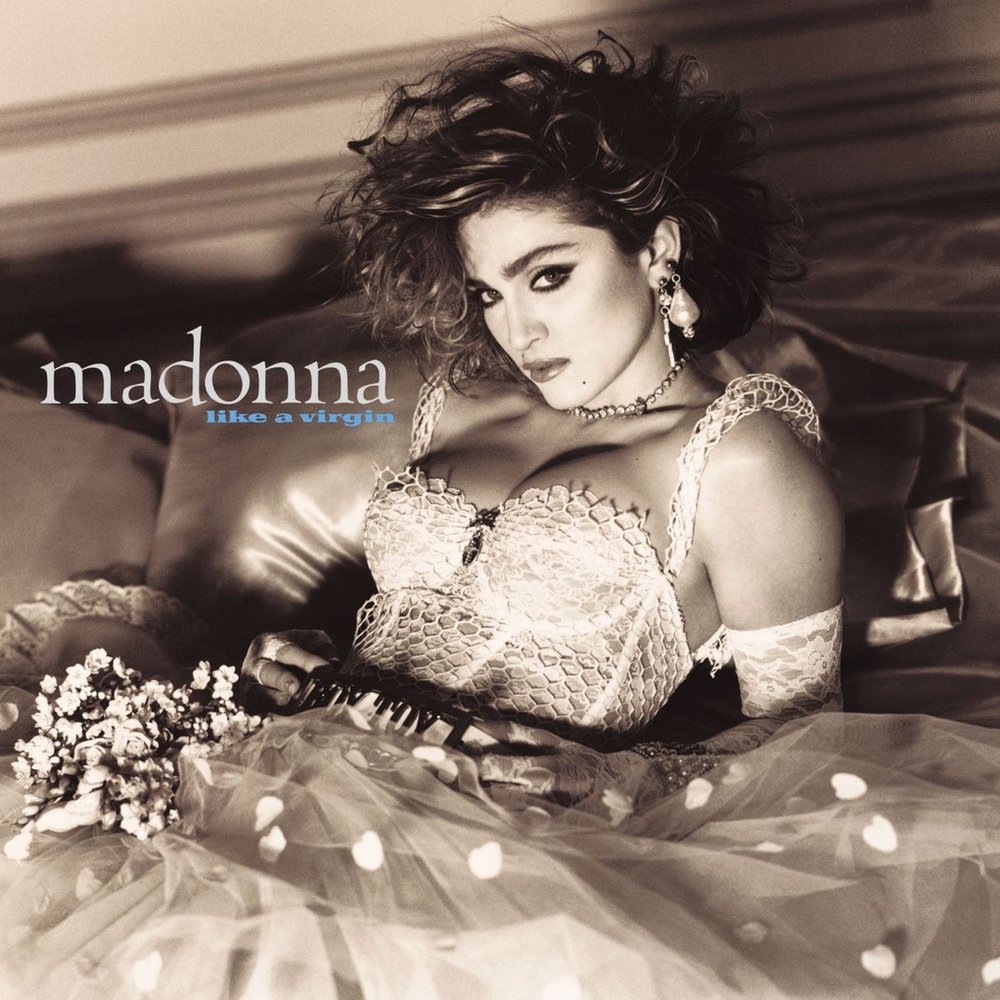
Madonna's second album, made in 1984 with Nile Rodgers and Chic's rhythm section at the Power Station. The record that made her a star, heard here as a producer's album more than a songwriter's.
- Released
- 12 November 1984 (US); November 1984 (UK and Europe, where sources differ on the day); 28 November 1984 (Japan)
- Label
- Sire Records (marketed by Warner Bros.)
- Producer(s)
- Nile Rodgers
- Runtime
- 38:44 across 9 tracks (US label timings)
- Chart peak (US)
- #1 (Billboard 200, 3 weeks: charts dated 9, 16 and 23 February 1985)
- Chart peak (UK)
- #1 (Official Albums Chart, 2 weeks: charts dated 21 September and 12 October 1985)
- Certifications
- RIAA Diamond (21 May 1998) · BPI 3× Platinum (28 November 1985) · Music Canada Diamond (31 July 1992)
- Awards & honours
- National Recording Registry, 2023 (announced 12 April 2023)
The two songs that define Like a Virgin came from outside writers, and its best quality is a drum sound built by Rodgers's engineer. Her own songs are uneven, and the record never quite hangs together.
On 9 February 1985, Like a Virgin reached #1 on the Billboard 200, in its 11th week on the chart. The title song's last week at the top of the Hot 100, its 6th, had come 2 weeks earlier. Billboard's Paul Grein noted that Madonna was only the third woman so far in the 1980s with a #1 single and a #1 album, after Barbra Streisand and Kim Carnes. She was 26. The two biggest songs on the record were written by other people.
That's the tension in this record. It deserved its success. But most of what makes it work came from outside her own writing: a producer she picked, his engineer's drum sound and two songs an A&R man brought in. A photograph did the rest. The production is the best thing on it. Her own songs are uneven, and the album doesn't hang together. AllMusic gives it 4.5 stars, yet its review calls the record less than the sum of its parts. We side with the review, not the stars.
She'd wanted more say after her first album. Classic Pop reports that the first album had disappointed her creatively, and that her ideas hadn't been welcome to its main producer, Reggie Lucas. The label refused to let her produce the follow-up herself. It did let her choose any producer. She wrote to Seymour Stein with a list of producers. Nile Rodgers was her first choice, for his Chic records and his work with Diana Ross, Sister Sledge and David Bowie. It was control of a limited kind. She couldn't produce, so she picked who would.
The songs came from two places. She and Stephen Bray had been writing and demoing since the start of 1984. 'Angel' went back further, to a demo from late 1983, and 'Stay' joins two songs they'd written in 1981. Michael Ostin, an A&R man at Warner, brought in 'Like a Virgin' and 'Material Girl' and suggested the Rose Royce cover. At their first meeting, Classic Pop says, she played Rodgers the Bray demos and told him that if he didn't love them they couldn't work together. He said he didn't love them yet, but would once he'd worked on them. So Madonna wrote or co-wrote 5 of the 9 songs, and 4 came from outside. Jason Corsaro, the engineer, told Sound on Sound in 2007 that the finished songs stayed close to Bray's demos in structure. In his telling, they just got better musicians. The songwriting's limits were in place before Rodgers arrived.
The title song reached her by a longer road. Billy Steinberg wrote its words from his own life, after a painful relationship ended and a new one began. Tom Kelly found the tune by clowning in a Motown-style falsetto over a bass line. Ostin heard the demo the day before he met Madonna, according to Stereogum's Tom Breihan. Rodgers disliked it. By Breihan's account he couldn't get it out of his head, and he came round after 4 days. Later he said he'd preferred 'Material Girl', and that Madonna was right to make the title song the first single. The song that defines her was found by other people and, at first, disliked by her producer.
What Rodgers brought was the sound. The back sleeve says the album was recorded digitally from start to finish on Sony equipment. Corsaro says he persuaded Rodgers to try it, on a Sony 24-track recorder, with the mix going to a Sony two-track. The drums were the point. At the Power Station, R&B drums usually went in the dead room. Tony Thompson's kit went in the big live room instead. Corsaro says he kept the room tracks in time by writing them into the mixing computer and fixing them when they drifted. They weren't gated. He told BMI in 2006 that the title song became "the first dance-pop record to have a real rock drum sound". It's his claim about his own work.
Listen to the title song. Corsaro remembers nothing under the drums but guitar and bass, so the drums had to fill the space. The sleeve, though, also credits Rob Sabino with synthesisers and bass synthesiser on it. The title line first lands at 0:45. Debby Miller heard the Four Tops' 'I Can't Help Myself' in the bass line when she reviewed the album for Rolling Stone in January 1985. Classic Pop reports that critics heard 'Billie Jean' in it as well, and says she quoted both songs on stage in her first two tours. Those are critics' ears, not credited borrowings. You can test them by playing the records back to back.
The sleeve shows two ways of working. Bernard Edwards on bass and Tony Thompson on drums, Chic's rhythm section, play on 4 tracks: 'Material Girl', the title song, 'Love Don't Live Here Anymore' and 'Shoo-Bee-Doo'. On the other 5, Jimmy Bralower programmed Linn and Simmons drum machines. It's tempting to say the live tracks are the good ones. They aren't, quite. The live four hold the two biggest songs, but also the ballad critics fought over. The machine five hold 'Angel' and 'Dress You Up', both #5 hits in America, and the two songs Slant calls hidden gems, 'Stay' and 'Over and Over'. Stephen Holden of the New York Times heard the fifth, 'Pretender', as disco fluff as elegant as Chic at its airiest, and he meant it kindly. The machines aren't the weakness. To our ears the soft spot is the middle of side two, 'Shoo-Bee-Doo' and 'Pretender'. It isn't a consensus. Slant praises 'Shoo-Bee-Doo', and Classic Pop hears a great melody in 'Pretender'. But AllMusic's list of the songs that work leaves both out, and both ended up as British B-sides.
The ballad is where the record is most exposed. 'Love Don't Live Here Anymore' is a 1978 Rose Royce song. Rodgers arranged and conducted the strings. Classic Pop says it was her first ballad and her first time with a live orchestra, and that she was daunted. By Rodgers's own account he liked to do everything live, so he told her to sing and the band would follow her. She was overcome and cried, and he left it on the record. That's the opposite of how the rest of her vocals were made. Corsaro says they were punched in again and again rather than comped, in a small room at the back. Miller called the song awful and thought the rejected lover didn't suit her. AllMusic's Stephen Thomas Erlewine says the remake works. Both views are fair. Miller also heard a light voice bobbing over heavy tracks, and Breihan, reviewing the title song for Stereogum in 2020, found the production unkind to her voice. The dance tracks ask little of her. The ballad asks more.
The British chart shows the limit. The album entered at #74 on 24 November 1984. It reached #1 only on the chart of 21 September 1985, 10 months later. In between, the label reissued it with a tenth track, 'Into the Groove'. That song came from the film Desperately Seeking Susan, and Madonna and Bray wrote and produced it. It isn't a Rodgers production. As a single it spent 4 weeks at #1 from 3 August 1985. Our reading is that nine tracks, hits included, didn't quite do the job alone. In all, it spent 152 weeks on the chart.
Critics were mixed at the time. Holden called it handsomely produced, and ended by predicting that a generation would tire of the Material Girl. He traced her singing to the girl groups before the Beatles, from the Shirelles to the Ronettes, but found her point of view more self-interested than theirs. Miller saw ambition under the pose. Robert Christgau gave it a B. He wrote that she'd hired Rodgers to make the music less mechanical, and that he wouldn't blame Rodgers for making it less catchy. Since then the case has been cultural. Alexis Petridis wrote in the Guardian in 2023 that it was the last album on which she sounded like a product of downtown New York. By True Blue, he said, everything seemed more calculated. In 2023 the Library of Congress added it to the National Recording Registry.
The image finished the job. 'Material Girl' came to the album through Ostin, and Peter Brown and Robert Rans wrote it. Holden read it as the 1980s teen-pop version of 'Diamonds Are a Girl's Best Friend'. It reached #2 in America and #3 in Britain. Two months before the album came out, Madonna sang the title song at the first MTV Video Music Awards in a wedding dress, starting atop a giant wedding cake. The sleeve put her in wedding clothes as well, and AllMusic's review calls the cover as important to her reinvention as the music. Caroline Sullivan wrote in the Guardian in 2011 that a woman in control of her sex life and career was a new idea in mainstream pop. The Library of Congress says the album fuelled her rise as she took more control of her music and image. Those are readings. They also fit the record: a persona built from other people's songs and a photograph, which she then took over.
The documented chain is short. BMI's Dave Simons wrote in 2006 that the Corsaro and Thompson drum sound was heard again on the Power Station's 'Some Like It Hot' and Robert Palmer's 'Addicted to Love'. That's the writer's reading, not a claim Corsaro makes in the piece. Reviewing True Blue in Rolling Stone in 1986, Davitt Sigerson praised Rodgers's production on Like a Virgin. He wrote that she'd resisted reaching for another like it, and made a cleaner record built around the songs. That was a choice of method, not a verdict on this one. The clearest line from Like a Virgin runs forward to the album she made in reply.
Like a Virgin is a very good record, and an important one. The importance is bigger than the music. The production is its best work and the best reason to play it. Its influence is real but narrower than its fame, and much of it rests on critics' readings. The writing is a mix: two outside songs that define it, a few of hers that work, and to our ears a soft middle on side two. The record doesn't hold together, and Britain needed a tenth track to put it at #1. Admire it for the sound and the nerve. Don't revere it.