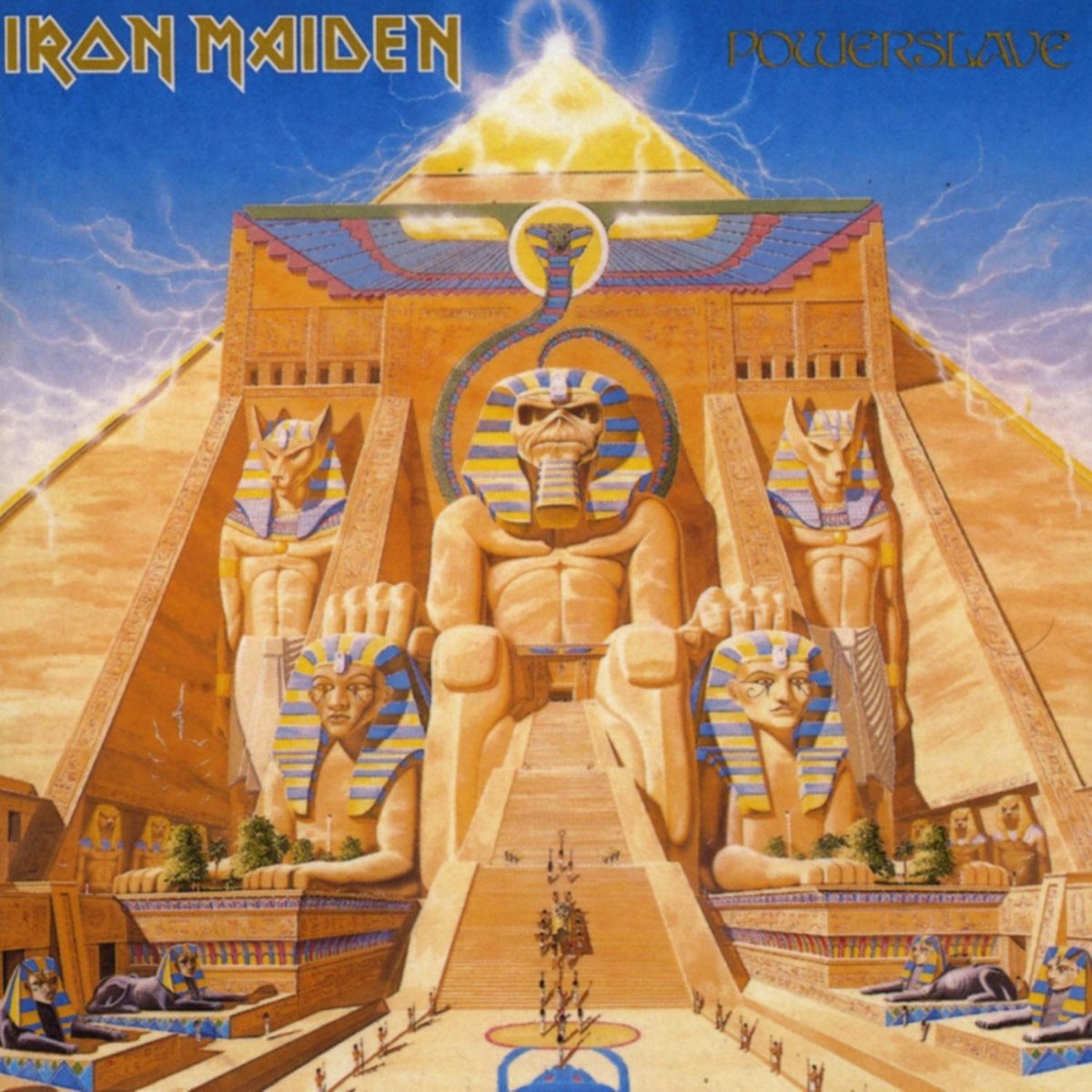
Iron Maiden's fifth album, home to 'Aces High', '2 Minutes to Midnight' and the 13-minute 'Rime of the Ancient Mariner'. A band at the peak of its playing, strongest at both ends.
- Released
- 3 September 1984 (UK, EMI) · 14 September 1984 (US, Capitol)
- Label
- EMI (UK) · Capitol (US)
- Producer(s)
- Martin Birch
- Runtime
- 51:12 across 8 tracks (label timings; the sleeve prints 51:20)
- Chart peak (US)
- #21 (Billboard 200)
- Chart peak (UK)
- #2 (Official Albums Chart), behind Now That's What I Call Music 3
- Certifications
- BPI Gold (11 December 1984) · RIAA Platinum (17 June 1991) · Music Canada 2× Platinum (12 October 2006)
- Awards & honours
- #38 in Rolling Stone's 100 Greatest Metal Albums of All Time (2017)
Iron Maiden made Powerslave the way they'd made Piece of Mind a year before, in the same studio with the same five people. The method produced some of their best playing, two songs that outgrew it and a middle that only repeated it.
Martin Birch had been up all night drinking with Robert Palmer, who lived next door to Compass Point Studios in Nassau. Then the producer called Adrian Smith in to work. Smith turned up hungover, with Palmer in the room, and played the solo on 'Powerslave' in what he believes was the first take. He later told BraveWords he didn't know how he managed it, "because I felt at death's door". It's the best story about Iron Maiden's fifth album, and it's also a fair description of it. By 1984 this band could play at the top of its game on a bad day.
That is the real subject of Powerslave, and it cuts both ways. The record is the product of a routine. "We had a process set up," Smith told BraveWords. The band rehearsed for a month or 6 weeks in Jersey, spent a couple of months in the Bahamas and then mixed in New York. Smith put the whole job at about 3 months, though Martin Popoff's 2018 book dates the recording alone from February to June 1984. They'd made Piece of Mind the same way a year earlier, at the same studio, and mixed it at the same Electric Lady. The routine explains the album's great strength, which is the playing. It also explains its limit. Too much of it is a band doing again what it already knew how to do.
The routine rested on a settled band. Metal Hammer's Malcolm Dome points out that it was the first Maiden album made by the same line-up as the one before. Steve Harris credits the world tour that bedded McBrain in, but cautiously: "maybe it did create some more confidence". It was Bruce Dickinson's third album with the band and Nicko McBrain's second. Piece of Mind had gone Gold in America, and the band had just headlined arenas there. Smith told Metal Hammer they were in Jersey as tax exiles, in winter. Nothing about the circumstances asked them to change course, and they didn't.
In Jersey the songs came fast. 'Aces High' was first played there, and Smith remembers thinking that if the album went that way, it would be a great one. '2 Minutes to Midnight' began as a riff he was working on with a four-track recorder in his hotel room. Dickinson banged on the door to ask what the riff was. He had a bunch of lyrics, and they wrote the song in about 20 minutes. 'Back in the Village' came from a riff Smith had played at soundchecks all through the previous tour. This is how a confident band works. It reaches for what's already under its fingers.
Side one opens with the two songs that justify that confidence. 'Aces High' is about the Battle of Britain, and it spends 40 seconds on an instrumental opening before Dickinson comes in. Martin Popoff, writing for the album's 30th anniversary, hears that intro dissolve into an unrelated verse. He's right about the join, but it hasn't hurt the song: the band put it first on Live After Death. '2 Minutes to Midnight' is better still. Smith calls it basically a hard rock tune. Popoff hears it as "groovy", a song that steps outside the rules Maiden were becoming tied to. Its title comes from the Doomsday Clock. In his memoir, Dickinson remembers the clock standing at 2 minutes to midnight. The Bulletin of the Atomic Scientists actually had it at 3 in 1984, and it had stood at 2 only in 1953. The title borrows a setting the clock no longer showed, and it's the sharpest lyric idea on the record. The song was the lead single, released on 6 August 1984, and it reached #11 in Britain.
Then side one runs out of new ideas. 'Losfer Words (Big 'Orra)' is an instrumental, and its title is a pun. "We just didn't have any words for it," Harris told Metal Hammer. Popoff calls it pointless, and it's hard to argue. 'Flash of the Blade' is Dickinson's fencing song, tight and short. Smith overdubbed many of its harmony lines himself because he felt some parts weren't strong enough. He says Maiden never played it live. 'The Duellists' is the real problem. Harris based it on Ridley Scott's 1977 film, and its instrumental middle runs from 1:47 to 5:17. Popoff hears a rehash of 'Where Eagles Dare' from Piece of Mind. The comparison is fair. Spending 3½ minutes on ground the band had already covered is where the routine shows.
Side two puts the record back on course. 'Powerslave' is Dickinson's song alone, about a pharaoh who learns that being a god won't stop him dying. In his memoir he describes it as partly an allegory of his own life as a rock star. The middle section runs from 2:47 to 5:21, and it holds the solo Smith played with a hangover. The same Egyptian idea runs through Derek Riggs's cover and the tour's stage set. Smith credits the concept to Dickinson, who had it on a four-track demo. Harris denies there was any plan behind it: "Total coincidence," he says. Either way, the song carries the weight the rest of the project put on it.
'Rime of the Ancient Mariner' closes the album at 13:45. Harris says he wrote most of it in the Bahamas. Smith remembers him walking into the studio and holding up a lyric so long it reached the floor. For the guide vocal, the band pinned it to the top of a stepladder so the verses hung down where they could be read. "We used to call it pyramid power," Smith said. The song retells Coleridge's poem of 1798 and quotes two passages from it. It stayed Maiden's longest song until 'Empire of the Clouds' in 2015. Its structure is the bravest thing on the record. Midway through, there's no vocal at all from 6:18 to 7:44. Then comes a long build, with solos, from 8:39 to 11:15. Popoff likes the song, but thinks it needs "a bit of an edit, but only a bit". He could also have done without Harris's bass solo. He has a point. The long stretch without a vocal is where attention drifts. Yet the band didn't notice the length. Harris says they thought it ran 8 or 9 minutes until Birch timed it. It's the one song here that the routine alone doesn't explain.
Birch's job was to hold all this together, not to redirect it. He's credited as producer, engineer and mixer. Harris is clear about where the ideas came from. "Martin was there to capture it," he told Metal Hammer. Describing how the band usually built their harmony solos, Smith told BraveWords that Murray would go in first. Smith would then add his own solos and put the harmony to what Murray had done. Mostly, though, he said they did the harmonies together. When it was one of Harris's songs, Harris sat in, and Smith calls him very meticulous. Smith later said he found Piece of Mind very dry, and that Powerslave was a little smoother, on the way to Somewhere in Time.
The record's commercial story is less tidy than its legend. It entered the UK chart at #2, behind Now That's What I Call Music 3 in its sixth week at the top, and ahead of Sade and Tina Turner. It went Gold in Britain in December 1984. Canada moved faster, certifying it Gold and Platinum on 1 November 1984, under 2 months after release. In America it reached #21, but the RIAA certified it Platinum only in June 1991, on the same day as Live After Death. That pairing tells you where the songs lived.
The tour is where the album found its audience. The World Slavery Tour opened in Warsaw on 9 August 1984, before the record was in the shops, and ran for 11 months. The first leg also played Hungary and Yugoslavia. That October, Billboard ran a story headlined 'Iron Maiden Pierces Iron Curtain'. Mick Wall's authorised biography counts those shows as the first time a heavy metal band took a full set behind the Iron Curtain. On 11 January 1985 they played Rock in Rio, on a bill headlined by Queen, to about 350,000 people by the band's own count. McBrain and Smith have said Powerslave made them famous very fast in places like Brazil. The stage show was Egyptian, with sarcophagi and a 30-foot mummified Eddie, and Harris called it probably their best. By the end, Mick Wall writes, Dickinson was demanding that management stop adding dates. The band then took about 6 months off.
Live After Death came out of that tour in October 1985. Sides one to three come from the band's four-night run at Long Beach Arena in March 1985, and side four from Hammersmith Odeon the previous October. The songs' stage life didn't end there. The 2008–09 tour largely recreated the Powerslave stage show, and on it Murray, Dickinson and Harris each named 'Rime' as their favourite song to play live. The stage, more than the turntable, is where this record has made its case.
Its reputation has settled high. AllMusic's Steve Huey calls it the third in a trilogy, often ranked the fans' favourite of the three, and perhaps the quintessential Maiden album. Rolling Stone put it at #38 among the greatest metal albums in 2017. Arch Enemy covered 'Aces High' in 1997, Children of Bodom had their own version out by 2001, and Avenged Sevenfold recorded 'Flash of the Blade' in 2008. The dissent is worth hearing too. Popoff gave it 9 out of 10 in 2005, yet calls it the band's cusp album, "a somewhat ragged, wayward affair". The Rolling Stone Album Guide gave it 2.5 out of 5 in 2004. Both readings can be true at once.
Powerslave is a very good record with clear limits. Its four best songs, the two openers and the two closers, are among the best things Maiden recorded in the 1980s, and the playing never slips. But its middle is a band on autopilot. The method that made it so assured also kept it from surprising anyone, and 'The Duellists' and 'Losfer Words' are the price. Admire the craft and play the ends. Reverence belongs to records that took bigger risks.
Pressing guide — the one to own
The one to own is the 1984 UK original on EMI POWER 1, with EJ 2402001 beside it on the spine and labels. It comes in a textured gloss sleeve with a double-sided printed inner carrying the lyrics and a band photograph. Early copies add a 21cm merchandise insert coded EJ 2402001 (I). The runouts read EJ 2402001T, with a two-part etched message split across the sides. The catalogue lists STERLING on 16 of the 17 runout variants it gives for the two UK issues. STERLING doesn't prove a British copy, because continental and American pressings carry it too. POWER 1 and the EJ 2402001T runout prefix do. The limited picture disc, POWER P1, was cut at Utopia and pressed by Orlake.