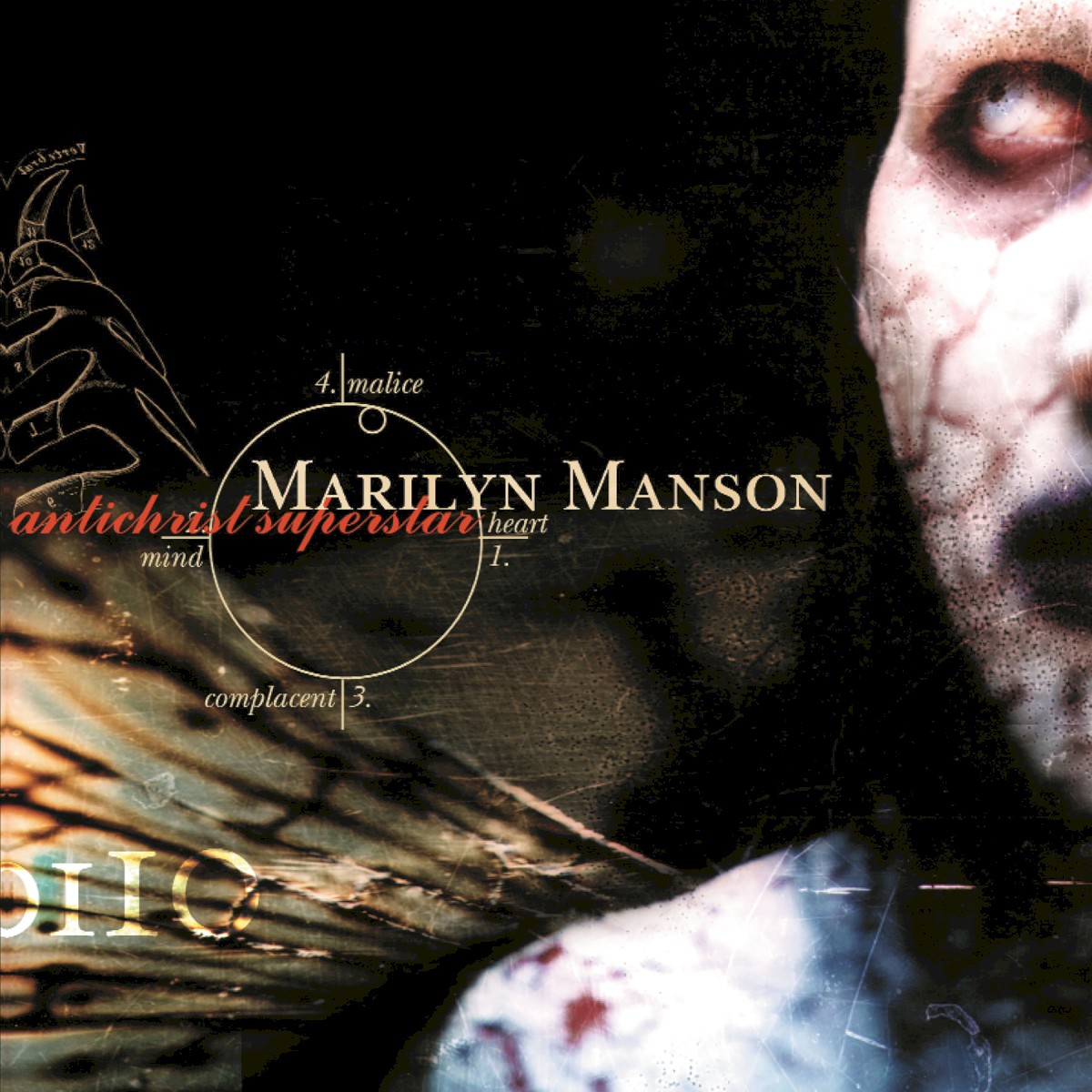
Eight months in a New Orleans studio, a founding member forced out before it was finished, and a rock opera about a worm that becomes a god. Antichrist Superstar arrived on 8 October 1996, went to #3 in America, and turned a Florida shock act into the subject of a US Senate hearing. What almost nobody remembers is how small it was everywhere else: one week at #73 in Britain. The panic was a local product, and the record underneath it is far more carefully built than either its defenders or its enemies ever admitted.
- Released
- 8 October 1996
- Label
- Nothing Records / Interscope Records
- Producer(s)
- Trent Reznor, Dave Ogilvie, Sean Beavan and Marilyn Manson
- Runtime
- 71:49 in total · the 16 listed tracks run 70:04, in three cycles, with the hidden track 99 after them
- Chart peak (US)
- #3 (Billboard 200), on 132,000 copies in week one
- Chart peak (UK)
- #73 (Official Albums Chart, 1 week) · #7 (Official Rock & Metal Albums Chart, 142 weeks)
- Certifications
- RIAA Platinum (US, certified 11 December 1996); 2× Platinum in Canada; Platinum in New Zealand; Gold in the UK, Australia and Mexico; roughly 7 million worldwide
- Awards & honours
- No Grammy nominations. The video for 'The Beautiful People', directed by Floria Sigismondi, took 3 nominations at the 1997 MTV Video Music Awards, including Best Rock Video, and won none
Marilyn Manson's second album, released on 8 October 1996 — a three-part rock opera about a worm that becomes a messiah, made over 8 months in Trent Reznor's New Orleans studio under conditions the band has described as deliberate psychological attrition. It cost them their founding guitarist, took them to #3 in America, and got them denounced on the floor of the US Senate. In Britain it spent one week on the albums chart.
The thing to understand about 1996 is how tired rock had got. Kurt Cobain had been dead 2 years, the bands that followed him had inherited the flannel and the sincerity without the songs, and the prevailing register in American alternative music was earnest exhaustion. Manson's own description of what he was making is the sharpest summary anyone has offered: "a volatile reaction to five years of earnest, post-Nirvana rock". Brian Warner had been a music journalist in Florida before he was a musician, which matters — he'd spent years watching how coverage worked from the inside, and he built a record designed to be impossible to cover neutrally.
It was made at Nothing Studios in New Orleans between February and August 1996, and by every account from inside the room the misery was partly the method. The band worked through sleep deprivation and heavy drug use; Manson has said the album "was conceived and written while I was enduring a lot of physical pain". Trent Reznor co-produced, having signed the band to his Nothing label; Dave Ogilvie, who'd made Skinny Puppy sound the way it sounds, was brought in and then fired, with Sean Beavan taking over. The casualty that mattered most was Scott Putesky — Daisy Berkowitz — who had co-founded the band in 1989 and had written the music for four of these songs. He was shut out of the sessions and gone before the record was finished. He later sued over songwriting royalties, including on 'Tourniquet', and settled on confidential terms. He died of colon cancer in 2017, aged 49.
What that process produced is far stranger and more deliberate than the sleeve suggests. It's a rock opera, in three titled cycles — 'The Heirophant', 'Inauguration of the Worm', 'Disintegrator Rising' — tracing a worm that hates the world into a messiah the world deserves, with the title lifted straight off Andrew Lloyd Webber's Jesus Christ Superstar and Nietzsche underneath the whole argument. And it's built as a loop. The opening seconds of 'Irresponsible Hate Anthem' and the last seconds of the hidden track 99 both carry the same distorted line — "when you are suffering, know that I have betrayed you" — timed so that a CD left on repeat closes the circle exactly. That's a compact-disc joke, and it only works on a compact disc, which turns out to matter more than anyone intended.
It went to #3 in America on 132,000 copies, and then the country lost its mind. The Dead to the World tour ran 175 shows across 8 legs, and religious and civic groups picketed nearly every North American date. Utah passed legislation letting state venues refuse them. The South Carolina House voted to bar them from state property. Dates fell in Richmond, Columbia, Portland and Calgary; Ozzy Osbourne was sued over an Ozzfest cancellation. Affidavits circulated claiming onstage animal sacrifice and bestiality, none of it true and all of it repeated. On 6 November 1997 a US Senate subcommittee held a hearing on violent lyrics at which Joseph Lieberman called the music "vile, hateful, nihilistic and damaging". P.R. Brown, who designed the packaging, has the best line about the whole episode: one of his proudest moments, he said, was seeing senators hold his album sleeve up in front of the Senate.
Britain barely noticed. The Official Charts Company has Antichrist Superstar entering the albums chart at #73 on 26 October 1996 and leaving the following week, and that is the entire story of this record on the main UK chart. It did much better where its audience actually was — #7 on the Rock & Metal chart, with 142 weeks logged across runs stretching to 2002 — but the contrast is the point. The moral panic was an American manufacture, running on American religious broadcasting, American state legislatures and an American election cycle. Strip that away and you have a well-reviewed industrial record that sold steadily to people who liked industrial records.
Then Columbine, on 20 April 1999, and the false claim that the shooters were fans — they weren't; reporters who went back through it found the pair had nothing but contempt for the music. The band cancelled the rest of its North American dates inside 9 days and Manson answered in Rolling Stone with an essay, 'Columbine: Whose Fault Is It?', that turned out to be the most durable piece of writing anyone produced about that month. He has said since that it nearly ended his career. The record's standing now is genuinely unsettled, and not for musical reasons: Warner has faced allegations of abuse since 2021, the Los Angeles County District Attorney announced in January 2025 that no charges would be filed, and several civil claims have been settled, withdrawn or dismissed. No court has made a finding either way, and this publication adjudicates nothing beyond that record. None of it changes what the album is — an unusually disciplined piece of construction made by people in a bad room, which America mistook for a threat and then, for a while, for an explanation.
Pressing guide — the one to own
The grail here is simply an official copy, which is a sentence that applies to almost no other record of this stature. Because there was no 1996 LP, the first vinyl edition is the 1998 British Simply Vinyl SVLP 055 — a 2×LP on 180g virgin vinyl in a gatefold, issued in a limited run by an audiophile reissue label that no longer exists. That is the object to want. It is also the object most heavily faked: of the 32 vinyl versions catalogued on the Discogs master, 23 are flagged as unofficial releases, and 17 separate pressings are sitting under the SVLP 055 catalogue number alone, because the counterfeiters simply cloned it. The authentication tells are physical rather than numerical. A genuine Simply Vinyl copy came in a PVC outer with a flap embossed with the label's insignia, carried a foil hype sticker and a circular sealing sticker, and has a hologram sticker on the reverse of the sleeve at the upper left, with 'shock symbol' centre labels and SVLP 0055 on the label against SVLP 055 on the jacket. If a seller cannot photograph the hologram, assume there is not one. After that the market is honest and cheap: the 2012–13 Nothing/Interscope 2×LP is the first official American vinyl and is the copy most people should actually buy.