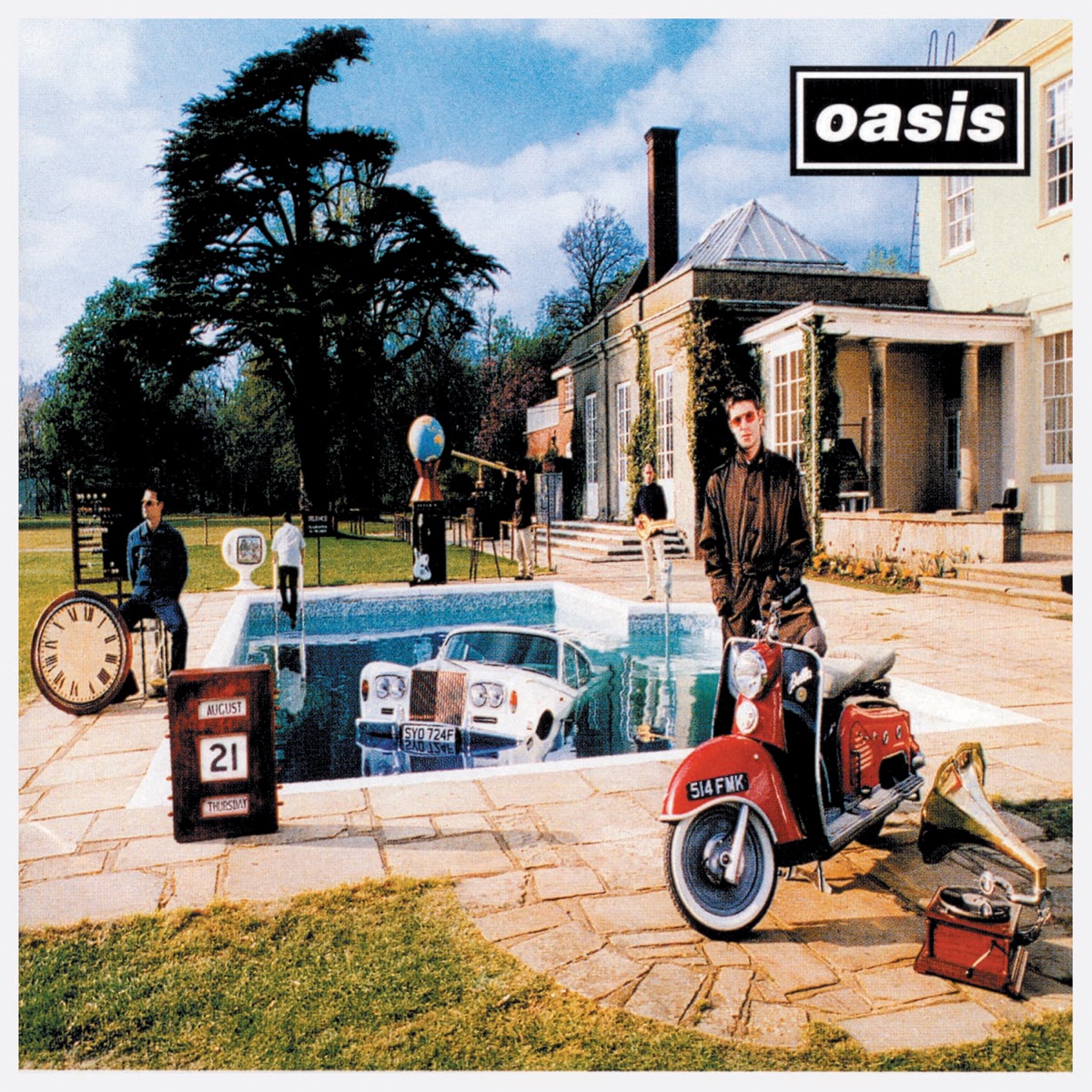
The third Oasis album arrived in August 1997 as the most anticipated British record of the decade — written by Noel Gallagher on a cocaine-and-champagne holiday on Mustique, cut in a fog of the same in London studios, and mixed until every song groaned under ten stacked guitars. It sold faster than any album in UK history and was hailed as a masterpiece for about a fortnight. Then the country sobered up, decided Britpop was over, and spent twenty years using Be Here Now as the punchline. The 2025 reunion has fans playing it again — and hearing something braver than they were told.
- Released
- 21 August 1997 (UK, Creation); late August 1997 (US, Epic)
- Label
- Creation Records (UK); Epic (US)
- Producer(s)
- Owen Morris and Noel Gallagher
- Runtime
- 71:31 (12 tracks, double LP)
- Chart peak (US)
- #2 (Billboard 200)
- Chart peak (UK)
- #1 (UK Albums Chart)
- Certifications
- BPI 7× Platinum (UK); RIAA Platinum (US); ~8 million sold worldwide (industry estimate)
- Awards & honours
- Won no major awards; holds the record as the fastest-selling album in UK chart history and became the emblem of Britpop's overreach — now the subject of a steady reappraisal
Oasis's third album, released on 21 August 1997 — the follow-up to (What's the Story) Morning Glory?, and the most hyped British record of the Nineties. Written by Noel Gallagher on holiday on Mustique and recorded across London studios and Ridge Farm in a blizzard of cocaine, it is twelve songs and seventy-one minutes of maximalism: every track long, every guitar multiplied, every chorus mixed to deafen. It sold faster than any album in UK history, was declared a masterpiece, and then became the record blamed for killing Britpop. Two decades on, its excess is starting to look less like failure than like a band burning at the exact top of its powers.
By the end of 1996 Oasis were not merely a big band; they were a national event. (What's the Story) Morning Glory? had sold in the millions, Knebworth had drawn a quarter of a million people across two nights, and Noel and Liam Gallagher had become tabloid royalty. The only question about the third album was how enormous it would be. Noel wrote most of it on a holiday on Mustique — staying at a villa associated with Mick Jagger, in the company of Johnny Depp and Kate Moss — where producer Owen Morris turned up with a portable eight-track to catch the demos. The songs came fast and confident. So, by every account since, did the cocaine, and both would leave their mark on the record that followed.
Recording ran from October 1996 to March 1997, moving through Abbey Road, AIR, Orinoco and Master Rock in London and Ridge Farm in Surrey. The atmosphere was one of unlimited money and diminishing restraint; Morris later remembered that when someone tried to score an ounce of weed in the first week they came back with an ounce of cocaine instead, and said the whole album should really have been captured on Mustique the previous summer, before the excess set in. Noel's method was to pile guitar on guitar — in places a dozen tracks of the same part — chasing a sound he wanted to be 'colossal'. What he got was density: a wall so thick that the songs underneath sometimes struggle to breathe.
The rollout was pure spectacle. 'D'You Know What I Mean?', a seven-and-a-half-minute lead single wrapped in helicopter noise and backwards loops, went straight to UK number one in July. When the album followed on 21 August — a Thursday, its release date printed on the calendar on the sleeve so fans could treat buying it as a historic act — it sold on a scale no British record had. Roughly 424,000 copies went on the first day and around 696,000 across the first three, making it, by the Official Charts' reckoning and Guinness's, the fastest-selling album in UK chart history. It hit number one at home and number two in America, held off the US top spot by a margin usually reported in the hundreds of copies. For about a fortnight, the reviews matched the sales: five stars, comparisons to Sgt. Pepper, a coronation.
Then the mood turned, and it turned hard. As the initial rush faded, listeners and critics began to hear the length, the sameness, the sheer weight of it — a record with no ballad it wouldn't inflate to six minutes and no idea it wouldn't repeat four times. The writer Jon Savage would later fix on Be Here Now as the moment Britpop's bubble visibly burst; Q magazine's verdict, that it 'fell so colossally short of expectations that it killed Britpop', became the received wisdom. Noel himself turned on it savagely, calling stretches of it rubbish and blaming the drugs. For years the album functioned less as music than as a cautionary tale — the sound of a scene, and a decade, overreaching.
The songs, heard now without the hype or the backlash, are better and stranger than either allowed. 'Stand by Me' and 'Don't Go Away' are among the finest ballads Noel ever wrote; 'The Girl in the Dirty Shirt' and 'It's Gettin' Better (Man!!)' have real lift under the murk; 'All Around the World', a nine-minute key-changing monster with Richard Ashcroft on backing vocals, became the longest song ever to top the UK singles chart. The problem was never the writing. It was the refusal — chemical, commercial, temperamental — to leave anything out. Be Here Now is what happens when a great band at the summit of its confidence loses every instinct for restraint at once.
This isn't in our hundred, and the reason is simply that the hundred is closed. But the case for revisiting it has never been stronger. With the Gallaghers back on a stage together in 2025 and a new audience arriving with no memory of the 1997 backlash, Be Here Now sounds less like the album that ended Britpop and more like its logical, gluttonous climax — a document of what unlimited success does to a band's judgement, made by musicians too high and too certain to stop themselves. Morning Glory is the record Oasis are loved for. Be Here Now is the one that tells you exactly how big, and how lost, they had become.
Pressing guide — the one to own
Because Be Here Now sold overwhelmingly on CD, the vinyl is the interesting hunt. The 1997 UK double LP (Creation CRELP 219, gatefold with illustrated card lyric inners, cut by Mike Marsh at The Exchange with 'MIKE'S — THE EXCHANGE' etched in the runouts and a stamped 'D' for Direct Metal Mastering) was pressed in far smaller numbers than the CD and is the original to own — a genuinely clean, unfaded gatefold, ideally sealed, being the prize. The everyday CD (CRECD 219) is common and cheap and sounds fine. The reissue to know is the 2016 'Chasing the Sun' remaster, which cleaned up the album and gathered B-sides, demos, the Mustique tapes and Noel's stripped-back 'NG's 2016 Rethink' of the lead single. Two things to weigh carefully: the 2022 25th-anniversary novelties (silver double vinyl, picture disc, cassette) are collector bait that trade on the reunion rather than on sound, and any 1997 CD bought expecting rarity — it isn't rare, it's everywhere.