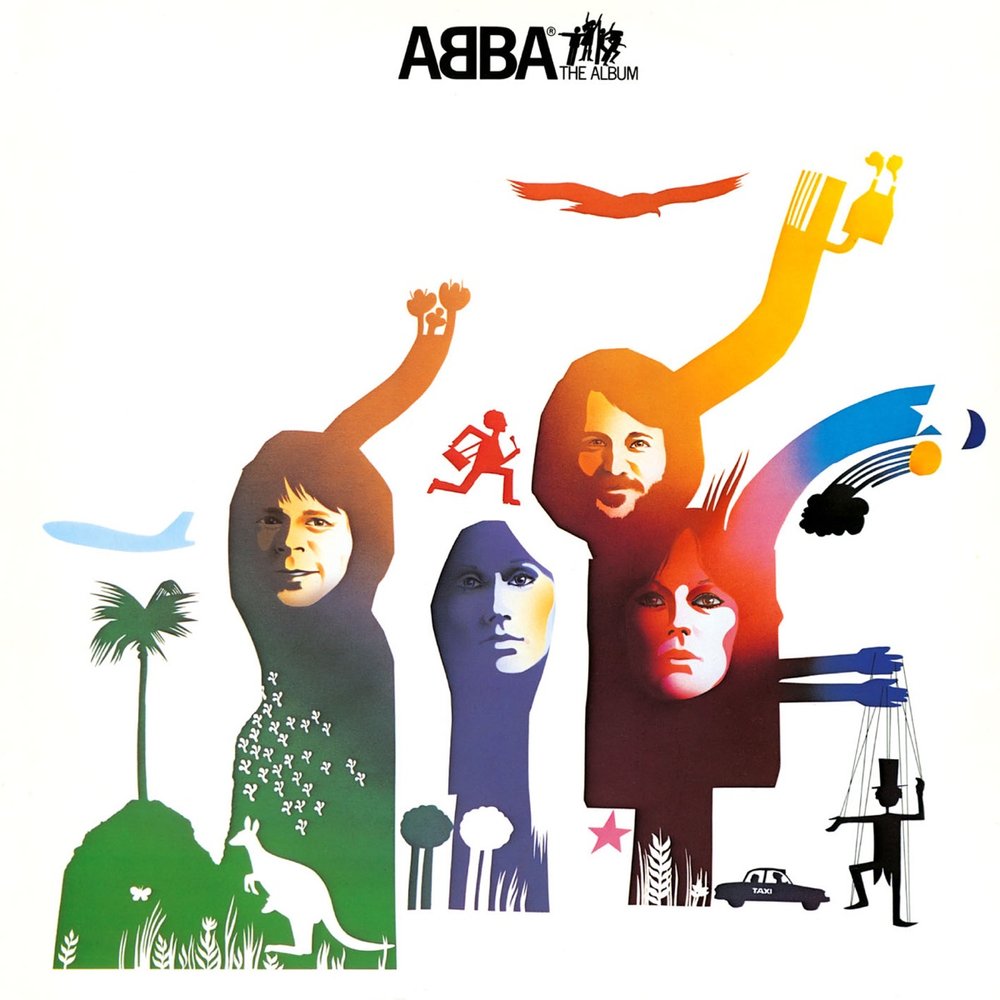
ABBA's fifth album, made in 1977 around a film and a mini-musical. Its first side is the strongest they'd made by then. Its second is where the ambition runs ahead of the songs.
- Released
- 12 December 1977 (Sweden, Polar); 13 January 1978 (UK, Epic)
- Label
- Polar (Sweden) · Epic (UK) · Atlantic (US)
- Producer(s)
- Benny Andersson and Björn Ulvaeus
- Runtime
- 39:53 across 9 tracks on one LP (19:15 and 20:38)
- Chart peak (US)
- #14 (Billboard Top LPs & Tape, charts dated 22 and 29 July 1978)
- Chart peak (UK)
- #1 (Official Albums Chart, 7 weeks from the chart dated 4 February 1978)
- Certifications
- BPI Platinum (27 January 1978) · RIAA Platinum (8 August 1978)
ABBA's 1977 album sold like a certainty, and its reviewers set its two sides apart. Four songs on side one carry it. Side two ends in three scenes from a stage piece that its own writers later doubted, and that's where the record comes apart.
The BPI certified The Album Platinum on 27 January 1978. That was 8 days before the chart dated 4 February, the one that put it straight in at #1. Record Mirror had already reported a million pounds' worth sold. Nobody needed persuading to buy it. The reviews were a different matter. Sheila Prophet of Record Mirror split the record by side, and she liked side two far less. John Rockwell of Rolling Stone also set the sides apart, but he praised side two's ambition. We think Prophet had the sides right. Side one is the strongest side ABBA had made by then. It holds two UK #1 singles and two album tracks that stand beside them. Side two is weaker, and it ends in a stage piece. The record is good but uneven, and the case for it and the case against it are close to level.
The band's historian, Carl Magnus Palm, says the title was chosen to match ABBA: The Movie and the sheet-music Folio. Thank You for the Music had been considered instead. Lasse Hallström's film was due out in December. The plan was to release the album alongside it. A live second disc from Australia was floated and dropped. So The Album is a studio record that ran to a film's schedule. By late 1976 ABBA had mapped out 1977. There would be a tour of Europe and Australia from 28 January to 12 March, and a concert film shot on the Australian leg. The rest of the year was for writing and recording, with no promotional trips.
Shortly before the sessions Björn Ulvaeus told an interviewer that people were talking as if the next album had to be ABBA's Sgt Pepper. He said it put pressure on them. He also said the words had been serving the rhythm of the music, and that they now wanted lyrics that said something. One answer to that pressure was a mini-musical. Benny Andersson and Björn had long wanted to write a musical, and Jesus Christ Superstar had been the spur. The tour gave them a stage. The Girl with the Golden Hair ran for 20 to 25 minutes and closed the main set before the encores. Agnetha and Frida played one girl in identical wigs, and the British actor Francis Matthews narrated. Three of its songs end this album.
It didn't travel well. Benny later called it a poor choice for a tour audience that wanted ABBA. Björn said the story wasn't good enough to expand into a full musical. Prophet found it short of plot, character and wit, and thought it came unstuck on its words. On record the narration is gone, so the songs have to carry it alone. One of them does. 'Thank You for the Music' wasn't written for the album at all. Björn and Benny had played a few bars of its chorus on Swedish television, in a feature filmed on 6 December 1976. That was almost 6 months before the first studio take.
The other influence was California. In May 1977 Benny, Björn and the engineer Michael B. Tretow went to Los Angeles to look at equipment for a studio Polar was planning. Palm records that they came home with 'The Name of the Game' and 'Eagle'. He ties both to the soft-rock sound of the Eagles and Fleetwood Mac. Benny later named Rumours among his ten favourite albums. In 2006 Björn said he heard Boston's 'More Than a Feeling' in 'The Name of the Game' instead. Either way, the starting point was someone else's records. That limits how new the album can claim to be.
'The Name of the Game' is the best argument for the album. A slow bass-and-synth riff opens it. The writing began with that riff. The song then moves through six distinct sections. The two lead voices trade lines and then merge, with stacked harmonies behind them. Björn calls it a guitar song, twelve-strings included. It began as 'A Bit of Myself', and Stig Anderson supplied the title. Six sections is a lot for a single, and it still spent 4 weeks at #1 in Britain. This is where ABBA's craft stops being about the hook and starts being about architecture. Rob Sheffield put it at #3 in his Rolling Stone list of ABBA's 25 best songs.
'Take a Chance on Me' opens with voices alone, the women high and the men low. The men's repeated backing phrase was recorded in overlapping sections. ABBA first tried the song on 3 August 1977 under the working title 'Billy Boy', in a rockier version. The tighter take came on 15 August, with Lasse Wellander on guitar, Rutger Gunnarsson on bass and Roger Palm on drums. Björn's own description of the song is a German march crossed with country music. It was a UK #1 for 3 weeks and reached #3 in America. Prophet thought it overdubbed to excess and the weakest song on side one. We think the overdubbing is the hook.
'Eagle' is the longest track at 5:51. Janne Schaffer improvised his lead guitar against a line Wellander had written. The Deluxe Edition notes frame the result as ABBA's nearest thing to a guitar duel. 'One Man, One Woman' is the ballad. Frida sings it, and Carl Magnus Palm counts it among her best vocals. Benny named it, with 'Thank You for the Music', as his favourites on the album. Prophet picked it as hers. Only two singles came out of the album in Britain at the time, and both were on side one.
Side two starts well enough. Björn speaks the opening of 'Move On'. It keeps some of the mood of an early idea, 'Big John', modelled on Jimmy Dean's 1961 hit 'Big Bad John'. Prophet thought the opening bad, and the song a respectable tune once it recovered. Rockwell heard a superb chorus. Both are right. 'Hole in Your Soul' is the real problem. It was briefly the planned single until 'The Name of the Game' replaced it. Rockwell called it the album's one overt failure, stiff and clinical. Sheffield dissents and puts it at #22 in his top 25. We side with Rockwell.
The last two mini-musical songs are 'I Wonder (Departure)' and 'I'm a Marionette'. A live 'I Wonder' from Sydney was the B-side of 'The Name of the Game', the first of the mini-musical to reach a record. Rockwell found the three scenes far more provocative than 'Hole in Your Soul'. He heard them as surprisingly self-revealing, with a dark frenzy in 'I'm a Marionette'. That's the best case for them. Our reading is that a pop group singing as a puppet on strings is a good idea for a closing song. It isn't enough to carry a second side.
The method explains the split. Sessions began on 31 May 1977 at Marcus Music in Solna, a room ABBA had never used before. They chose it because it could be block-booked for long periods. Then the record ran into trouble. Agnetha was pregnant and was told to rest, but still did some morning sessions and sang some vocals lying in a deck chair. In mid-September the release was put back to February 1978, and in November it was brought forward again. The last mixes, of 'I'm a Marionette' and 'One Man, One Woman', were done on 10 November. Tretow's view was that the studio is where you assemble the best of many performances. That suits the singles. 'I Wonder' and 'I'm a Marionette' were recorded almost as they'd been staged, so the studio had less to give them. 'Thank You for the Music' was recorded twice and rearranged, and it's the one that lasts.
The commercial case is strong. The album spent 7 weeks at #1 in Britain and 61 weeks on the chart. In 2021 the Official Charts Company ranked it ABBA's third best-selling studio album there. In America it reached #14 in July 1978, their highest placing of the original run. Atlantic had declared May 1978 'Abba month', and the climb from #48 in mid-May to #14 in late July followed that campaign. The influence is real but narrow. Palm calls the mini-musical the first step towards Chess and Kristina från Duvemåla. The Fugees built 'Rumble in the Jungle' on the bass-synth groove of 'The Name of the Game', and it reached #3 in Britain in 1997. Erasure's 1992 EP Abba-esque, which includes 'Take a Chance on Me', spent 5 weeks at #1.
The reputation needs a correction. Sheffield calls the album ABBA's prog statement and an art-rock record, and the six sections of 'The Name of the Game' support him. The stage piece is the part of that ambition that doesn't pay off. The borrowed sound of the Los Angeles songs limits it too. NME gave the 2007 Deluxe Edition 7 out of 10 and found it pleasantly nostalgic. Once the album was finished in late 1977, Björn told a reporter it was the summit of what they could do at that point. He was right about side one.
The Album is good but uneven, a record that doesn't hold together. Side one earns the praise. Side two earns the reservations: a failure, a split decision and a stage piece its writers came to doubt. Prophet's verdict on the two sides still holds after 48 years. Rockwell's case for the ambition holds too, and it's the reason to hear side two at all. Play side one often, and side two for what it tried. The ambition is the point, and it's also the reason for the flaw.
Which pressing to own
The Swedish original, Polar POLS 282, is the edition this dossier describes, with the front on a white ground and the credit 'All Keyboards: Benny Andersson' on the back. The catalogue lists 9 runout variants, 8 of them carrying the plant code GA, and nothing puts them in order. On 16 October 2026, 14,480 collectors listed a copy in their collections. The UK Epic edition is a different object, a gatefold with a blue gradient front and an airmail-envelope inner. It was pressed in England and in Holland, and the catalogue doesn't say which came first.