
Deep Dive
Black Sabbath
Black Sabbath by Black Sabbath (1970). What a copy is worth and which pressing to own, in a full Lead-In dossier: Made in a few days in November 1969, it reached #8 in the UK and #23 in the US.
Black Sabbath by Black Sabbath (1970). What a copy is worth and which pressing to own, in a full Lead-In dossier: Made in a few days in November 1969, it reached #8 in the UK and #23 in the US.
Black Sabbath's debut, made in a few days at a London studio in November 1969 and released on Friday 13 February 1970. One side points towards heavy metal. The other plays for time.
Critics hear heavy metal begin in the title track, and the first side backs them up. The second side holds a cover, a short original and a 10-minute cover from the live set. That's why this is a very good debut, not a great one.
For the first 1:26 of the first track, no word is sung. What you get is rain, thunder, a church bell and a riff. The band didn't put the weather there. Rodger Bain, the producer, and Tom Allom, the engineer, added the storm in the mix, without telling the band. Allom rang tubular bells, with reverb, for the bell. Geezer Butler, the bassist, told Rolling Stone in 2020 that the band didn't hear the finished album until about a week before release. Their manager, Jim Simpson, calls the storm the greatest introduction to any rock record, and gives Bain the credit. In 2023 Rolling Stone put the song at #1 on its list of the 100 greatest heavy metal songs.
That opening is a fair sketch of the whole record. The best of it belongs to the band, and some of the finishing belongs to other people. AllMusic and Rolling Stone both point to the title track as the place where heavy metal begins. The first side backs the claim. The second side doesn't. It holds a cover, a short original and a 10-minute cover from the live set. It's a good club band playing for time. That split is why Black Sabbath is a very good album and not a great one.
The band had been turned down by label after label, and Butler says one producer told them to learn to play and to write. Tony Iommi spent a couple of weeks in Jethro Tull in late 1968. Rolling Stone's oral history says it taught him to rehearse in the daytime, and the band started rehearsing at 9am. Their manager couldn't land a deal until the publisher Tony Hall Enterprises took them on. Hall's company funded the recording, and the sleeve says Bain produced it for them. The sum usually quoted is £600, a figure Rolling Stone itself hedges. The label was Vertigo, Philips's new progressive imprint, and this was one of its first six releases. Vertigo's Olav Wyper picked Friday 13 February 1970 for the release, for the superstition. Between them, a label, a publisher and a live set made the record.
Butler told Rolling Stone the aim was to be heavier than any other band. Most of the songs were already their live set, and Iommi says they played their set and that was the album. They recorded it at Regent Sound, in Denmark Street, London, in November 1969. Older accounts say October. Iommi remembers a single day, and Allom remembers two days of tracking and two of mixing. Butler has told it both ways. In 2015 he said two days were booked and one used, and that the band skipped the mix to get to a show. In 2020 he told Rolling Stone they had used up their two days. Either way, it was a few days at most. It sounds like a working band's set, because it was one.
The room shaped the sound as much as the band did. Bill Ward was put in an isolation booth and felt his drums came out muffled. Butler's bass was disturbing a film company upstairs, so Allom took it straight into the desk. Allom says Butler told him, on hearing the playback, that it was the first time he'd heard his bass on a recording. Iommi's Stratocaster pickup failed during 'Wicked World', and he finished on the Gibson SG he'd brought as a backup. These are the accidents of a rushed session. Muffled drums and a mix the band weren't at are why the production is the weakest of the six scores here.
The title track makes you wait, and it's built to. AllMusic and the BBC both hear a tritone in Iommi's riff. Butler says the band wrote it in a couple of hours. Iommi played the riff, the others joined in and Ozzy Osbourne made up the words on the spot. Butler has described the nightmare behind it, in which he woke to a black shape at the foot of his bed. The name came from the 1963 Boris Karloff film. Butler says he'd been playing Holst's 'Mars' on bass and thinks it fed the riff. Iommi says he was thinking of Hammer horror music. Osbourne's first line comes at 1:26, and his last begins at 5:12. For long stretches in between, nobody sings. The riff carries the song and the singer is its guest. Nothing else on the record states the idea so cleanly.
The other three originals on side one are shorter and looser. Butler says 'Behind the Wall of Sleep' came from a dream, after he'd been reading Lovecraft. Bain and Allom added echo to Osbourne's voice on it, and the first line comes at 0:39. The BBC's Pete Marsh praises it, and also praises 'N.I.B.', which opens on Butler's bass, recorded straight into the desk. Its first verse arrives at about 1:01. The band wrote it during one of their club residencies. Butler, who wrote the words, says he wanted some humour in them, with the devil as the one in love. Iommi says the title began as a dressing-room joke, when Osbourne told Ward his face looked like a pen nib. It doesn't stand for 'Nativity in Black', a name the tribute albums used later. 'The Wizard' is the slightest of the four. No word is sung in it until 1:17.
Side two is where the record thins out. 'Evil Woman' is Crow's song, written by Dave Wagner and Dick and Larry Wiegand, and it was the band's first single. Rolling Stone says the publisher wanted a hit. Iommi's memoir says it was the manager's idea for radio. Either way, the band recorded it reluctantly. Ward heard the finished version once and didn't like it, and Wagner thought Sabbath's version too slow. It didn't chart. The American LP drops it for 'Wicked World', the single's B-side and the band's first original song, which AllMusic's Steve Huey says fans much prefer. 'Sleeping Village' opens quietly, with Osbourne over Iommi's picked guitar and Bain's jaw harp. Iommi says the band wrote it for light and shade. The two covers add up to 14:00 of side two's 17:46.
'Warning' is the test. It's the Aynsley Dunbar Retaliation's song, and it was a long number in the band's live set. The last line before the break begins at 3:15, and the words don't return until 9:41. For more than 6 minutes in between, nobody sings. Iommi's solo is a first take. He asked for another, and the first was better. Butler says Osbourne was nearly hoarse by the end and wanted to redo the end of the song, but there was no time. That's a band playing well and writing little. Huey calls the track murky and meandering, and hears Iommi recycling licks. He's right about the shape. A good player and 6 minutes of room don't add up to a song.
The 1970 press was harder still. In Britain, Disc & Music Echo dismissed it as a black-magic marketing ploy. Melody Maker, more mildly, found it heavy going. Lester Bangs, in Rolling Stone on 17 September 1970, heard Cream imitators and waved away the satanic publicity. Robert Christgau gave it an E in the Village Voice on 19 November 1970, and later raised it to a C minus. They were wrong about side one. They had a case about side two. Buyers had already decided. The album entered the UK chart on 7 March 1970 at #25, peaked at #8 and stayed 42 weeks. In America it reached #23 on 26 December 1970 and stayed 66 weeks.
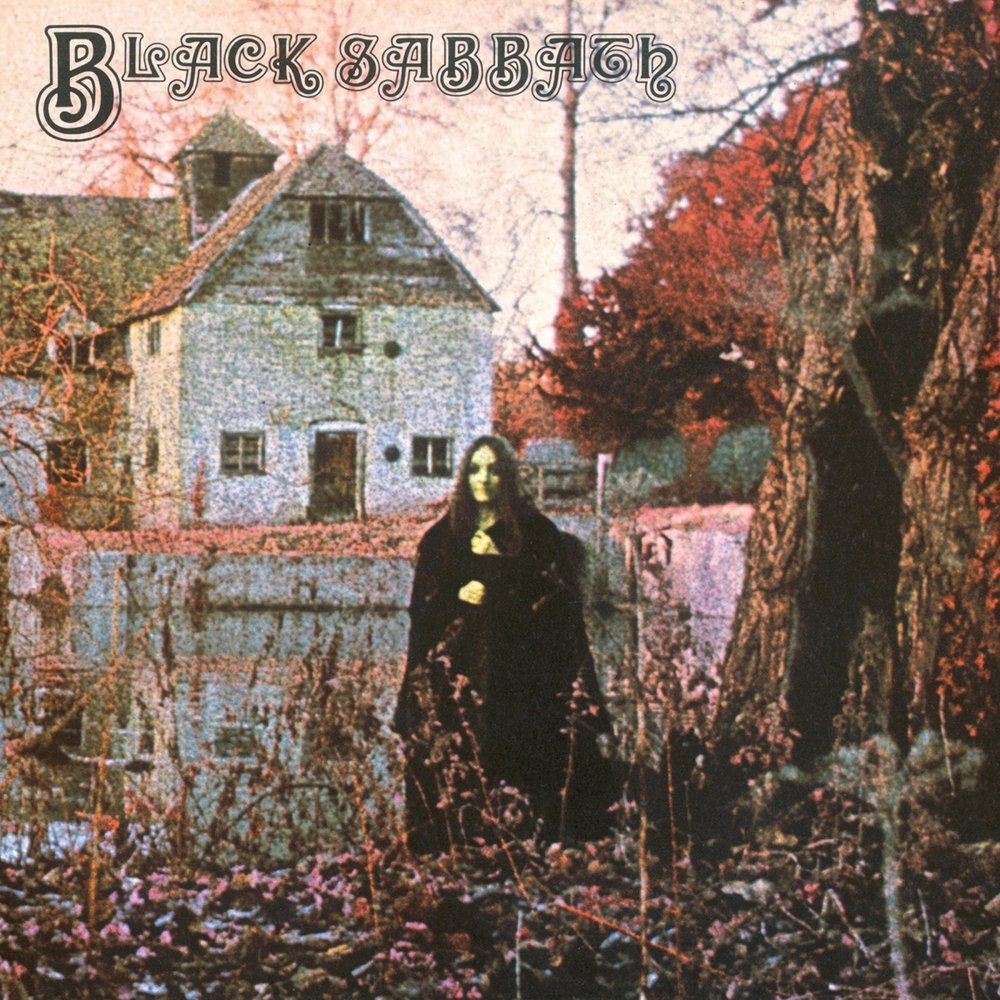
The storm and the sleeve are what most people remember, and neither was the band's work. Keith Macmillan, Vertigo's in-house designer, photographed a model in a black cloak at Mapledurham Watermill, on infrared film made for aerial photography. Sandy Field designed the inverted cross inside the gatefold, and the band weren't consulted. Iommi says they liked the sleeve. Ward loved the front and hated the cross, which he says cost them years of arguments in the press. Macmillan says the cross was a nod to the occult, not meant as satanic. The occult look came from the sleeve's designers, laid over a band that had been rehearsing at 9am.
The reputation has since swung the other way. Rolling Stone ranked it #5 on its 2017 list of the 100 greatest metal albums, behind Paranoid at #1. It's #355 on the magazine's 2020 list of 500. The documented influence is narrower than the praise. The influence score stays high anyway, because in our reading the influence runs through the sound the title track started, not through anyone's testimony. Electric Wizard's Jus Oborn confirmed in a 2005 interview that the band's name joins two Sabbath titles, one of them 'The Wizard'. Primus recorded 'N.I.B.' with Osbourne singing, and it reached #2 on Billboard's Mainstream Rock chart on 7 October 2000. Allom went on to produce Judas Priest's British Steel in 1980. Whether it was the first heavy metal album is a separate argument. Wyper, who released it, told Rolling Stone he doesn't think it was, only that it was probably the first to travel the way it did.
What the title track did was put a slow tritone riff and a horror-film premise in one place. That's a claim about one song, not about the whole LP. It didn't invent loudness: AllMusic's Huey names Blue Cheer and Led Zeppelin as other heavy contemporaries. It did show what a riff could carry, and the first side carries it for 20:31. Most of what works on side two, from the solo in 'Warning' to the doubled solos in 'Sleeping Village', works as playing. Little of it works as writing. Marsh went further in his 2007 BBC review. Apart from the title track, he said, thin material and a rushed production hold the album back, though he spares 'Behind the Wall of Sleep' and 'N.I.B.'. That's the limit, and it's the reason the songwriting and cohesion scores sit below innovation and influence.
Seven months later Paranoid made the case better. It reached #1 in Britain, and Rolling Stone put it above this record on its metal list. The debut is the lesser album next to it, but it's the one where the sound starts. Own it for the title track and 'N.I.B.', and for a good live band caught in a few days. Play side one twice for every time you play side two. This is a very good record with clear limits. Admire what it began. Don't mistake it for the band's best.
The copy to own is the UK first issue, Vertigo VO 6, in a gatefold sleeve with the large 'swirl' label. Two marks identify it: 'A PHILIPS RECORD PRODUCT' printed beneath 'Vertigo' on the label, and a misprint inside the gatefold that reads 'Copyright subsists in all Stereo recordings'. Later swirl issues drop both. The order of the swirl issues rests on collectors' notes in the price guide, not on a label document. The American original, WS 1871, is a different running order.
© The Lead-In · an independent, reader-supported music publication.