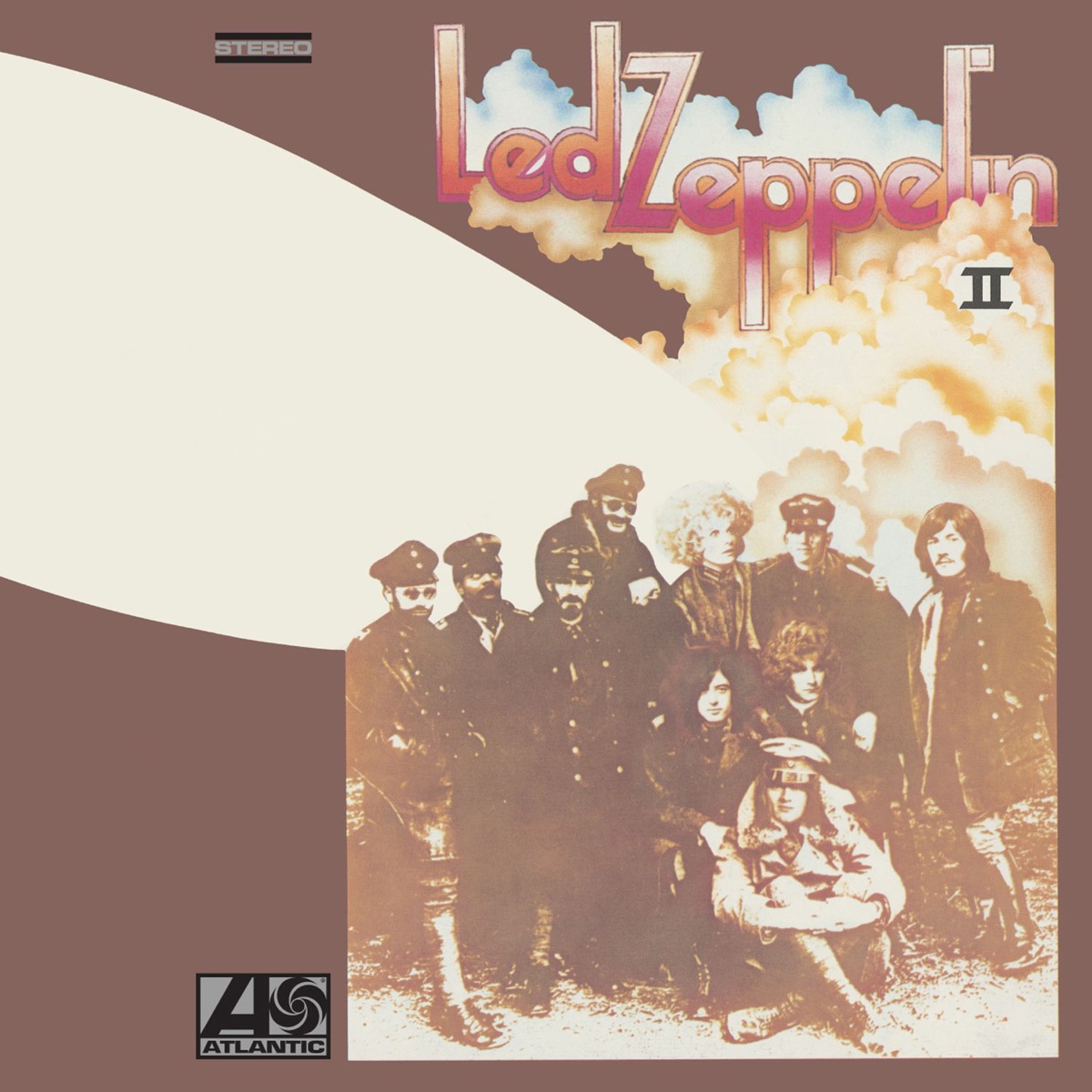
Led Zeppelin's second album, cut between tours in at least four cities and mixed in 2 days. The playing is immense, but the songs under the riffs are uneven and two tracks are filler.
- Released
- 22 October 1969 (US, Atlantic SD 8236); October 1969 (UK, sources disagree on the day)
- Label
- Atlantic Records (UK copies made and distributed by Polydor)
- Producer(s)
- Jimmy Page; executive producer Peter Grant. Eddie Kramer engineered and mixed it, with George Chkiantz, Chris Huston and Andy Johns also credited as engineers
- Runtime
- 41:43 across 9 tracks on 2 sides (the sleeve prints 3:50 for 'Thank You', which runs 4:49; the sleeve times total 40:44)
- Chart peak (US)
- #1 (Billboard 200, 7 weeks in all from the chart dated 27 December 1969, with Abbey Road back at the top for 3 of the weeks between)
- Chart peak (UK)
- #1 (Official Albums Chart, 1 week, the chart of 7 February 1970); it entered at #4 on 8 November 1969
- Certifications
- RIAA 12× Platinum (15 November 1999) · BPI 4× Platinum (25 September 2008)
- Awards & honours
- Ranked #123 on Rolling Stone's list of the 500 greatest albums, 2020
Led Zeppelin II was pieced together between tours, from sessions in at least 7 studios, with a few songs carried over from the stage. It's a great record because of the playing and the mix, and a flawed one because the writing is uneven.
On the Billboard 200 dated 27 December 1969, Led Zeppelin II took the top spot from Abbey Road. The Beatles got it back for 3 weeks, in two spells, and Zeppelin ended with 7 weeks at #1. In Britain the album came in at #4 on 8 November 1969. It reached #1 on the chart of 7 February 1970, for a single week, and spent 129 weeks on the chart in all.
That's a lot of success for a record its own producer doubted. Late in 1969, Jimmy Page said he'd lost confidence in it by the time it came out. Some of it had been written in hotel rooms, he said, and its tapes had moved between cities. He had a point. Led Zeppelin II is a great record with a real flaw. The playing is superb and the mix is thrilling. The songs underneath are uneven, a third of them lean on other people's blues, and it was put together in such a hurry that two of the nine tracks are filler.
Atlantic wanted a second album quickly. Dave Lewis writes in Classic Rock that label executives aimed for a July release and that the manager, Peter Grant, didn't give way. In late June, Page told the BBC the album was three-quarters done and due in the first week of August. In between, the band was on the road. It began a North American tour on 18 April, and recording went on in whatever time that left. Page told Trouser Press in 1977 that it was made wherever they could get into a studio. By his account the first album had taken about 30 hours. This one had no such luxury.
Some of the material came from the stage. 'Killing Floor' was in the 1969 set before it became 'The Lemon Song', and John Bonham's drum feature 'Pat's Delight' became 'Moby Dick'. Page said some of the songs came out of rehearsing for the next tour. 'Whole Lotta Love' was first worked on at Olympic in April and played on stage at Winterland in San Francisco on 26 April 1969, months before the album was finished. Most of the rest hadn't been played live. By October, Lewis writes, only a handful of the album's songs had been rehearsed for the stage. At the Lyceum in London on 12 October the band premiered just two, 'What Is and What Should Never Be' and 'Heartbreaker'.
So the sessions followed the schedule. The first, at Olympic Studios in Barnes in April, began with 'What Is and What Should Never Be' and 'Whole Lotta Love'. At Mystic Sound in Los Angeles, the engineer Chris Huston cut 'The Lemon Song' live in a low room 16 feet square. On 10 May, Robert Plant overdubbed harmonica for 'Bring It On Home' in Vancouver. Page told Trouser Press the vocal overdubs there were done in an eight-track studio without proper headphones. Morgan Studios in London added 'Thank You' and 'Living Loving Maid' in June. Two more songs cut there, 'We're Gonna Groove' and 'Sugar Mama', stayed off the album. In July and August the work moved to New York. That's at least 7 studios on two continents, and Guitar Player's 2008 account of the sessions lists 13, from Ardent in Memphis to a hut in Vancouver.
Then Page and the engineer Eddie Kramer mixed it at A&R in New York, in 2 days. Kramer had a Scully 8-track recorder and a console with a dozen or fewer channels and 2 pan pots. That's very little for a record that sounds this wide. The middle of 'Whole Lotta Love' shows what they did with it. The words stop at 1:17 and don't return until 3:20. In between, Kramer and Page threw instruments and voices from one side of the stereo picture to the other. Kramer has described the two of them flying around the console, twiddling every knob. Near 4:00 a second vocal line turns up in the mix. Kramer says it's bleed from a guide vocal on track 8. He kept it and added reverb. He also left in the laugh at the start of the track. Page said he used backwards reverb on the slide part.
This is where the record's real invention sits, and it belongs to the producer and the engineer more than to the songwriters. A hard rock band had found a place to drop the words and let the studio play. It wasn't new in itself. Kramer had engineered Jimi Hendrix's Electric Ladyland, and the toolkit is the same: stereo movement and tape tricks. On 'What Is and What Should Never Be', he made the phasing on Plant's voice with 2 tape machines. The song ends with stereo movement too. People call the sound heavy. It's as much a record of space as of weight.
Page had changed his equipment since the first album. In place of the debut's Telecaster and Supro, Guitar Player reported in 2008, he played a 1958 Les Paul through a Marshall. The 'Heartbreaker' solo shows the result. It was recorded on its own, at Atlantic Studios, after the band's track was cut at A&R. There are no words between 2:00 and 3:41. Eddie Van Halen told Guitar World in 2008 that he thought he got the idea for tapping from watching Page play that solo in 1971. The trick was a pull-off to an open string.
Plant's progress is easier to miss. He wrote the words of 'Thank You' alone, and Page told Trouser Press in 1977 that it was the moment he came through as a lyricist. It's the best song here that doesn't lean on a riff. Plant said after release that the album used his voice in different ways, rather than in one safe formula. Bonham gets a drum feature in 'Moby Dick', and that's where the record sags and where the patching shows. Kramer spliced it from several sections and says he isn't proud of the edits. At 4:25, it's the least necessary track on the album. 'Living Loving Maid', at 2:40, never gets past its first idea.
The deeper problem is where some of the songs come from. Three of the nine tracks lean on blues songs by other writers: 'Whole Lotta Love', 'The Lemon Song' and 'Bring It On Home'. AllMusic's Stephen Thomas Erlewine overstated it when he said most of the songs were reworked standards. Three isn't most. It's still a third of the record. The 1969 US label credited all nine tracks to members of the band. A UK label from 1970 credits the third track to Burnett, meaning Howlin' Wolf, as 'Killing Floor', though the sleeve still says 'The Lemon Song'. The 2014 European pressing credits 'Bring It On Home' to Willie Dixon alone and adds him to the writers of 'Whole Lotta Love'. David Fricke wrote in 2014 that the album is still tied to its blues sources.
In America, the sound also depended on who cut the lacquers. Bob Ludwig cut the first US lacquers at Sterling Sound, at Kramer's request for a hotter version than the reference disc cut at A&R. Atlantic's own cutters later re-cut the master at a lower level, Ludwig says, without consulting him, Kramer or the band. He didn't hear of it for years. The tale that Ahmet Ertegun's daughter's record player started it is hearsay. Ludwig says 'apparently', and Michael Fremer says niece. For a record whose appeal is loudness, it matters which cut you own.
The first reviews heard the sameness. John Mendelsohn's review in Rolling Stone on 13 December 1969 was a satire, a pan dressed as a rave. Robert Christgau gave the album a B in the Village Voice on 15 January 1970 and conceded that all the songs sound alike. He asked if anyone held that against Little Richard. On 12 February he called the band's trademark, clear only on this second album, an 'artistic triumph'. He was right both times. The riff songs do sound alike, and that shared sound is why they work. Lewis writes that Page asked Kramer to give tracks cut in so many places one sound, and the 2-day mix did it. Erlewine heard a lack of dynamics, though he allowed that 'Thank You' and 'Ramble On' have light acoustic touches. 'Bring It On Home' has a third, opening quietly on harmonica and voice.
The influence is documented, not just claimed. Erlewine called the album 'the blueprint' for heavy metal and said nearly every Led Zeppelin imitator used it. That's his reading, and it's a fair one for the riff songs. Elsewhere the evidence is concrete. CCS's version of 'Whole Lotta Love' reached #13 in the UK in 1970 and became the theme of Top of the Pops until Yellow Pearl replaced it in 1981. On 24 August 2008, Page played the song in London's handover at the Beijing Olympics closing ceremony. By 2014 Fricke could write that Rolling Stone was still living down its 1969 pans, and that the music was now 'beyond reproach'. The magazine's 2020 list of the 500 greatest albums put the record at #123. Erlewine judged it less eclectic than the debut but arguably more influential.
Led Zeppelin II earns its praise with the playing, the mix and its hold on the bands that followed. Fricke's 'beyond reproach' fits the playing. It doesn't fit the writing. Page, Plant, John Paul Jones and Bonham are all at full stretch, and 'Whole Lotta Love' still sounds wider than a desk with 2 pan pots should allow. The reservations are just as real. Two tracks are filler, three lean on other people's blues, and its own maker lost faith in it before it was out. Hear it for 'Whole Lotta Love', 'Heartbreaker', 'Thank You' and 'Ramble On'. Skip 'Moby Dick'. It's a great record that was put together in a hurry, and the weaker tracks show it.
Which pressing to own
The UK original is the first label state of Atlantic 588198, made and distributed by Polydor. Its tell is a misprint: the label for the second side's second track reads 'Livin' Lovin' Wreck (She's A Woman)', and the sleeve is unlaminated light-brown card by E.J. Day. On 16 October 2026, 12,272 collectors listed it in their collections. The American copy to look for is the RL cut, with RL in the dead wax for Bob Ludwig, usually beside SS for Sterling Sound. Atlantic's own re-cut replaced it, and 14,845 collectors listed the re-cut on the same date.