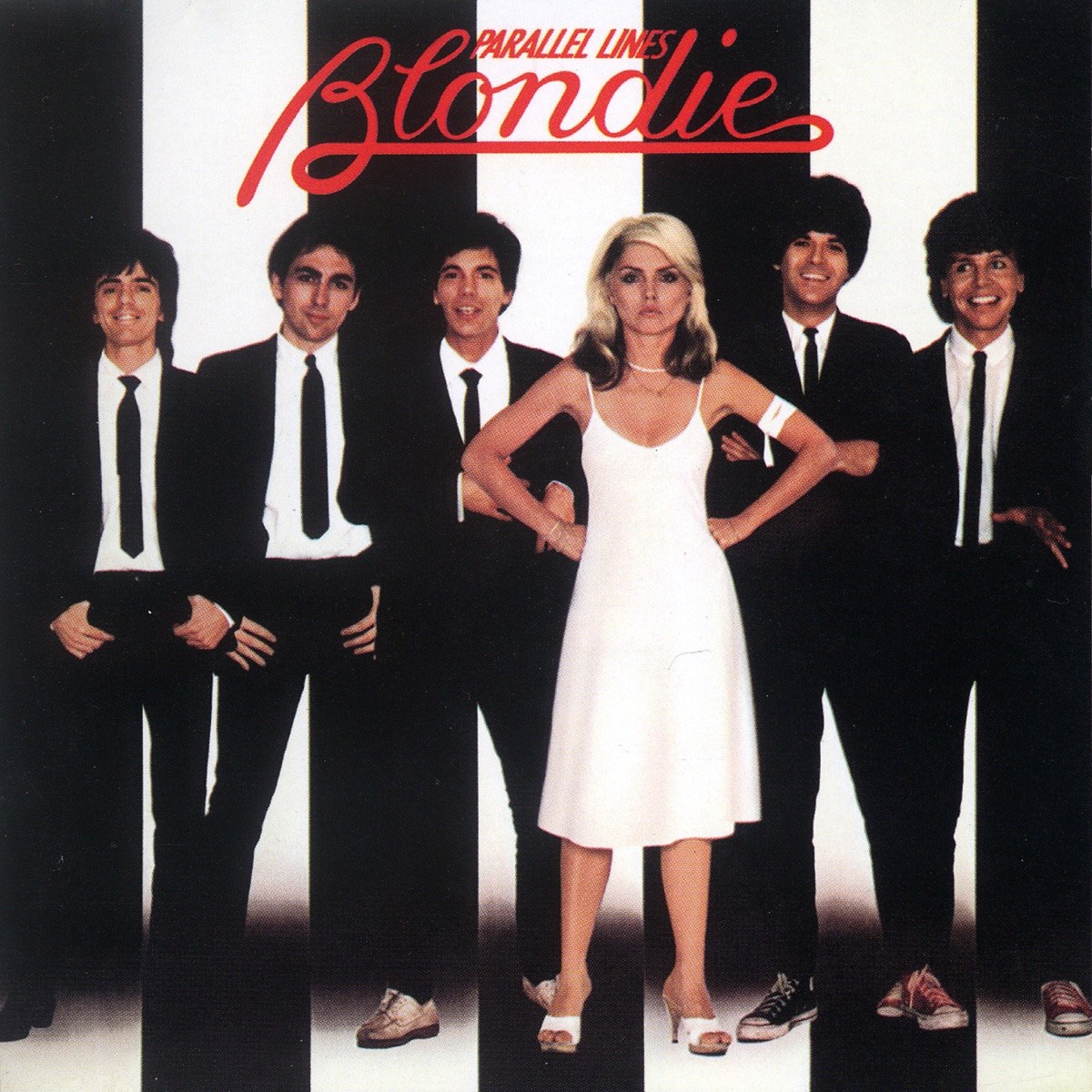
Blondie's third album: 12 short songs, made in about 6 weeks with a glam-rock producer who drove a loose New York band through take after take. Nearly every song comes out finished.
- Released
- 8 September 1978 (UK, Chrysalis CDL 1192); September 1978 (US, Chrysalis CHR 1192)
- Label
- Chrysalis
- Producer(s)
- Mike Chapman
- Runtime
- 38:20 by the label timings; US copies pressed from 1979, with the 5:50 'Heart of Glass', run about 40:16
- Chart peak (US)
- #6 (Billboard 200), 3 weeks at #6 in April and May 1979
- Chart peak (UK)
- #1 (Official Albums Chart), 4 weeks at #1 from February 1979; 115 weeks on the chart
- Certifications
- BPI Platinum (6 February 1979); RIAA Platinum (6 June 1979); Music Canada 4× Platinum (1 June 1980)
- Awards & honours
- Added to the Library of Congress's National Recording Registry in 2024; 'Heart of Glass' entered the Grammy Hall of Fame in 2016
Parallel Lines is remembered as the record where a punk band went disco. That's the least original thing about it. What makes it great is a producer's discipline applied to a band's best songs, and only a weak patch on side two lets it down.
The first sound on Parallel Lines is a British telephone. Mike Chapman, the producer, wanted a British phone ring at the start of 'Hanging on the Telephone'. He told Sound on Sound in 2008 that the band thought it a stupid gimmick. He had his engineer, Peter Coleman, call someone in London to record one. Debbie Harry starts singing at 0:04. It's a tiny decision, and the whole album is in it. A New York band had brought in a song by somebody else, and a producer from the glam charts decided how it should start.
'Heart of Glass' is what people remember, and it was a disco song from the start. Its sources were records already in the shops. What this album does better than anything else Blondie made is finish its songs. There are 12 of them, and none runs past 3:57 on the original pressing. Each one gets to its hook and gets out. That's Chapman's craft as much as the band's, and it's why the record is great. It also has a soft patch on side two, though some good critics hear none.
Blondie weren't failing when they met Chapman. 'In the Flesh' had reached #2 in Australia in 1977. In Britain, 'Denis' went to #2 in March 1978, and '(I'm Always Touched by Your) Presence, Dear' made #10 that May. America was the problem. Pitchfork's 2008 review points out that their debut hadn't charted there at all, and that Plastic Letters barely scraped into the top 75. Chrysalis paired them with Chapman, who with Nicky Chinn had made hits for Sweet, Suzi Quatro and Mud. Terry Ellis of Chrysalis gave him 6 months to make the album. He used about 6 weeks.
Chapman has never pretended the sessions were happy. He told Sound on Sound they were the worst band he'd worked with for musicianship. He named Frank Infante as the one great player, and said Clem Burke had the right ideas but no sense of timing. There were no click tracks. Chapman stood on the studio floor in headphones, singing guide vocals, and by his own description acted as the band's drum machine. He spent hours with Chris Stein on guitar parts. With Harry, whom he found moody, he says he took a psychological approach. In his telling, none of them liked each other except Stein and Harry, and a row with the bassist Nigel Harrison nearly came to blows. Stein, asked in 2013, called recording with him fun, if a little painstaking.
'Heart of Glass' carries the album's reputation, so it's worth being exact about it. Harry and Stein wrote it around 1974, when they lived in a loft on the Bowery. Harry told the Guardian in 2013 that it had no title, and the band just called it the disco song. They tried it as a ballad and as reggae, she said, and neither took. Chapman tells the next part as his own idea. At the first rehearsal, he says, he asked Harry what music excited her, and she said Donna Summer. He suggested treating the song as if it were meant for Summer. The band looked blank until Harry said she liked disco. That may be how the room went, but the idea wasn't new to them. In February 1978 Harry told the NME she wanted to make music like Giorgio Moroder's, and the band had been covering 'I Feel Love' at gigs. Chapman didn't bring disco to Blondie. He made them commit to it.
How the finished track was built depends on who's telling it. Harry and Chapman both recall a little Roland drum machine, and Stein says Jimmy Destri brought it in. Stein says Jimmy Destri brought it in, with a synthesiser. Chapman says he suggested building the groove on it. He added a time change in the middle, and had to stop and restart the machine by hand to get through it. Burke's drums went down one piece at a time, and Stein remembers about 3 hours on the bass drum alone. The real disagreement is over the keyboards. Chapman describes sequenced keyboard parts. Stein says the machine and the synthesiser were kept together by hand, every note played in real time. The record opens on the machine, and Harry doesn't sing until 0:17. In Rolling Stone's 2003 entry on the album, Burke says he was chasing the groove of the Bee Gees' drummer. He credits Kraftwerk and Saturday Night Fever. In his Rolling Stone review, Ken Tucker heard Kraftwerk crossed with Donna Summer. That's a fair description of a great single. It's also a list of debts.
The rest of the album shows Chapman's method more clearly than 'Heart of Glass' does. 'Hanging on the Telephone' reaches its title at 0:14 and is over in 2:17. 'Sunday Girl' gets there at 0:15. 'One Way or Another' sings its title in its first line, a little over 20 seconds in, and keeps coming back to it. Harrison wrote the music. At rehearsals, Chapman says, it was just a riff, with no melody or words. Harry wrote them during rehearsals and finished just before the band went into the studio. Tucker's review noticed that Chapman mixed Stein's guitar right beside Harry's voice. The mixing took about 10 days, at Forum Studio in Covington, Kentucky. That's the sound of the whole record. Nothing waits in the background, and almost nothing gets to take its time.
The few songs that do take their time are among the best things here. 'Picture This', the first British single, doesn't reach its title until 1:11, and it's still one of the album's strongest songs. 'Fade Away and Radiate' is Stein's, with Robert Fripp on guitar because Stein wanted him there. At 3:57 it's the longest track on the original pressing. After the last vocal line, which starts at 3:21, the band plays on for more than half a minute. Pitchfork heard Roxy Music in it. It's the one place where the art band of the first two albums survives, and the album is better for the change of pace.
'Sunday Girl' is the album's purest pop song. It's credited to Stein, who has said it's about Harry's cat, which had run away. Chapman doesn't think its words were written until the band reached the studio. It was #1 in Britain for 3 weeks in 1979, and it was never a single in America. Robert Christgau's Consumer Guide review, which gave the album an A, heard 1960s pop sources with real feeling under the sweet surface. 'Sunday Girl' is the clearest case of both.
The other members' songs hold up too. Destri's '11:59' opens side two, and he'd already written much of Plastic Letters. Infante's 'I Know but I Don't Know' closes side one and takes its time, with more than a minute of the band alone before the last verse. The closer, 'Just Go Away', is Harry's alone, and Christgau singled it out in his review. Tucker heard it as a sardonic brush-off and compared it to the Rolling Stones. Harry wrote or co-wrote 5 of the 12 songs, and her voice holds the record together. It's cool and exact, and it never begs.
The weak spots are on side two, around the hits. Three of the 12 songs came from outside the band: two by Jack Lee of the Nerves, and a Buddy Holly song. 'Hanging on the Telephone' earns its place at the front. Lee's other song, 'Will Anything Happen?', is solid but forgettable. The Holly cover, 'I'm Gonna Love You Too', is the real problem. It lasts 2:03 and sounds like a band filling a slot. It comes straight after 'Sunday Girl' and 'Heart of Glass', the album's two British #1s, so the best run on the record leads into its weakest track. Chrysalis made it the first American single anyway, and it missed the chart there. Not every critic agrees. Christgau wrote that "even on side two every song generates its own unique, scintillating glitz". Pitchfork called these two songs "weak only by comparison". That's generous. The drop after 'Heart of Glass' is plain.
Success then changed the album itself. 'Heart of Glass' was #1 in Britain for 4 weeks in February 1979, and the album reached #1 while it was there. In America the single went to #1 on 28 April 1979. By then American pressings had changed. Copies from 1979 swap the 3:54 album cut for the 5:50 disco version, with a sticker calling it uncensored. American buyers got a different record from the one released the previous September. Pitchfork argued in 2008 that the hits had turned Parallel Lines into an album people knew through compilations. The swap shows how early the single started to swallow the album.
In New York the hit cost them something. Harry told the Guardian that people were angry with the band for bringing in outside influences, and Burke at first refused to play the song live. Stein remembered the Ramones' teasing as tongue in cheek. Harry also tied the backlash to the riot at Disco Demolition Night in Chicago, on 12 July 1979. That came about 11 weeks after the song topped the Hot 100. None of it touched the album in Britain, where its first run on the chart lasted 96 weeks, into July 1980. When the Library of Congress added it to the National Recording Registry in 2024, Harry recalled that the record company hadn't liked it and had heard no hits on it.
So the legend gets the reason wrong. Parallel Lines didn't invent much, and its innovation is the thinnest part of its case. The disco idea was in the song before Chapman arrived, however hard he pushed it. What it has is finish. At least nine of its 12 songs are as sharp as pop got in 1978, and the running order rarely lets one outstay its welcome. The Holly cover and a forgettable Jack Lee song keep it from being flawless, and the hits make it easy to hear as a singles collection. Play it as an album anyway. It's a great record with a soft spot on side two, and the producer's hand is as much its signature as the band's.
Pressing guide — the one to own
The original to own is the UK first edition, Chrysalis CDL 1192, released on 8 September 1978 and pressed by Phonodisc. It has blue and white Chrysalis labels and a printed lyric inner, which catalogue notes say is missing from some later copies with the same number. Several 1978 UK lacquer cuts are listed. One reads CDL 1192 A//10∇E420 12 1, with 'RL' etched, and CDL 1192 B//11∇E420 12 6. Other 1978 copies carry Pye cuts, with a 'P' in the runout. The catalogue entry for that copy credits Bob Ludwig with cutting the side A lacquer, while the sleeve credits mastering to Steve Hall at MCA-Whitney. In America, the test is the label: a 1978 copy lists 'Heart of Glass' at 3:54, and 1979 copies list the 5:50 disco version.