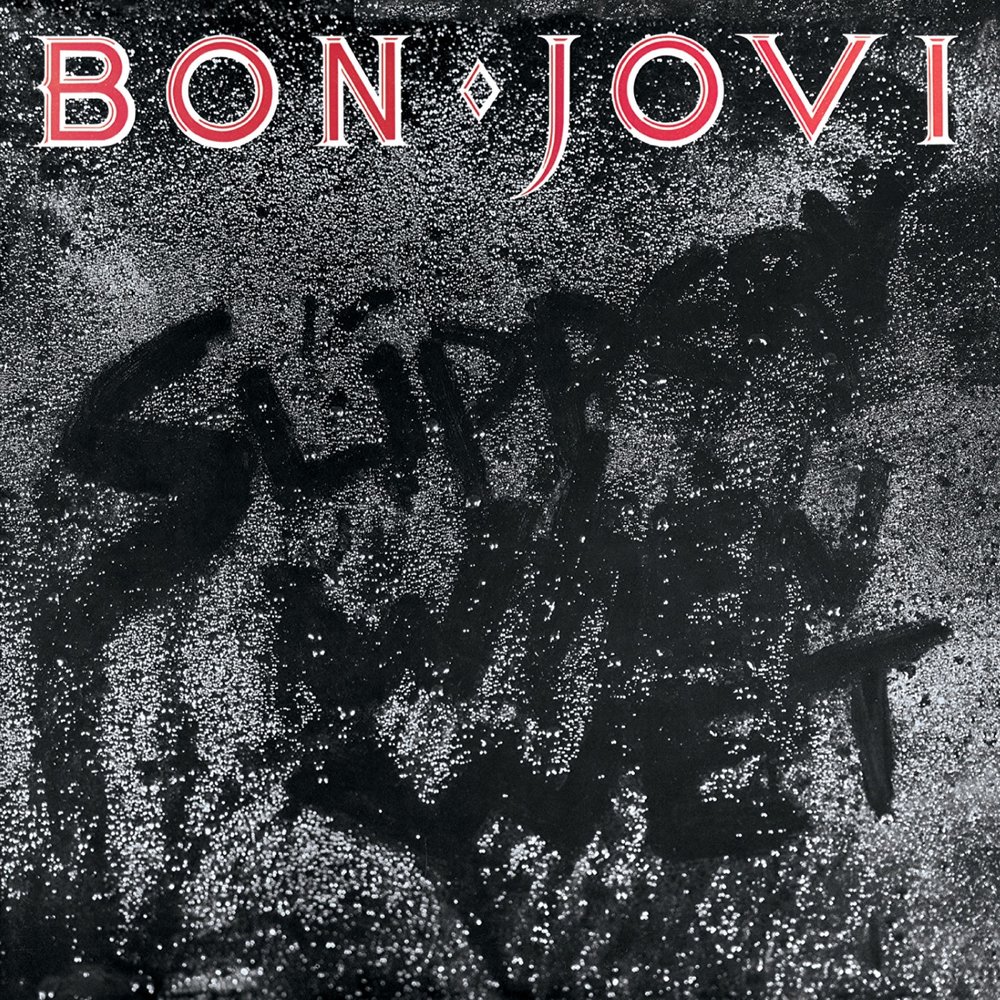
Bon Jovi's 1986 breakthrough, written with an outside hit-writer and made in Vancouver with a producer chosen for his sound. Three great singles and a sound to match, then an album that can't keep up.
- Released
- 18 August 1986 (US, Mercury). Japan came first, on 10 August; the BPI lists 31 August for the UK (Vertigo)
- Label
- Mercury (US, Europe and Japan) · Vertigo (UK)
- Producer(s)
- Bruce Fairbairn (engineered and mixed by Bob Rock)
- Runtime
- 43:58 across 10 tracks on one LP
- Chart peak (US)
- #1 (Billboard 200, 8 weeks in all, the first on the chart dated 25 October 1986)
- Chart peak (UK)
- #6 (Official Albums Chart, charts of 29 November 1986 and 17 January 1987), with 141 weeks in the Top 100
- Certifications
- RIAA 15× Platinum (23 July 2024) · BPI 3× Platinum (31 July 1993) · Music Canada Diamond (28 October 1987)
- Awards & honours
- Ranked #3 in Rolling Stone's 50 Greatest Hair Metal Albums list (2019). Bon Jovi were inducted into the Rock and Roll Hall of Fame in 2018
Slippery When Wet gave Bon Jovi two American #1 singles and a third hit built to the same plan. The sound is the album's best idea. The songs between the hits are why the critics who called it thin in 1986 weren't simply wrong.
On 25 October 1986, Slippery When Wet went to #1 on Billboard's album chart. It was the record's 7th week on the list. It had entered at #45 on the chart dated 13 September. In the same issue, Paul Grein noted that Bon Jovi were only the fourth heavy metal act to top that chart, after Led Zeppelin, AC/DC and Quiet Riot. The claim that they were the first is still repeated, and it's wrong. Billboard's own reviewer had filed them as pop/metal in September. By late October its chart columnist was counting them as metal, and the pop had dropped out of the description.
Here's the argument. Slippery When Wet is three great singles inside a very good sound, followed by an album that can't keep up. Both halves are true, and the record's reputation depends on which one you hear first. Billboard's reviewer, on 6 September 1986, called it a breakthrough that should take the band all the way. On 20 September, Record Mirror's Mike Gardner said the polish had left it with no danger at all. They were each describing something real.
Bon Jovi had made two albums and had one real hit, 'Runaway'. Billboard described a hard-working, hard-touring band with a strong core audience. What they lacked was a sound. Jon Bon Jovi compared his own CD of the second album, 7800° Fahrenheit, with Black 'n Blue's Without Love. He was stunned by how much better the Black 'n Blue record sounded, and he called its producer. That was Bruce Fairbairn, who'd also made records with Loverboy and Honeymoon Suite. Fairbairn had trained Bob Rock, who engineered and mixed this one.
The songs needed help too. Desmond Child, who'd met Jon and Richie Sambora through Kiss, was brought in after he'd co-written Kiss's 'Heaven's on Fire'. He says Kiss had opened the door to outside writers in bands. On his account, the three of them wrote 'You Give Love a Bad Name' on their first day together, and 'Livin' on a Prayer' a few weeks later. The Observer places that first session at Sambora's childhood home, and says Child secretly reworked a recent flop he'd written for Bonnie Tyler to make 'Bad Name'. More than two dozen songs were written for the record. Sambora has said the demos were road-tested on local kids at a pizza place.
Nobody planned a phenomenon. Fairbairn said he and Jon agreed on a goal of 500,000 copies, and that nobody expected hits. They worked at Little Mountain in Vancouver, and the Georgia Straight reported in July 1986 that the band had spent 2 months there. Jon told the paper the studio was as good as the ones behind his first two albums, or better, and called Rock the greatest. Fairbairn also remembered being nearly fired in rehearsals, when Jon told him he wasn't contributing. His answer was that he wanted to learn the songs before he changed them. The working title, Wanted Dead or Alive, was dropped after a visit to a strip club in Gastown. The black bin-bag cover came later, with 'Bad Name' already on the radio.
What Fairbairn and Rock built is the record's best idea. Bryan Reesman, a sympathetic biographer, hears reverb, gloss and a thick drum sound that makes pop-rock feel heavier than it is. The producer Kevin Shirley ranks the sound with Def Leppard's Hysteria. The gloss does a specific job. It gives songs with pop hooks the weight of a stadium act. Put on 'Let It Rock' and listen to the entrance. David Bryan's keyboards open it, and Reesman hears Jon Lord in them. Japanese editions index the first 57 seconds as a separate track, 'Pink Flamingos'. The first vocal doesn't arrive until 1:22. Not everyone heard weight. Rolling Stone's Jimmy Guterman heard Jon's voice double- and triple-tracked to hide a bland singer. Record Mirror's complaint was the same polish seen from the other side.
The singles use that weight differently. 'You Give Love a Bad Name' has no run-up. The first sung line is at 0:00, and the title is in the air by 0:04. A radio listener has no time to change station. 'Livin' on a Prayer' is built the other way. Sambora's talk box carries the riff, and nobody sings until 0:39. Late on, the voice drops out at 2:59 for an instrumental break and comes back at about 3:15 for the final stretch. Maura Johnston, writing in Rolling Stone in 2017, called it amped-up Springsteen, and the comparison is fair. It's Springsteen with the doubt taken out.
Three hits, three openings: a voice at 0:00, a riff for 39 seconds, a mood for 47. 'Wanted Dead or Alive' is the slow one, and nothing is sung for those 47 seconds. Reesman hears a moody intro and crystalline acoustic guitars. The song then runs to 5:09, with an instrumental break from about 2:48 to 3:09 and roughly the last 24 seconds without a voice. It reached #7 on the Hot 100 and #13 in Britain. Sambora is the thread through all three. The sleeve credits him with electric and acoustic guitars, guitar synths and the talk box. Away from the hits, Rolling Stone's 2019 hair-metal list singled out his wall of guitars on 'Raise Your Hands'. The magazine's own reviewer had called the solos afterthoughts.
The case against starts with what surrounds the singles. By the CD timings, side one runs 22:45 and side two 21:13, so the sides are nearly the same length. The hits aren't spread that way. Only one of the four songs that charted as singles in Britain is on side two. Reesman calls 'Social Disease' raunchy filler and 'Without Love' vapid. Guterman opened his Rolling Stone review by counting the clichés in 'Raise Your Hands', and he had a point. 'Never Say Goodbye', a single in Britain, splits everyone. Reesman finds it cringe-inducing and Guterman says it strays into sentiment. Johnston, arguing for the band, called it a tearjerker built with precision.
There's a second reservation, about invention. Everything that made the record is documented, and almost none of it was new. An outside hit-writer who'd already written with Kiss. A producer picked for the sound of another band's album. Demos tried out on local kids. This is craft, and it worked. Robert Christgau gave the record a B− in the Village Voice on 1 September 1987. He granted a version of that point: on his reading, this was youth rebellion tame enough to simulate and sell. Then he waved the point away. Who had ever thought youth was dangerous, he asked, and would you rather the band sold patriotism? He ended by asking whether you were immune to 'Livin' on a Prayer'. That's a grudging yes, from the critic who named the formula.
The singles outlived the reviews. 'Livin' on a Prayer' spent 4 weeks at #1 on the Hot 100 in February and March 1987, and 'Bad Name' had been #1 before it. They were the band's first two American #1s, back to back. The video for 'Prayer', filmed at the Grand Olympic Auditorium in Los Angeles, passed a billion YouTube views on 1 February 2023. The RIAA has certified the song Diamond. On 16 October 2026 the BPI certified 'Bad Name' 3× Platinum. Forty years on, the hits are still being counted, which is the simplest case for the record.
The critics have softened without quite converting. AllMusic rates the album 4.5 stars. Rolling Stone ranked it #3 on its 2019 list of the best hair-metal albums. The Rolling Stone Album Guide judged that the record came close to redeeming the band. It named 'Livin' on a Prayer' and 'Wanted Dead or Alive' as the best of it. Johnston, arguing for the band in 2017, granted that critics had hardly loved them. That's a long way from the verdicts of 1986, and not a long way from the argument of this essay.
Its reach is documented. In Britain it peaked at #6 and spent 141 weeks in the Top 100. In America the RIAA certified it 15× Platinum. No audited world total exists, and the published figures run from 13 million to 28 million. Jon told the Arizona Republic in 2013, 'That was our Thriller.' On the band's own scale, the claim holds. Documented influence is narrower, and it runs through people. Child says the Bon Jovi hits led to his work with Aerosmith, who had never used an outside writer. Executive producer Joel Gallen says the band's acoustic set at the 1989 MTV Video Music Awards changed Unplugged's ambition, from new acts to stadium acts going acoustic.
So the case for and the case against are both true, and the case for wins, but not by much. For: three singles that still work, a sound that gave them weight, and a live band good enough to upstage the headliner at the Meadowlands in September 1986. Against: thin songs around the hits, a formula where invention should be, and a polish the first critics were right to notice. It's a good album with a few great tracks. Play the singles loud, and don't expect the rest to keep up.