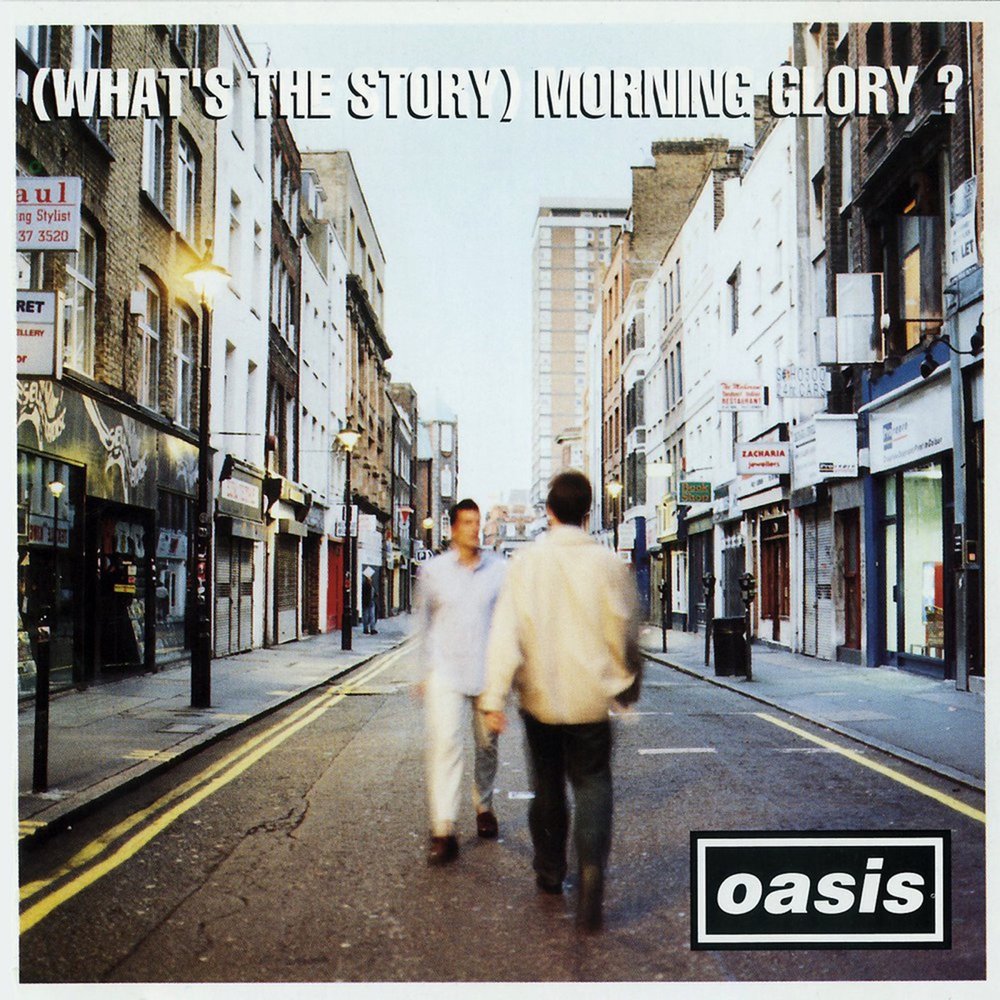
Oasis's second album, made mostly at Rockfield in 1995 with a new drummer. The UK's biggest studio album rests on a handful of great songs, not on new ideas.
- Released
- 2 October 1995 (Creation, UK) · 3 October 1995 (Epic, US) · 10 October 1995 (Epic, Japan)
- Label
- Creation Records (UK) · Epic (US and Japan) · Helter Skelter (continental Europe)
- Producer(s)
- Owen Morris and Noel Gallagher
- Runtime
- 50:00 across 12 tracks on CD; the 2×LP adds a 13th, 'Bonehead's Bank Holiday' (3:47)
- Chart peak (US)
- #4 (Billboard 200, chart dated 24 February 1996), 84 weeks on the chart
- Chart peak (UK)
- #1 (Official Albums Chart, from the chart dated 14 October 1995), 10 weeks at #1
- Certifications
- BPI 19× Platinum (15 May 2026) · RIAA 4× Platinum (8 November 1996) · Music Canada 8× Platinum (23 May 1997)
- Awards & honours
- Best album of the Brit Awards' 30 years (16 February 2010) · #10 in the 1995 Village Voice critics' poll (Pazz & Jop)
The songwriting and Liam Gallagher's singing earn the sales: four singles reached the top two of the UK chart. But the ideas are borrowed, the mastering favours volume, and the hits come early.
On 30 September 1995, two days before it went on sale, the BPI certified (What's the Story) Morning Glory? Gold, Platinum and 2× Platinum, all on the same day. It went in at #1 with 268,554 sales in its first week, beating Janet Jackson's Design of a Decade. In July 2026 the Official Charts Company named it the UK's biggest studio album, at 6.2m units. Numbers like that prove reach. They don't prove quality.
Here's our argument. The songs and the singing are why the record lasts. Four of its singles reached the top two of the UK chart, and two of them went to #1. Little else about it is new. Critics in 1995 heard the Beatles, T. Rex and Gary Glitter in it, and the producer Owen Morris has said he mastered it for volume. Those limits keep it a very good record. They stop it short of a great one.
Oasis made it with a gap to close. Definitely Maybe had come out in August 1994, and Morris wrote that he hoped the new album would match its 400,000 sales. Alan McGee, a former president of Creation Records, told the Guardian in 2005 that Blur were 3 times bigger than Oasis before the chart battle of August 1995. The band had a new drummer as well. Alan White replaced Tony McCarroll in April 1995. Noel Gallagher told Rolling Stone that the first album was about dreaming of being a pop star, and this one about being one.
Some of the songs were older than the sessions. Demos of 'Some Might Say', 'Hey Now!' and 'Bonehead's Bank Holiday' were taped at a soundcheck in Tokyo in September 1994. Noel said in 2021 that it was the only album they never made demos for. That's partly true. Demos exist, though the engineer Nick Brine says Noel mostly played the songs on acoustic guitar. Morris had recorded the single 'Whatever' with the band in a 5-day session, which Sound on Sound says led to him co-producing the album. The sessions began at Rockfield, near Monmouth, in early May 1995, with a 6-week booking. They started live. 'Roll with It' was a band take. After that, Morris says, every song was built in layers. Noel's guide guitar and vocal went down to a click, then came drums, bass, Bonehead's guitar and Noel's overdubs. Morris took the method from an article on how T. Rex recorded. 'Hello', 'Wonderwall', 'Don't Look Back in Anger' and 'Champagne Supernova' all began in that first week.
Then came the row. Morris's accounts agree that Liam brought people back from the pub and that the brothers fought over it. Morris told Sound on Sound in 2012 that Noel told Liam to get them out. Liam kicked in Noel's door, Noel hit him with a cricket bat and Liam broke his foot. Noel left. Morris rejects the idea that the fight was about who'd sing 'Don't Look Back in Anger'. The band resumed after a break of 10 days to 2 weeks. By Morris's 1996 account, Noel wrote 'Cast No Shadow' on a train stuck under the Severn on his way back, and Liam sang it in one take that night. Morris's later memoir tells the same train story about an earlier session at Loco, with 'Acquiesce' as the song. Morris wrote in 1996 that Liam was the most passionate singer he'd known.
That layered method suits Noel's songs. It lets a plain guide track grow strings, Mellotron and layers of guitar, and in our hearing that's where the ballads get their weight. The mastering is the price. Morris has said he mastered Definitely Maybe for 'quantity rather than quality', and did a similar thing here. Nick Southall wrote in Stylus in 2006 that many tracks sit at about −8dB RMS, against about −12dB for a 1994 rock record. He called the album the probable jump-the-shark moment of CD mastering, and added that the loudness suited cars and pubs. Noel is no fan either. He told Mojo in 2021 that he doesn't like any of the recordings on it.
'Wonderwall' shows the method at its best. Noel played 3 acoustic parts and, by Morris's account, the bass. Bonehead played Mellotron cello notes. A piano line at the end came weeks later, and Kurzweil strings went on in the mix. Morris chose the quicker Rockfield mix over the Orinoco one and fed the strings through Rockfield's echo chambers. Alan White's shuffling snare, he says, became the song's signature rhythm. Liam doesn't sing the title until 1:43. The loose, unhurried feel is the song's appeal, whatever its writer thinks. Noel has called it unfinished and one of his least favourite songs. Radio X reported in 2021 that it was the first 1990s song to reach a billion streams.
'Don't Look Back in Anger' came out of the same week, and Liam's choice shaped it. By Morris's 2012 account, Noel offered Liam the pick of the two songs, and Liam took 'Wonderwall'. Noel's version, from 2021, is that he told Liam to sing one or the other, not both. The Rockfield engineer Nick Brine says a Liam version existed, and that who would sing the song was a big talking point. All three agree on the outcome. Bonehead plays the piano, in a figure Morris says was a joke on 'Imagine' that made the band laugh. Noel's voice comes in at 0:12. Putting Noel in the middle of a Liam record gives the album a second centre. The song was #1 in the week ending 2 March 1996 and had reached 3.9m UK units by April 2025.
'Champagne Supernova' is the longest track, at 7:27, and the best case for the album's scale. Andy Gill of the Independent picked it and 'Morning Glory' as the best things here. Morris says Noel's guitars took about 2 hours: acoustics, an electric, 2 tracks of picking, half a dozen feedback tracks and 2 E-Bow lines. At the end of the 6 weeks, Morris had Liam re-sing his vocal section by section. Paul Weller came to Orinoco in July for an afternoon, Morris says. He played several solos on a white Gibson SG through a Vox AC30, and Morris picked one. Weller also whistled and sang 'ooh' backing vocals. From 4:32 the song runs 72 seconds with no lead vocal. Morris says Liam's Beatles-style backing vocals go over the guitar solo, and that Weller's whistle comes a few bars after it. The E-Bows and the picking are Noel's. The solo is Weller's.
The borrowing is the record's clearest limit. 'Hello' ends on a Gary Glitter refrain that the sleeve credits to Glitter and Leander. In 1995 critics heard 'Imagine' in 'Don't Look Back in Anger', R.E.M. in 'Morning Glory' and the end of 'With a Little Help from My Friends' in 'She's Electric'. Sound on Sound adds that 'She's Electric' also takes in part of 'While My Guitar Gently Weeps' and the theme to the children's show You and Me. Robert Hilburn of the LA Times found it so Beatlesque that it invited charges of thievery. 'Step Out' was on the test pressing and the promo cassette, and it was pulled before release. NME called it a Stevie Wonder rip-off and its removal farcical. Quotation is part of the fun. It also means the ideas were already on the shelf. What Oasis added was force, and force isn't invention.
The weak songs are easy to name. Gill called 'Roll with It' drab and 'She's Electric' tiresome generic laddism. Stuart Berman of Pitchfork, who calls the album Oasis's pinnacle, still names 'Roll with It' its weakest song. It was released on 14 August 1995, the same day as Blur's 'Country House'. 'Country House' went to #1, and 'Roll with It' stopped at #2. We'd add the two Swamp Song fragments, which last 44 and 39 seconds and are filler on any hearing. The LP adds 'Bonehead's Bank Holiday' on top, which Morris says Noel sang once Bonehead's drunken takes were abandoned. Gill also blamed the sequencing, but for a quiet start: in his hearing it opens low-key and saves its best for the end. We hear the opposite problem. Three of the four UK singles sit in the first four tracks. After 'Don't Look Back in Anger' the record has to make its case with 'Hey Now!' and a 44-second fragment.
The reputation has moved around. Reviews in 1995 were mixed, not hostile. NME's John Robinson found it subtler than the debut, but said only about two-thirds of the songs landed and named a couple of fairly hefty shortcomings. In the LA Times, Hilburn called it a tonic for the despair of so much 90s rock. Rolling Stone's Jon Wiederhorn called it a bold leap forward. US critics put it #10 in the Village Voice poll for 1995. In 2014 Pitchfork gave the reissue 8.9 and named it Best New Reissue. Berman's praise has a limit. He calls Noel a master craftsman who has 'never really been one for artistry'.
Its reach is beyond argument. It reached #4 on the Billboard 200 and is 4× Platinum with the RIAA. In Britain the BPI made it 19× Platinum on 15 May 2026. At the 2010 Brit Awards it was named best album of the ceremony's 30 years. In May 2017 a crowd in St Ann's Square in Manchester sang 'Don't Look Back in Anger' after a minute's silence for the 22 people killed at the Manchester Arena. The documented influence on later records is thinner. John Harris suggested in 2005 that 'Wonderwall' made the light ballad compulsory, and McGee rejected the idea. The clearest link is to Oasis themselves. Dorian Lynskey argued in 2016 that the press's late conversion to this album fed the hype around Be Here Now.
Play 'Wonderwall', 'Don't Look Back in Anger', 'Cast No Shadow' and 'Champagne Supernova' loud, and the record justifies itself. Skip the Swamp Song fragments and 'Roll with It'. The case against it holds up too. Its ideas are borrowed, its mastering chose volume over quality, and its hits come early. That makes it a very good album with some great songs on it.
Which pressing to own
The copy to own is the UK original 2×LP, Creation CRE LP 189, in its three-fold sleeve. The Damont-pressed copy has CRELP189 and DAMONT etched in the runouts and heavyweight black inners with a finger slot. On 16 October 2026, 6,449 collectors said they own it. A second plant, MPO, pressed the same catalogue number. The LP carries a 13th track, 'Bonehead's Bank Holiday', which the CD doesn't. The CD, CRE CD 189, has the same sleeve credits.